Content ownership: BitcoinToolkit Editorial TeamTechnical references: Official protocol and developer documentation.Review approach: Technical explanations are checked against primary sources and updated when the network or asset changes.Last content review: Data integration last tested:
How USDT Transfers Across Different Networks Work
Three related ideas are often collapsed into one, but they answer different questions.
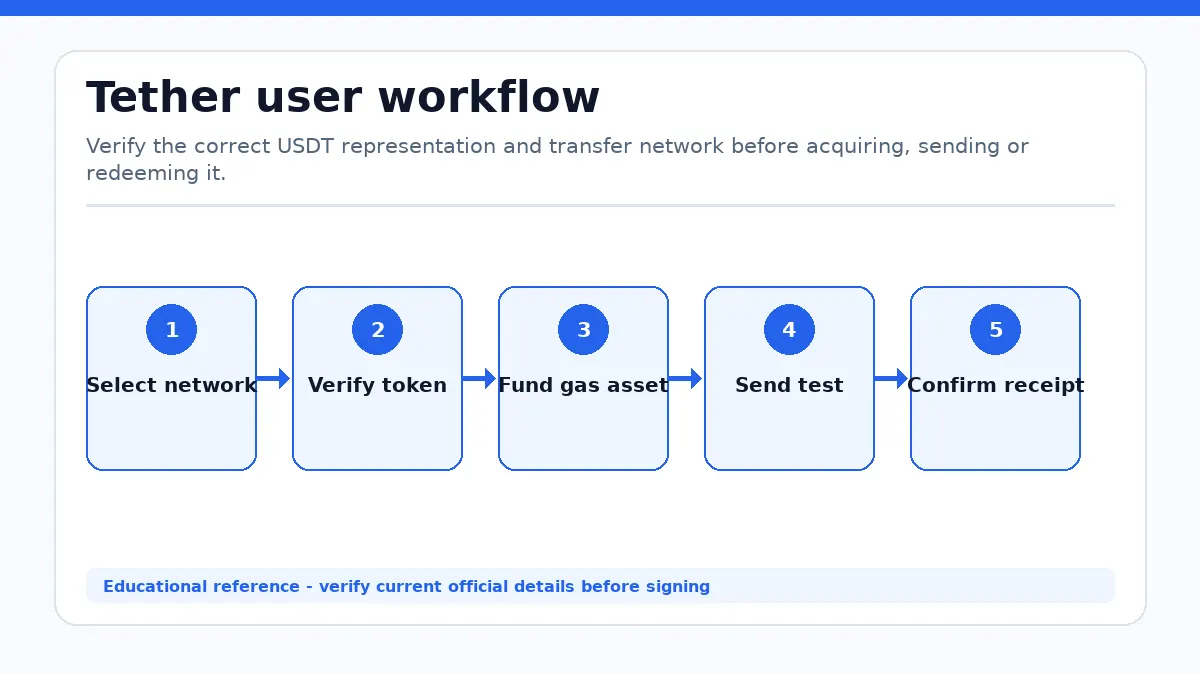
Tether workflow from the first user decision to a verified outcome.
Issuer and intended reference
Tether issues USDT and describes each supported token as referenced one-to-one to the US dollar and backed by its reserves. Reserve disclosures describe the issuer's reported assets and liabilities at the reporting level; they are not a live promise that every exchange order will execute at exactly one dollar.
Direct issuance or redemption occurs through Tether's platform and eligibility process. A user buying USDT from an exchange or another wallet is participating in a secondary market and does not automatically become a direct Tether customer. Access, minimums, verification and jurisdictional restrictions can apply.
Price implication
The secondary-market price can move above or below the intended reference because liquidity, venue access, network availability and redemption expectations vary. The snapshot is a reference, not a redemption quote.
A USDT transfer is always a transaction on a specific host blockchain.
Native issuance and host-chain gas
Tether lists supported protocols and the identifiers used for official issuance. Ethereum ERC-20 USDT, Tron TRC-20 USDT, Solana tokens and other supported representations have different addresses, confirmation rules and fee assets. ETH, TRX, SOL or another host asset may be required even though the transferred balance is USDT.
Check the sending network, receiving network, official contract or asset ID, destination address format and service support before signing. A matching USDT ticker does not make two networks interchangeable. Sending one representation to an unsupported deposit route can make recovery difficult or impossible.
Bridged representations
A third-party bridge can create a representation whose backing and control path differs from issuer-native USDT. Verify whether Tether lists the protocol, whether the receiving service accepts that exact asset, and which bridge contracts add risk.
USDT Risks That Depend on More Than Price
Stable reference does not remove issuer, custody, chain or operational risk.
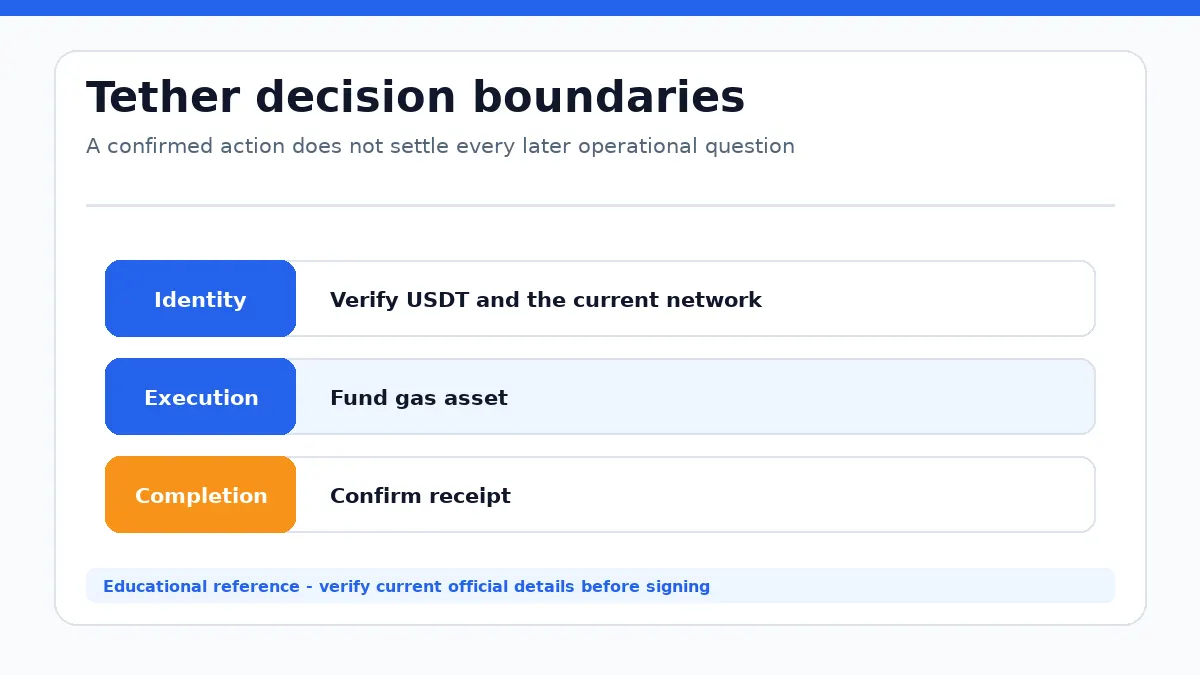
Tether confirmation does not settle every later operational question.
Issuer and custody controls
Users rely on Tether's reserve management, terms, compliance controls and supported redemption process. Token contracts can include administrative controls, and custodial exchanges can freeze withdrawals independently. A wallet balance can therefore face issuer, platform and legal constraints even when the host chain is functioning.
Network congestion, bridge incidents, contract impersonation and unsupported deposits create separate risks. A depeg can arise from market stress or impaired redemption access. Diversifying venues does not remove a common issuer exposure.
Practical warning
Do not treat a block confirmation as proof of reserves, and do not treat a reserve report as proof that a specific token contract is authentic. Verify each claim through the appropriate source.
The safest workflow verifies identity, route and eligibility before funds move.
Before sending
Confirm the official supported protocol, token identifier, destination support, host-chain fee balance and a small test amount. Keep enough host gas for any follow-up transaction.
Do not send by ticker alone.
Do not assume all USDT is issuer-native.
Do not assume exchange access equals direct redemption.
Do not describe USDT as having validators or its own finality.
Before redemption
Review current Tether eligibility, verification, fees and minimums directly. If using an exchange instead, evaluate that platform's liquidity, custody and withdrawal policies as a separate decision.
Tether issues and redeems supported token representations under its platform terms and publishes reserve information. On-chain transfers are executed by the selected host network, whose fee asset, finality and address rules remain in force.
A USDT ticker match can still point to the wrong network, contract or bridged representation. USDT is the stable asset profiled in the market snapshot. The selected host chain determines the asset required to pay transfer fees.
What Tether users should verify and why this design differs
Supported networks and redemption terms can change. The page does not verify an individual token or account.
For Tether, the practical sequence is Select network, Verify token, Fund gas asset, Send test, Confirm receipt. Confirm the official destination and current network, then inspect the final balance, position, receipt or documented exit state that actually completes the task: Verify the correct USDT representation and transfer network before acquiring, sending or redeeming it.
Tether Transfers FAQ
Does USDT have its own blockchain?
No. USDT exists as token representations on supported host blockchains.
What pays a USDT transfer fee?
The selected host network's fee asset, such as ETH, TRX or SOL.
Can every holder redeem directly with Tether?
Direct redemption depends on Tether's current eligibility, verification, terms and minimums.
Known Limitations
Supported networks and redemption terms can change.
The page does not verify an individual token or account.
Reserve disclosures and market prices update on different schedules.
Market Data Methodology
The page uses a CoinGecko aggregated USDT/USD snapshot. No exchange chart is rendered for this entity.
Market Snapshot Source
CoinGecko aggregated market data (USDT/USD)
Cache
Snapshot cache is approximately 60 seconds.
Failure Handling
Verified cached data is labeled Cached or Delayed. Missing values remain unavailable.