DAI is an ERC-20 stable asset created by the protocol now documented under Sky. It targets one US dollar but remains a crypto token whose supply, backing and risk depend on protocol contracts and approved collateral. This page focuses on how DAI Enters and Leaves Circulation and the checks users need before choosing a network, redeeming or moving funds.
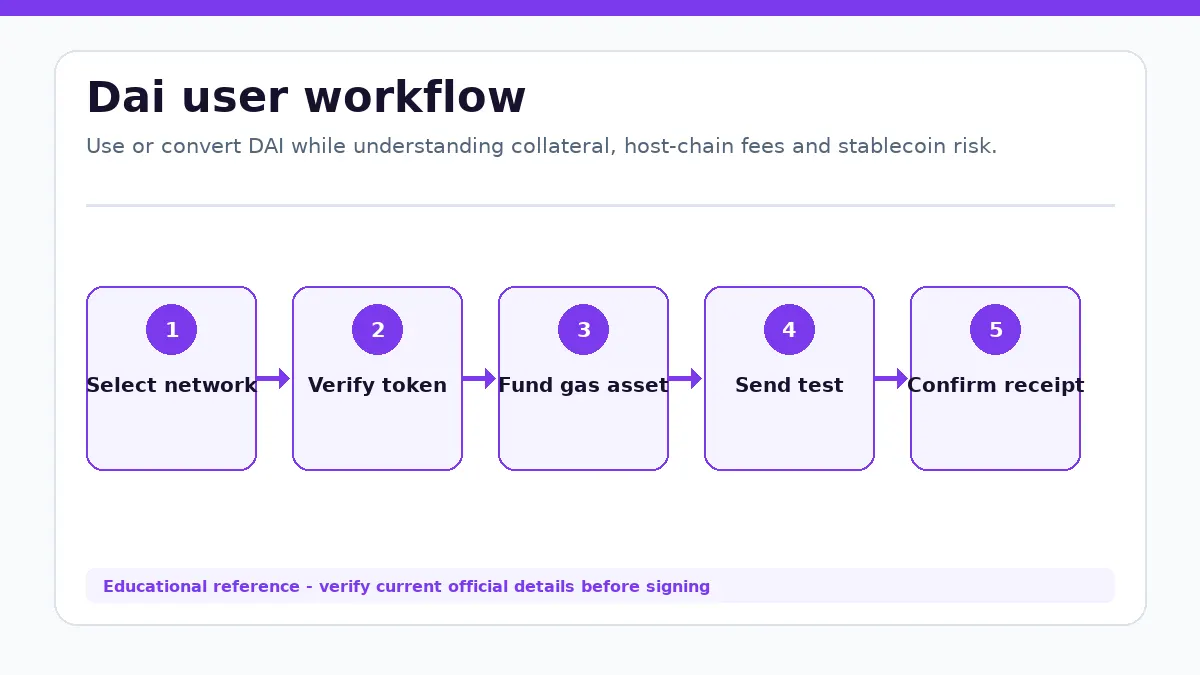
Use or convert DAI while understanding collateral, host-chain fees and stablecoin risk.
Subject:
Dai
Market mode:
Snapshot Only
Fee asset:
Varies
Timezone:
UTC
This page does not open a vault, quote collateral ratios, redeem DAI for bank dollars or verify a token contract on every network.
Content ownership: BitcoinToolkit Editorial TeamTechnical references: Official protocol and developer documentation.Review approach: Technical explanations are checked against primary sources and updated when the network or asset changes.Last content review: Data integration last tested:
How DAI Enters and Leaves Circulation
DAI is a token at the edge of a larger collateral and accounting system.
Dai workflow from the first user decision to a verified outcome.
Collateralized issuance
The Sky core accounting system tracks approved collateral, debt and risk parameters. Users can create DAI through supported vault workflows by locking collateral and generating debt, while other protocol mechanisms and liquidity routes can expand or contract supply. The user-facing DAI contract records external ERC-20 balances after they are moved out of internal accounting through the relevant adapter.
A DAI holder does not own a specific piece of collateral. The stable-value target depends on the complete system: collateral quality, liquidation execution, oracle inputs, governance parameters, liquidity and external assets used by stability mechanisms. Those dependencies can change even though the token symbol remains DAI.
Vault risk is not holder redemption
A vault owner must maintain the required collateralization and can be liquidated if the position breaches protocol rules. An ordinary DAI holder can transfer or trade the token without owning a vault, but does not automatically have a direct legal claim to redeem one DAI for one bank dollar from an issuer.
The secondary-market price can move around the target. Market depth, protocol demand, collateral events and exchange conditions can produce temporary or material deviations. A snapshot near one dollar is an observation, not proof that every venue or redemption route will return exactly one dollar.
A fixed protocol conversion route does not make the two contracts identical.
The documented converter
Sky documentation describes an Ethereum converter that exchanges DAI and USDS at a fixed 1:1 ratio without a protocol fee on that route. DAI and USDS still have different contracts and token features, and wallet, exchange or application support can differ. Users must select the direction, contract and destination token deliberately.
Ethereum gas remains payable in ETH. A third-party interface, bridge or exchange can add costs or restrictions that are not part of the core converter. The route also does not guarantee that a secondary market elsewhere quotes both tokens at exactly one dollar at all times.
Transfers, Permits and Approvals
DAI supports familiar ERC-20 transfers plus signature-based approval behavior.
Approval is permission, not payment
Unlimited approvals can expose the full approved balance to a compromised or malicious spender. Review the chain, DAI contract, spender, amount, nonce and expiry. A signature request can create meaningful authority even when it does not immediately move tokens.
A stable target can hide contract, network and liquidity differences.
Before sending or converting
Confirm the network and canonical token contract, especially when a wallet lists bridged or wrapped DAI. Keep the host-chain gas asset, verify the destination supports the same representation, and check whether an exchange deposit expects a specific network. Do not send to a converter contract without the supported flow.
Distinguish DAI from USDS, sUSDS and third-party yield-bearing wrappers. A wrapper can add rate, withdrawal, bridge and smart-contract dependencies. Stablecoin yield is not the same as the stablecoin target, and neither removes depeg or protocol risk.
Dai Risks Before Completion
Continue with the stablecoin, protocol or host-network question you need to answer.
What Dai users should verify and why this design differs
Review USDS before using the protocol converter. Review Ethereum for gas, approvals and transaction finality. Compare collateral and issuer models with USDC or Tether rather than assuming all dollar-targeting tokens work the same way. Use the tools directory for calculations and validation utilities.
Dai Transfers FAQ
How does Dai differ from Frax?
Compare the exact network, permissions, fee path, final state and exit requirement rather than token price alone.
Known Limitations
Collateral types, risk parameters and protocol routes can change.
DAI does not provide universal direct fiat redemption.
The page does not verify bridged or wrapped representations.
Market Data Methodology
The page uses a CoinGecko aggregated DAI/USD snapshot. No exchange chart is rendered for this entity.
Market Snapshot Source
CoinGecko aggregated market data (DAI/USD)
Cache
Snapshot cache is approximately 60 seconds.
Failure Handling
Verified cached data is labeled Cached or Delayed. Missing values remain unavailable.