Frax (FRAX): Locked Frax Positions Coordinate Governance and Gauges
Frax is the governance and utility asset formerly known as FXS. It must be distinguished from frxUSD, the dollar-oriented stable asset, and from historical FRAX stablecoin documentation. This page focuses on locked Frax Positions Coordinate Governance and Gauges and the checks users need before choosing a network, redeeming or moving funds.
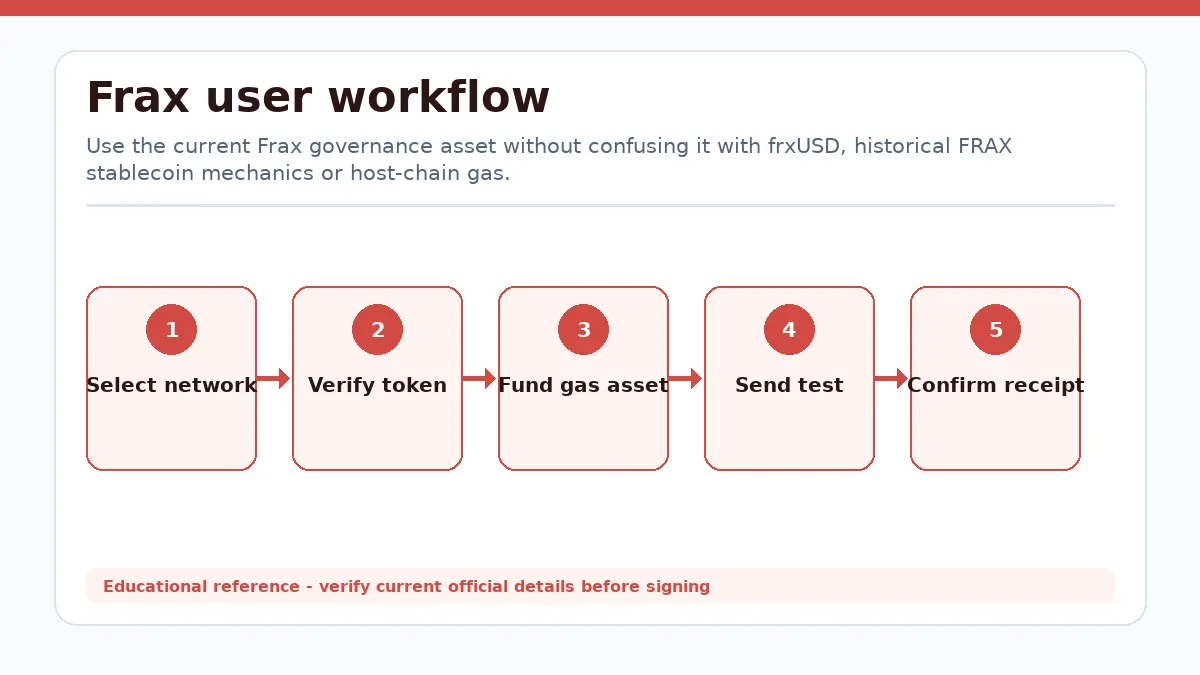
Use the current Frax governance asset without confusing it with frxUSD, historical FRAX stablecoin mechanics or host-chain gas.
Subject:
Frax
Market mode:
Snapshot Only
Fee asset:
ETH / varies
Timezone:
UTC
This page does not perform a token migration, quote frxUSD redemption, value a veFRAX lock, verify a bridge or calculate protocol yield.
Content ownership: BitcoinToolkit Editorial TeamTechnical references: Official protocol and developer documentation.Review approach: Technical explanations are checked against primary sources and updated when the network or asset changes.Last content review: Data integration last tested:
Locked Frax Positions Coordinate Governance and Gauges
Voting power and reward eligibility depend on the deployed lock system.
Frax workflow from the first user decision to a verified outcome.
Vote escrow and protocol direction
Frax vote-escrow systems lock the governance asset for time-weighted voting power. Governance can direct gauges, protocol resources and contract parameters. Legacy veFXS and newer naming or deployment contexts must be checked at the contract level; an interface label does not safely identify where a position is recorded.
Locks reduce liquidity and can last well beyond a temporary incentive campaign. Review expiry, delegation, voting rules, chain and reward source before committing. Protocol revenue, gauges and emissions can change through governance, and none creates a guaranteed fiat return for a locked holder.
Current FRAX, Former FXS and frxUSD Are Not Interchangeable
The ecosystem reused familiar names during a major product transition.
Read the contract and date
The volatile governance and utility token historically called Frax Share, or FXS, transitioned to the FRAX name under the current ecosystem roadmap. The dollar-oriented stable asset is frxUSD. Older documents may call the previous stablecoin FRAX and the governance token FXS, so a ticker without contract and publication date can describe a different asset role.
Before transferring, match the official contract, chain and migration status. Do not send current FRAX to a frxUSD deposit or interpret historical fractional-stablecoin mechanics as the current governance token. Market providers can retain legacy identifiers such as frax-share even after public naming changes.
Frax Products Span Several Assets and Networks
Governance, stable value, staking and blockspace are provided by different components.
Fraxtal and hosted contracts
Frax ecosystem products include frxUSD, staking-related assets, lending, AMMs and Fraxtal deployments. Ethereum and other host chains keep their own fee assets. Fraxtal has its own network configuration and bridge path, so a balance on Ethereum does not automatically appear there even when the token branding matches.
Confirm the network, contract and product purpose for every action. Stablecoin redemption, governance locking, bridge transfers and liquidity positions each have different contracts and risks. A market page for FRAX should not be used as a live proof of frxUSD reserves or Fraxtal transaction status.
Resolve identity before evaluating protocol mechanics.
Transfer, stablecoin or governance task
For a transfer, verify the current FRAX contract and chain. For frxUSD, use stablecoin documentation and reserve or redemption data specific to frxUSD. For governance, verify the lock contract and expiry. For Fraxtal, confirm the official bridge route and destination representation.
Do not use FXS, FRAX and frxUSD as synonyms, follow an obsolete mint or redeem tutorial, or assume legacy CoinGecko naming defines the onchain role. Use current Frax documentation and contract registries for the exact product. Preserve the transaction record for migration troubleshooting.