First Digital USD (FDUSD): How FDUSD Issuance, Reserves and Redemption Work
First Digital USD is a U.S. dollar-backed stablecoin issued by FD121 (BVI) Limited, with reserve custody provided through First Digital Trust. It is available on several blockchains but is not their native fee currency. This page focuses on how FDUSD Issuance, Reserves and Redemption Work and the checks users need before choosing a network, redeeming or moving funds.
Transfer or hold FDUSD while understanding issuance, reserves, redemption eligibility and network selection.
Subject:
First Digital USD
Market mode:
Snapshot Only
Fee asset:
Varies
Timezone:
UTC
This page does not open an issuer account, confirm eligibility, verify a contract or guarantee a one-dollar secondary-market exit.
Content ownership: BitcoinToolkit Editorial TeamTechnical references: Official protocol and developer documentation.Review approach: Technical explanations are checked against primary sources and updated when the network or asset changes.Last content review: Data integration last tested:
How FDUSD Issuance, Reserves and Redemption Work
Issuer, reserve custodian and distribution venue are separate operational roles.
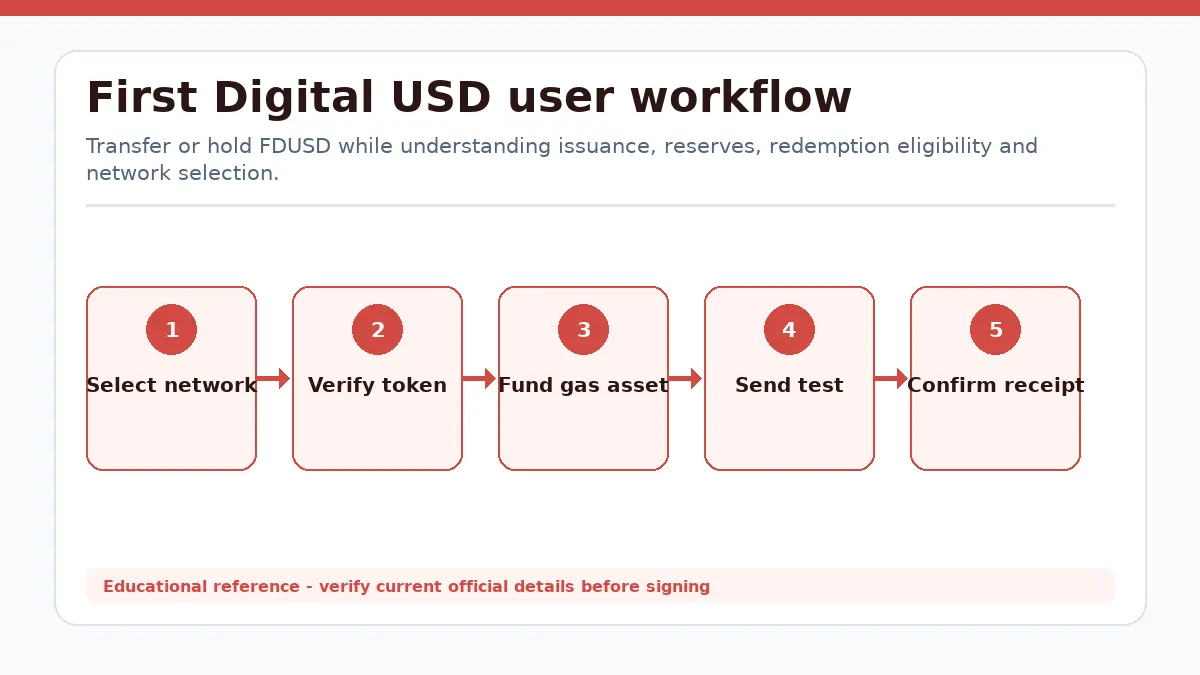
First Digital USD workflow from the first user decision to a verified outcome.
Reserve-backed issuance
First Digital identifies FD121 (BVI) Limited as the FDUSD issuer and First Digital Trust as reserve custodian. The project states that each token is intended to be backed by cash and cash equivalents for one-to-one U.S. dollar redemption. The reserve structure and balances are reported through monthly third-party attestations.
An attestation supports reserve claims at the stated date; it is not a continuous audit of every operational risk. Users should check the latest report, reserve composition, total tokens in circulation and the legal entity named in current terms. Exchange listing or market liquidity is not a substitute for reserve evidence.
Direct redemption is eligibility-based
First Digital states that direct minting and redemption require client onboarding and AML and CTF checks and are not offered directly to ordinary retail customers. Other holders can obtain or exit FDUSD through supported exchanges or OTC providers, where price, fees and counterparty terms apply.
The one-dollar design does not force every venue to trade at one dollar. A user who cannot access the issuer route depends on market liquidity and intermediaries. Jurisdiction restrictions also matter; the issuer states that services are not intended for U.S. persons or entities.
FDUSD uses different contracts, token standards and gas assets across its supported networks.
Verify the chain and canonical identifier
Current First Digital materials list FDUSD on Ethereum, BNB Chain, TON, Sui, Solana and Arbitrum. Ethereum and Arbitrum require ETH gas, BNB Chain requires BNB, TON requires TON, Sui requires SUI and Solana requires SOL. FDUSD itself is the transferred stable asset, not the universal gas token.
Contract and mint identifiers differ by network. Confirm the official identifier and receiving platform support before withdrawing. A valid address format does not prove that an exchange accepts FDUSD on that network, and a familiar ticker can belong to a bridged or impersonating token.
Moving between chains
An exchange withdrawal, issuer-controlled issuance or bridge can move value across networks, but an ordinary token transfer cannot change chains. Each path adds its own settlement, custody and smart-contract assumptions. Test a small amount when practical and verify the destination balance before a larger transfer.
Redemption, Trading and Network Costs
The issuer route and the secondary market have different costs and access rules.
Evaluate the whole exit path
Eligible clients should check current issuer minimums, banking costs and redemption terms. Other users should review exchange spreads, withdrawal fees and liquidity. Onchain transfers additionally require the host network gas asset, and bridges can add route fees and waiting periods.
Fee-free minting or redemption language applies only under the stated issuer conditions and does not eliminate blockchain or intermediary costs. Compare the final received amount and settlement path rather than only the nominal one-dollar token value.
Multichain availability increases routing choices and the chance of selecting the wrong one.
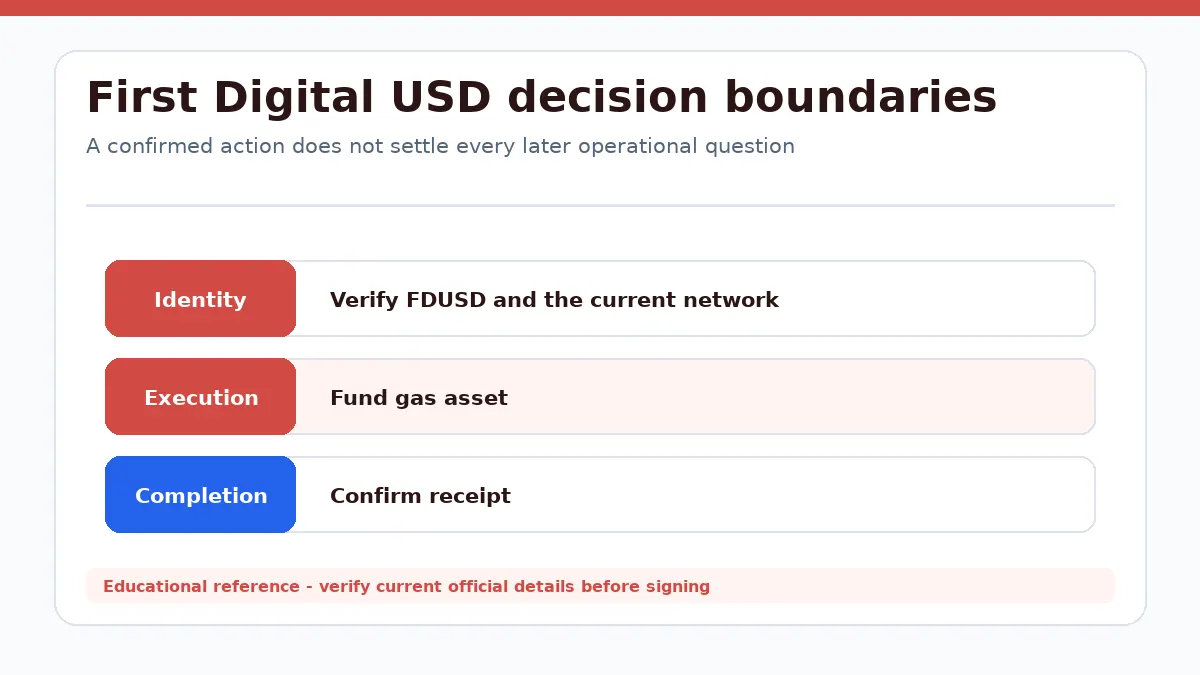
First Digital USD confirmation does not settle every later operational question.
Before a transfer or reserve review
Confirm the latest issuer and custodian disclosures, the date of the reserve report and whether direct redemption applies to you. Verify the exact network identifier, receiving platform, memo or tag requirements and gas balance. Do not infer redemption rights from holding FDUSD on an exchange.
Distinguish canonical, bridged and wrapped representations. Review depeg, issuer, custody, smart-contract and venue risks separately. A monthly attestation cannot verify the safety of a wallet, bridge or exchange used after issuance.
Continue with reserve evidence, host-network behavior or stablecoin comparison.
Transparency, network or comparison
Use First Digital transparency reports for dated reserve evidence. Review the selected blockchain before transferring. Compare FDUSD with PYUSD, USDC, Tether or USDS to understand why issuer, collateral and redemption models produce different risks even when every token targets one dollar.
The issuer mints and redeems FDUSD for eligible clients and states that reserves are held in cash and cash equivalents within a segregated custody structure. Monthly third-party attestations report reserve coverage at specific dates.
A FDUSD ticker match can still point to the wrong network, contract or bridged representation. FDUSD is the stable asset shown in the market snapshot. Each supported blockchain uses its own fee asset.
What First Digital USD users should verify and why this design differs
Supported networks, issuer eligibility and reserve composition can change. Attestations report a dated reserve position.
For First Digital USD, the practical sequence is Select network, Verify token, Fund gas asset, Send test, Confirm receipt. Confirm the official destination and current network, then inspect the final balance, position, receipt or documented exit state that actually completes the task: Transfer or hold FDUSD while understanding issuance, reserves, redemption eligibility and network selection.
First Digital USD Transfers FAQ
Who issues FDUSD?
FD121 (BVI) Limited issues FDUSD, while First Digital Trust provides reserve custody services.
Can retail holders redeem directly?
First Digital states that direct service requires eligible client onboarding and is not sold directly to retail customers.
What pays FDUSD network fees?
The native gas asset of the selected blockchain pays fees.
Known Limitations
Attestations report a dated reserve position.
The page does not verify a specific contract or exchange deposit route.
Market Data Methodology
The page uses a CoinGecko aggregated FDUSD/USD snapshot. No exchange chart is rendered for this entity.
Market Snapshot Source
CoinGecko aggregated market data (FDUSD/USD)
Cache
Snapshot cache is approximately 60 seconds.
Failure Handling
Verified cached data is labeled Cached or Delayed. Missing values remain unavailable.