PayPal USD (PYUSD): Paxos Issues PYUSD and Holds Its Reserves
PayPal USD is a dollar-denominated stablecoin issued by Paxos Trust Company, not by the PayPal operating company. Official PayPal terms list native issuance on Ethereum, Solana, Arbitrum and Stellar. This page focuses on paxos Issues PYUSD and Holds Its Reserves and the checks users need before choosing a network, redeeming or moving funds.
Transfer or hold PYUSD while understanding Paxos issuance, reserves, redemption and network selection.
Subject:
PayPal USD
Market mode:
Snapshot Only
Fee asset:
Varies
Timezone:
UTC
This page does not provide a PayPal account, confirm redemption eligibility, verify an address or guarantee that PYUSD trades at one dollar on every venue.
Content ownership: BitcoinToolkit Editorial TeamTechnical references: Official protocol and developer documentation.Review approach: Technical explanations are checked against primary sources and updated when the network or asset changes.Last content review: Data integration last tested:
Paxos Issues PYUSD and Holds Its Reserves
PayPal supplies the brand and user experience; Paxos performs the regulated issuance role.
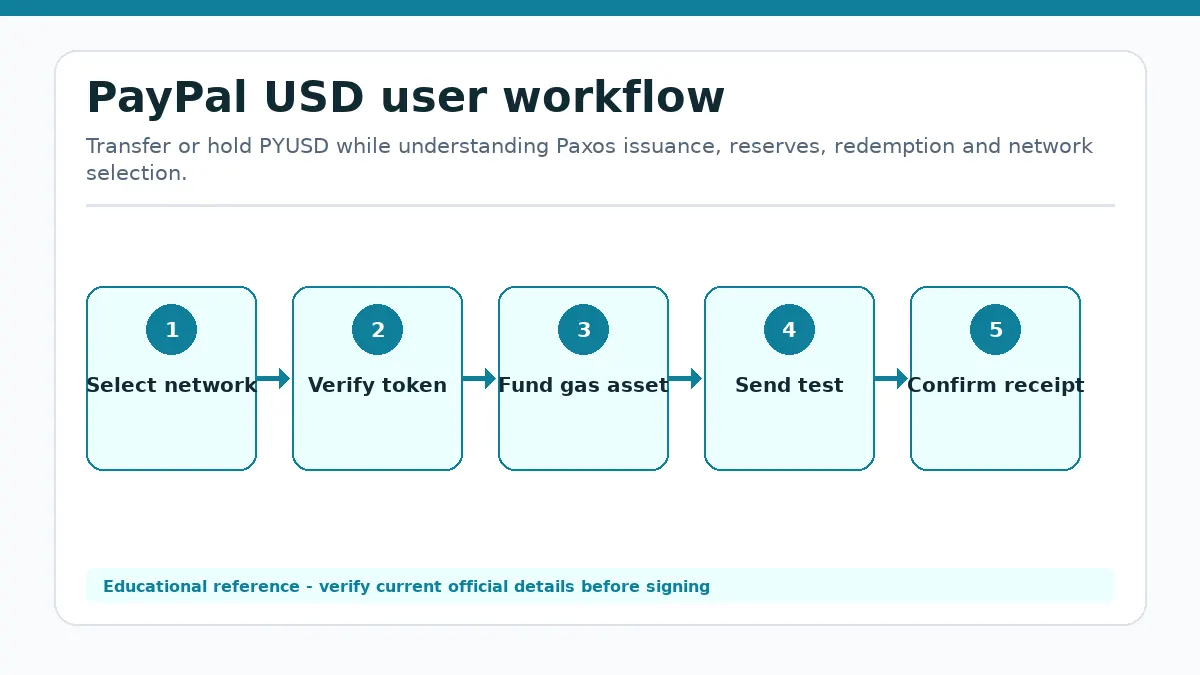
PayPal USD workflow from the first user decision to a verified outcome.
Issuer and backing
PayPal terms identify Paxos as the PYUSD issuer. They describe reserves including U.S. dollar deposits, U.S. Treasuries and Treasury reverse repurchase agreements held for PYUSD holders. Paxos publishes monthly reserve reports and independent attestation reports, which should be checked as dated evidence rather than treated as a permanent guarantee.
Reserve backing is different from deposit insurance and from PayPal corporate performance. PYUSD is a token and is not legal tender or a bank deposit. The issuer, custodian structure, applicable terms and regulatory regime determine redemption rights, while PayPal can separately decide whether its own platform supports the asset.
Redemption eligibility matters
Paxos describes 1:1 minting and redemption for eligible institutional customers, while PayPal offers supported consumer routes in eligible regions. Identity verification, account type, jurisdiction and platform availability can limit direct access. A retail holder who cannot use a direct route may need to sell on a secondary market, where price and fees can differ.
A one-dollar issuer obligation does not force every exchange order book or decentralized pool to quote exactly one dollar. During market stress, liquidity, withdrawals or platform availability can affect the practical exit price and timing.
The same issuer-backed unit can use different token standards, addresses and fee assets.
Ethereum, Solana, Arbitrum and Stellar
Official PayPal information lists PYUSD on Ethereum, Solana, Arbitrum and Stellar and publishes canonical identifiers. Ethereum and Arbitrum representations follow EVM token behavior and use ETH for gas. Solana uses an SPL mint and SOL fees. Stellar identifies the asset through its issuer account and uses XLM for network fees and reserves.
A PayPal account balance may not expose a particular blockchain representation to the user. For an external withdrawal, verify which network PayPal or the receiving platform will use. Never send one representation to an address or deposit route that supports only another network.
Cross-chain movement is a separate operation
Moving PYUSD between chains requires an issuer-supported withdrawal route or a compatible bridge. A bridge can add messaging, contract and finality risk even when both endpoints use canonical PYUSD. Confirm the route, amount, destination and completion state before using the destination balance.
Platform Fees and Network Fees Are Different
A zero-fee platform action does not make every onchain route free.
Where costs can appear
PayPal may offer PYUSD purchases, sales or transfers under specific account terms. An external onchain transfer still consumes the selected network fee asset, and an exchange or bridge can add withdrawal, conversion or service fees. The receiver can also require a memo or select a particular network.
Compare the complete route rather than only the token amount. Check account eligibility, platform spread disclosures, withdrawal minimums, blockchain fees and whether the destination supports the exact representation.
Issuer recognition does not remove ordinary wallet and stablecoin risks.
Before receiving or redeeming
Check the official contract or issuer identifier for the selected network and reject lookalike tokens. Confirm the destination network, memo requirements and fee balance. Do not assume any token named PayPal USD is canonical, and do not assume a third-party wrapped version has the same redemption rights.
Read the current Paxos and PayPal terms for your region. Separate reserve composition, attestation date, direct redemption eligibility and market liquidity. They are related trust signals but answer different questions.
Continue with the issuer, network or stablecoin comparison.
Reserve report, network guide or comparison
Use the Paxos transparency page for dated reserve evidence and PayPal support for current networks and account rules. Review Ethereum, Solana, Arbitrum or Stellar before an onchain transfer. Compare PYUSD with USDC, Tether, FDUSD or protocol-issued USDS to understand issuer and redemption differences.
Paxos Trust Company issues PYUSD; PayPal provides branded services and supported account routes.
Which networks have official PYUSD issuance?
Current PayPal materials list Ethereum, Solana, Arbitrum and Stellar.
Can every holder redeem directly with Paxos?
No. Direct redemption depends on eligibility, account and jurisdiction under current terms.
What should I verify before a PayPal USD transaction?
Check the official destination, current network, asset representation, amount, recipient and requested permissions. Paxos holds reserve assets for PYUSD and publishes monthly reserve information and independent attestations. Eligible customers can use supported Paxos or PayPal routes, while onchain transfers follow the rules and fees of the selected blockchain. After confirmation, inspect the resulting balance or protocol state instead of relying only on a wallet success message.
Known Limitations
Network support and account eligibility vary by region and provider.
Attestations describe reserves at a stated date.
The page does not verify a token address or guarantee secondary-market liquidity.
Market Data Methodology
The page uses a CoinGecko aggregated PYUSD/USD snapshot. No exchange chart is rendered for this entity.
Market Snapshot Source
CoinGecko aggregated market data (PYUSD/USD)
Cache
Snapshot cache is approximately 60 seconds.
Failure Handling
Verified cached data is labeled Cached or Delayed. Missing values remain unavailable.