What the Ethereum user is confirming
Ethereum validators use proof of stake to propose and attest to blocks, while execution clients process transactions and smart-contract calls against the shared account-based state.
Ethereum is a decentralized smart-contract platform, and ether (ETH) is its native asset. Ethereum uses an account-based state model where externally owned accounts and contract accounts interact through transactions executed by the network. This page focuses on how Ethereum Gas Fees and Smart Contracts Work and the checks users need before sending funds, paying fees or using the network.
Help users understand how ethereum gas fees work and make safer usage and transaction decisions for Ethereum.
Use this page to check reference market data and understand how Ethereum accounts, gas and transactions work. It is educational reference material, not an executable exchange quote or trading recommendation.
BitcoinToolkit separates CoinGecko's aggregated USD reference from the Binance Spot ETH/USDT market, shows the source and age of each dataset, and provides sourced explanations of ETH units, gas, accounts, transactions and finality.
Ethereum validators use proof of stake to propose and attest to blocks, while execution clients process transactions and smart-contract calls against the shared account-based state.
Ethereum (ETH) is the asset profiled on this page.
Ethereum (ETH) pays the applicable transaction cost.
ETH/USDT · Binance Spot · UTC
Long ranges automatically use a compatible candle interval so the chart stays within the supported candle limit.
Historical Binance Spot candles are available. JavaScript is required for current-candle updates.
| Time (UTC) | Open (USDT) | High (USDT) | Low (USDT) | Close (USDT) | Volume (ETH) |
|---|---|---|---|---|---|
| Oct 10, 2026 23:00:00 UTC | 2,509.99 USDT | 2,510.73 USDT | 2,506.13 USDT | 2,506.69 USDT | 8,912.18 ETH |
| Oct 10, 2026 22:00:00 UTC | 2,509.75 USDT | 2,511.37 USDT | 2,504.13 USDT | 2,510.00 USDT | 8,538.86 ETH |
| Oct 10, 2026 21:00:00 UTC | 2,508.52 USDT | 2,511.85 USDT | 2,507.32 USDT | 2,509.75 USDT | 8,814.88 ETH |
| Oct 10, 2026 20:00:00 UTC | 2,513.73 USDT | 2,514.76 USDT | 2,506.82 USDT | 2,508.52 USDT | 8,424.75 ETH |
| Oct 10, 2026 19:00:00 UTC | 2,512.39 USDT | 2,519.51 USDT | 2,511.95 USDT | 2,513.72 USDT | 9,331.23 ETH |
Market data: Binance Spot ETH/USDT
Charting library: TradingView Lightweight Charts
Convert ETH, Gwei and Wei instantly with exact integer-Wei arithmetic. Swap units, copy precise results and distinguish Gas Price from total…
Estimate USDC, USDT and DAI transfer fees across verified networks. Compare fee assets, cost ranges, fee percentages and sender total cost.
Ethereum is the network, ETH is its native asset, and token balances such as ERC-20 assets are maintained by smart-contract state.
Ethereum
ETH/USDT
EVM Layer 1
Ethereum is a distributed state-transition network that executes transactions and smart-contract calls.
ETH is not an ERC-20 token. Native ETH balances belong to protocol account state, while ERC-20 balances belong to token-contract storage.
Ethereum tracks an account-based state containing balances, nonces, contract code and contract storage.
The global state maps account addresses to account data and changes as valid transactions execute.
Externally owned accounts are controlled by private keys and can originate signed transactions.
Contract accounts are controlled by deployed code and run when called by a transaction or another contract.
An externally owned account nonce counts transactions sent and prevents the same signed transaction from being processed repeatedly.
An account balance records the amount of native ETH assigned to that account.
Contract bytecode executes in the Ethereum Virtual Machine when a message call reaches the contract.
Contract accounts can maintain persistent storage that is updated by successful execution.
One ETH equals 1,000,000,000 gwei or 1,000,000,000,000,000,000 wei.
Wallets usually display ETH, gas prices are commonly quoted in gwei, and raw EVM values use wei.
Ethereum charges for computation in gas; the amount of gas used and the applicable per-gas fees determine the execution cost.
Gas is the unit used to measure computational work.
The gas limit caps how much gas a transaction is allowed to consume.
Gas used is the amount of metered work actually consumed by execution.
Gas price is the per-gas price used by legacy transactions and remains a general fee reference.
The protocol sets a base fee for each block; the base-fee portion is burned.
A priority fee is an optional per-gas tip paid to the block proposer.
The maximum fee per gas caps the total per-gas amount a sender is willing to pay.
The maximum priority fee per gas caps the proposer tip.
The final execution fee depends on gas used and the effective gas price; unused gas is not charged as consumed work.
An Ethereum transaction is created and signed by an externally owned account, validated and propagated by nodes, executed, recorded in a receipt, included in a block and later finalized.
Ethereum smart contracts are programs deployed as contract accounts and executed by the Ethereum Virtual Machine.
A contract account has code and can be called by transactions or other contracts.
Compiled contract bytecode executes deterministically in the Ethereum Virtual Machine.
Contracts can read and update persistent storage when execution succeeds.
Message calls pass value and encoded input data to contract code.
ERC-20 token contracts implement token balances, transfers, allowances and related behavior in contract state.
Native ETH is part of protocol account state. ERC-20 token balances are entries managed by token contracts.
Ethereum uses proof-of-stake consensus in which validators propose blocks, attest to their view of the chain and contribute to checkpoint finality.
Ethereum uses proof of stake to coordinate agreement on the canonical chain.
Validators participate by proposing blocks when selected and by broadcasting attestations.
A selected validator proposes a beacon block containing an execution payload.
Validators issue attestations that vote for their view of the chain and checkpoint targets.
Checkpoint finality is reached through the protocol's proof-of-stake justification and finalization rules.
Applications should distinguish block inclusion from finalized checkpoints and choose confirmation policies appropriate to their risk model.
The CoinGecko USD snapshot and Binance Spot ETH/USDT chart are separate datasets and can differ. Market reference data may be delayed or unavailable when a provider cannot return validated values.
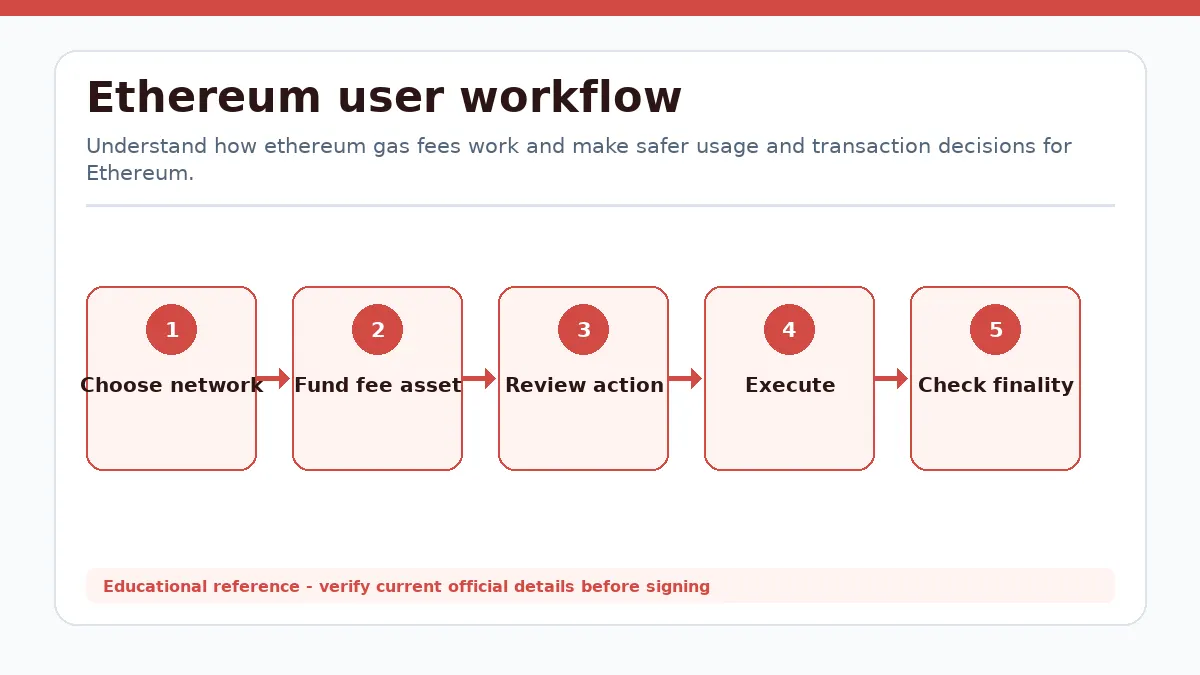
For Ethereum, the practical sequence is Choose network, Fund fee asset, Review action, Execute, Check finality. Confirm the official destination and current network, then inspect the final balance, position, receipt or documented exit state that actually completes the task: Understand how ethereum gas fees work and make safer usage and transaction decisions for Ethereum.
No. ETH is Ethereum's protocol-native asset. ERC-20 balances are maintained by token contracts.
Execution cost depends on gas used and the effective per-gas fee under the transaction's fee settings.
No. CoinGecko provides an aggregated USD reference, while the chart represents the Binance Spot ETH/USDT market.
The snapshot uses CoinGecko aggregated USD data. The chart uses Binance Spot ETH/USDT data. Their providers, venue coverage and quote currencies differ, so displayed values can differ. Missing or malformed values remain unavailable; verified cached data must be labeled Cached or Delayed.
The snapshot is CoinGecko aggregated USD data. The chart is Binance Spot ETH/USDT data. Their providers, venue coverage and quote currencies differ, so displayed values can differ.
Selected primary sources support the operational explanations. Market-provider attribution remains separate.
Verified technical content, reviewed sources and update history.