USD Coin (USDC): How USDC Issuance, Redemption and Transfers Work
USD Coin is a dollar-referenced stable asset issued by Circle affiliates across multiple supported blockchains. USDC is not its own consensus network, and each deployment depends on the rules and fee currency of its host chain. This page focuses on how USDC Issuance, Redemption and Transfers Work and the checks users need before choosing a network, redeeming or moving funds.
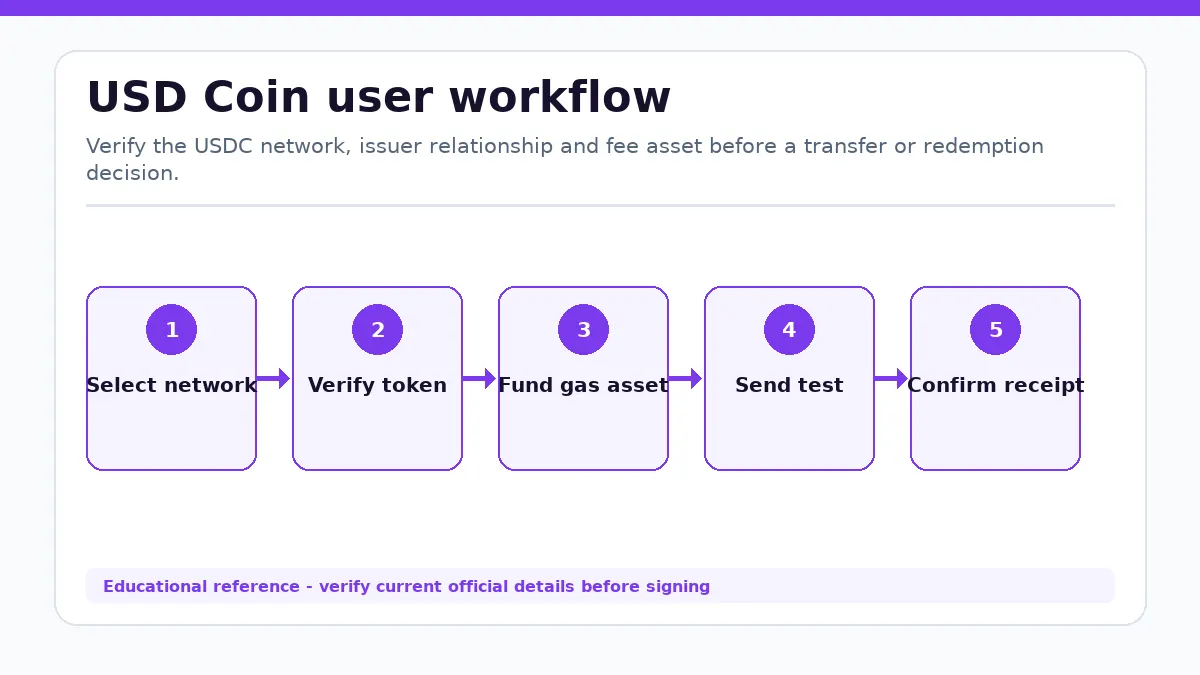
Verify the USDC network, issuer relationship and fee asset before a transfer or redemption decision.
Subject:
USD Coin
Market mode:
Snapshot Only
Fee asset:
Varies
Timezone:
UTC
This page does not verify a particular token contract, guarantee one-dollar execution, determine Circle Mint eligibility or recommend a bridge.
Content ownership: BitcoinToolkit Editorial TeamTechnical references: Official protocol and developer documentation.Review approach: Technical explanations are checked against primary sources and updated when the network or asset changes.Last content review: Data integration last tested:
How USDC Issuance, Redemption and Transfers Work
A ticker match does not prove two balances use the same contract or transfer path.
USD Coin workflow from the first user decision to a verified outcome.
Native issuance and host-chain gas
Circle publishes the blockchains where it supports native USDC. Each native deployment uses that chain's address format, confirmation rules and fee currency. Ethereum transfers need ETH, Solana transfers need SOL, and other supported chains use their own fee assets even though the asset being transferred is USDC.
Bridged or application-issued tokens can use similar names without being Circle-issued native USDC. Moving value between networks normally burns and mints through an approved cross-chain mechanism, routes through an exchange, or locks one representation and issues another. Users should verify the exact contract or mint and destination support before sending.
USD Coin Tools
Fee Calculators
$
Stablecoin Transfer Fee Calculator
Estimate USDC, USDT and DAI transfer fees across verified networks. Compare fee assets, cost ranges, fee percentages and sender total cost.
The token, reserve claim and public market are related but not identical.
Issuer-backed digital dollars
Circle describes USDC as a digital dollar backed by highly liquid cash and cash-equivalent reserve assets. Creation and redemption occur through issuer-controlled processes, while most retail users obtain or sell USDC through exchanges and applications. Holding a token does not automatically create an unrestricted Circle Mint account.
The intended one-dollar reference is an operating objective rather than a promise that every venue will quote exactly $1 at every moment. Banking access, liquidity, compliance actions and market stress can affect execution. Reserve reporting helps users evaluate backing, but it does not eliminate custody or platform risk.
Stable-asset convenience comes with centralized operational controls.
Who can redeem and what can be restricted
Direct redemption is governed by Circle terms, account availability, identity checks, jurisdiction and compliance requirements. A wallet holder who cannot use Circle Mint may still trade USDC through a third party, but that is a market transaction with separate fees and counterparty risk rather than direct issuer redemption.
Circle contracts can support address blocking or freezing where required by policy or law. Transactions confirmed by a host chain are generally irreversible, so the issuer cannot simply recover a mistaken transfer to an incompatible address. The stable reference therefore does not remove smart-contract, custody or operational risk.
Most preventable losses come from choosing the wrong network or representation.
A practical verification sequence
Confirm that sender and recipient support the same blockchain, compare the token contract or mint with Circle's current list, and keep enough of the host network currency for fees. Send a small test when the destination is new. Do not assume an exchange deposit labeled USDC accepts every network where USDC exists.
For redemption, confirm account eligibility, minimums, banking instructions and processing limits directly with Circle. For cross-chain movement, identify whether the route produces native USDC or a bridged representation at the destination and understand which operator or protocol carries the transfer risk.
Match the network on both ends.
Verify the canonical contract or mint.
Hold the host-chain fee asset.
Treat bridge and exchange routes as separate counterparties.
Circle issues and redeems eligible USDC against reserve assets under its terms. On-chain transfers move a specific network representation, while cross-chain movement requires an approved transfer system, exchange workflow or bridge rather than changing networks inside one token balance.
A USDC ticker match can still point to the wrong network, contract or bridged representation. USDC is the market-profiled stable asset. The selected blockchain determines the currency required for transfer fees.
What USD Coin users should verify and why this design differs
Supported networks and account eligibility can change. The page does not validate a pasted contract address.
For USD Coin, the practical sequence is Select network, Verify token, Fund gas asset, Send test, Confirm receipt. Confirm the official destination and current network, then inspect the final balance, position, receipt or documented exit state that actually completes the task: Verify the USDC network, issuer relationship and fee asset before a transfer or redemption decision.
USD Coin Transfers FAQ
Does USDC have its own blockchain?
No. Circle issues USDC on supported host blockchains, each with its own fees and finality.
Can every USDC holder redeem directly with Circle?
Direct redemption depends on Circle account eligibility, terms and compliance requirements.
What pays a USDC transfer fee?
The native fee asset of the selected host blockchain pays the network fee.
Known Limitations
Supported networks and account eligibility can change.
The page does not validate a pasted contract address.
Market liquidity can temporarily move away from the intended reference.
Market Data Methodology
The page uses a CoinGecko aggregated USDC/USD snapshot. No exchange chart is rendered for this entity.
Market Snapshot Source
CoinGecko aggregated market data (USDC/USD)
Cache
Snapshot cache is approximately 60 seconds.
Failure Handling
Verified cached data is labeled Cached or Delayed. Missing values remain unavailable.