Wormhole (W): How VAAs and Cross-Chain Transfers Complete
The source transaction confirmed. The destination chain can still be waiting. Wormhole is a cross-chain messaging protocol in which Guardians attest messages as VAAs before they can be delivered and executed on another chain.
Trace source confirmation, Guardian attestation, VAA availability, delivery and destination execution so you can identify what remains before a message or token transfer is complete.
Subject:
Wormhole cross-chain messaging and token-transfer completion
Market scope:
CoinGecko W/USD token snapshot
Fee scope:
Source and destination chains use their own native fee assets
Timezone:
UTC
This reference explains message and transfer states. It does not relay a VAA, recover funds, validate an arbitrary token contract or guarantee destination execution.
A source-chain confirmation is only the first observable state in Wormhole's cross-chain lifecycle.
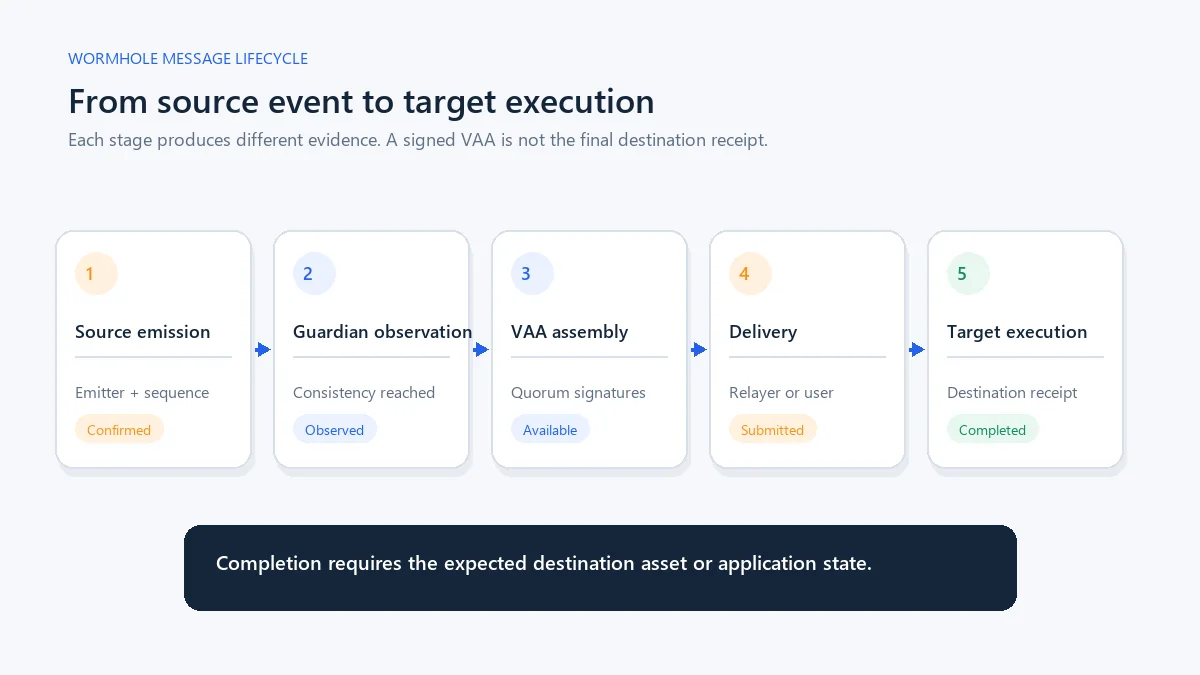
A source event becomes a Guardian-signed VAA before delivery and destination execution can occur.
From source application to signed message
A source application calls the Wormhole Core Contract and publishes a message. The application is the emitter, while the emitter chain, emitter address and sequence identify that message across the network. The payload carries the application-specific instruction that a destination contract may later process.
Guardians observe the source-chain event and sign the same message after the application's configured consistency requirement is met. When the required Guardian quorum is assembled, the signed envelope is a Verifiable Action Approval, or VAA. The VAA records the signed message; it is not a receipt from the destination chain.
What to preserve when tracing a message
The source transaction hash and source chain.
The emitter chain, emitter address and sequence.
The destination application expected to consume the VAA.
The VAA identifier or signed payload once it becomes available.
A valid VAA still has to reach the correct contract and complete a destination transaction.
Delivery is a separate action
A relayer, an application service or the user can retrieve a VAA and submit it to the target chain. The exact route depends on the Wormhole product and application. Delivery therefore needs a valid destination, a supported integration and enough target-chain gas unless the selected relaying service has already accounted for that cost.
The target contract verifies the Guardian signatures and checks the message against its expected emitter, authorization rules and replay protection. Only then can the destination application mint, release or update state. A VAA being available proves attestation; it does not prove that this target transaction succeeded.
The receipt that matters
Inspect the destination transaction and application state. A failed target call, paused contract, unsupported token representation or insufficient destination gas can leave the source transaction confirmed while the intended destination result remains absent.
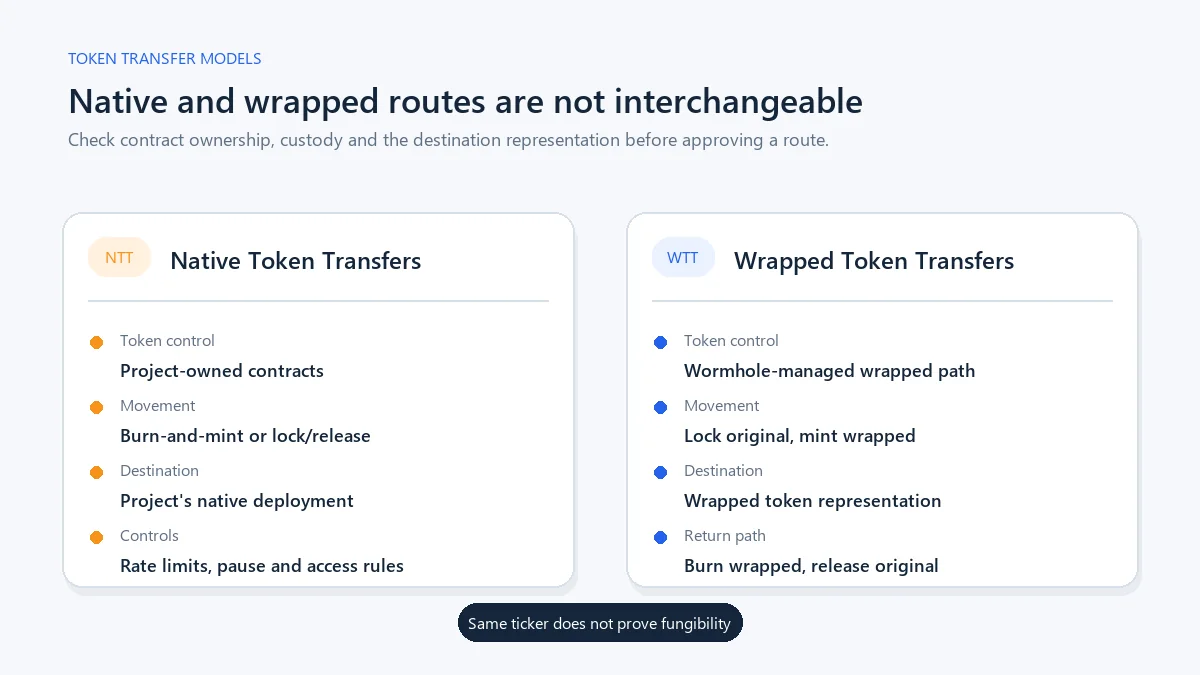
Native Token Transfers, or NTT, let a project control the token contracts and transfer policy across connected chains. A deployment can use burn-and-mint or locking patterns, and it can add controls such as rate limits, pausing and access rules. The project remains responsible for the chosen contracts, governance and destination support.
Wrapped Token Transfers
Wrapped Token Transfers, also called Token Bridge in Wormhole contracts and SDKs, use a lock-and-mint path for broad compatibility. Tokens are locked on the origin side and a wrapped representation is minted on the destination. Returning through the supported path burns the wrapped representation and releases the original asset.
Matching names or tickers do not prove that two token contracts are interchangeable. Confirm the source contract, destination contract, transfer product, custody model and redemption path before approving a transfer or adding the received asset to another application.
Finality and Trust Boundaries
Completion crosses several systems, so one confirmation cannot represent every security and execution boundary.
Source finality and Guardian attestation
The application chooses a consistency level that tells Guardians how much source-chain confirmation to observe before signing. A lower waiting threshold can improve speed but may expose the application to more source-chain reorganization risk. Guardians attest the observed message; they do not make the source or destination chain final.
Delivery, execution and application risk
Relayers or users deliver VAAs, target chains confirm the resulting transaction, and target applications enforce their own contract logic. Operational risk can therefore sit in the source chain, Guardian observation, VAA retrieval, delivery, destination gas, destination finality, application permissions or token implementation.
Wormhole's security model should be assessed alongside the application using it. A correctly signed message can still call an application with different upgrade, pause, rate-limit or authorization controls than another route.
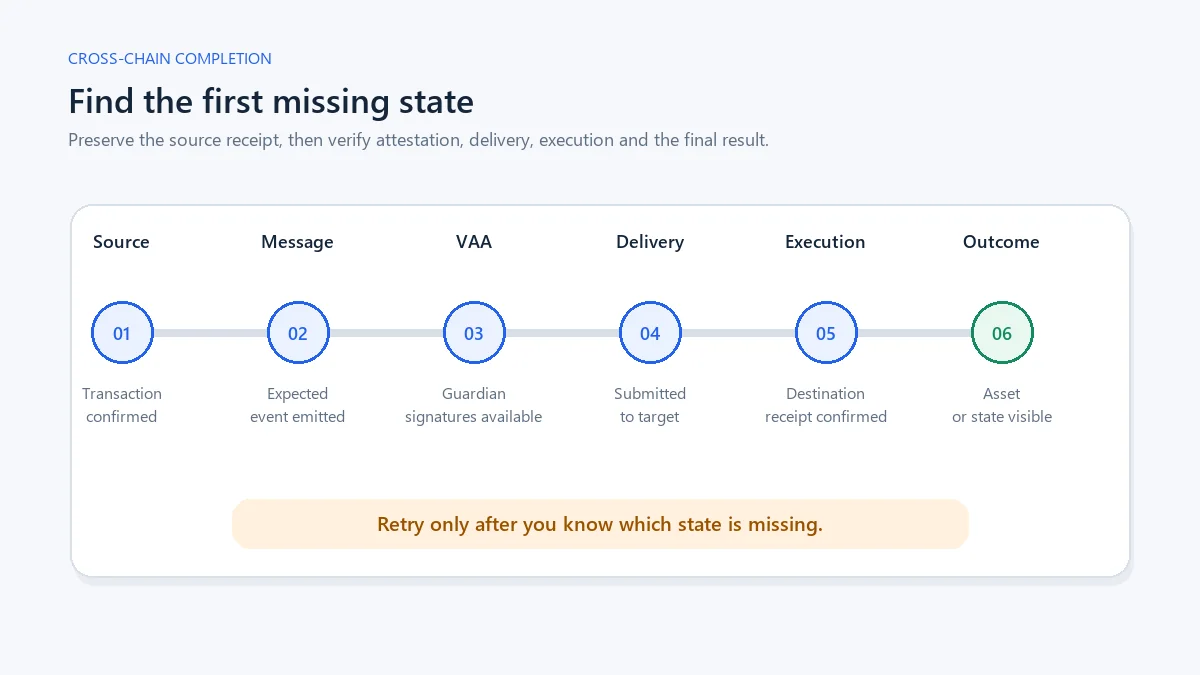
Treat completion as a sequence of verifiable states rather than a single bridge status.
Each completed state supplies different evidence; destination state is the final user-facing check.
Cross-chain completion checklist
The source transaction is confirmed at the required source-chain level.
The expected Wormhole message was emitted by the correct application.
The matching Guardian-signed VAA is available.
The VAA was delivered to the intended destination contract.
The destination transaction confirmed without a contract revert.
The expected asset balance or application state is visible at the destination.
Do not stop at an intermediate success
A source explorer can show success while delivery is pending. A VAA service can return the signed message while no destination transaction exists. A destination explorer can show a confirmed call while the receiving application displays a different token representation. The transfer is complete only when the expected destination outcome is present.
Before You Retry a Stalled Transfer
Retry only after identifying whether the missing step is attestation, delivery or destination execution.
Preserve evidence first
Keep the source transaction hash, source chain, emitter and sequence. Locate the VAA before assuming the message was never observed. Confirm the intended destination chain and contract, then search for a destination transaction linked to that VAA or application request.
Check route-specific blockers
Keep the native fee asset required by the destination chain.
Verify that the destination supports the exact native or wrapped token representation.
Check rate limits, paused contracts, relayer availability and destination reverts.
Determine whether delivery remains or execution already failed.
Do not repeat the source transfer blindly; a second source message can create a second obligation.
Wormhole does not use W as a universal gas token. Source and destination transactions use the fee assets of their respective chains.
What the W Token Does
W is the profiled market asset and a governance token; it is not the cross-chain message itself.
Governance role
W holders can participate in Wormhole governance through the supported governance process, including delegating voting power. W is available across supported Solana and EVM environments through Wormhole's token-transfer infrastructure, but the contract and chain still matter when a wallet displays a W balance.
Holding W does not create a VAA, deliver a message or pay every source and destination fee. The W/USD market snapshot on this page describes the token's market context. Transaction progress must still be checked through the source chain, VAA and destination execution states described above.
Wormhole Message and Transfer FAQ
Focused answers about VAAs, delivery, gas, transfer models and completion checks.
What is a Wormhole VAA?
A Verifiable Action Approval is a Wormhole message plus the Guardian signatures required by the protocol. It proves that the Guardian quorum attested the message, not that a destination contract executed it.
Does a confirmed source transaction mean a Wormhole transfer is complete?
No. The message may still need Guardian attestation, VAA delivery, destination verification and successful target-chain execution before the expected asset or state appears.
Who delivers a Wormhole VAA to the destination chain?
Delivery can be performed by a relayer, an application service or the user, depending on the Wormhole product and route. The destination transaction still needs an accepted VAA and sufficient gas.
Why does a Wormhole transfer need destination-chain gas?
Submitting and executing the VAA creates a transaction on the destination chain. That transaction uses the destination chain's fee asset unless the selected relaying service has included the cost in its service flow.
What is the difference between NTT and Wrapped Token Transfers?
NTT lets a project control native token contracts and policies across chains. Wrapped Token Transfers use a Wormhole-managed lock-and-mint path that creates a wrapped destination representation.
How can I tell where a Wormhole transfer is stalled?
Compare the source receipt, emitter and sequence, VAA availability, destination transaction and final destination balance or state. The first missing item identifies whether observation, delivery or execution remains.
Should I repeat the source transaction when delivery is delayed?
Not until you have identified the missing stage. Repeating the source action can emit a second message and create another transfer while the original VAA is still deliverable.
What is the W token used for?
W is Wormhole's governance token and the market-profiled asset on this page. It is not a universal gas asset and does not itself prove that a cross-chain message completed.
Known Limitations
Supported chains, deployed contracts, relaying products and token representations can change.
A Guardian-signed VAA does not guarantee successful delivery or destination execution.
This page cannot recover a transfer or confirm the safety of an arbitrary application or token contract.
Market Data Methodology
The page uses a CoinGecko aggregated W/USD snapshot. No exchange chart is rendered for this entity.
Market Snapshot Source
CoinGecko aggregated market data (W/USD)
Cache
Snapshot cache is approximately 60 seconds.
Failure Handling
Verified cached data is labeled Cached or Delayed. Missing values remain unavailable.
Primary Wormhole documentation supports the message, transfer, security and governance explanations. CoinGecko attribution remains with the market snapshot.