LayerZero is a cross-chain messaging protocol that deploys endpoints and message libraries on supported blockchains. ZRO is a protocol token and optional payment or governance asset in supported contexts; it is not the native gas currency of every connected chain. This page focuses on message Fees, Native Gas and ZRO and the checks users need before integrating the service or using the token.
Understand how LayerZero messages are verified and executed, and what ZRO does within the protocol.
Subject:
LayerZero
Market mode:
Snapshot Only
Fee asset:
Varies
Timezone:
UTC
This page does not certify an OApp, recommend DVNs, quote a message fee or guarantee destination execution.
Content ownership: BitcoinToolkit Editorial TeamTechnical references: Official protocol and developer documentation.Review approach: Technical explanations are checked against primary sources and updated when the network or asset changes.Last content review: Data integration last tested:
Message Fees, Native Gas and ZRO
A message can combine service fees and two blockchains' transaction costs.
Payment choice is pathway specific
The source quote can include DVN and executor fees plus options for destination gas. Standard endpoints can accept the source chain's native currency, while supported configurations can allow ZRO payment for protocol fees. ZRO does not replace gas for every source or destination transaction.
Executors estimate destination resources and source-token cost, but an application can configure its own executor or choose manual execution. Users should inspect the quoted amount, refund address, native drop options and destination gas before signing. A cheap quote can reflect fewer resources or a different pathway.
LayerZero Connects Applications, Not Blockchain State
A cross-chain message carries application-defined data between endpoint deployments.
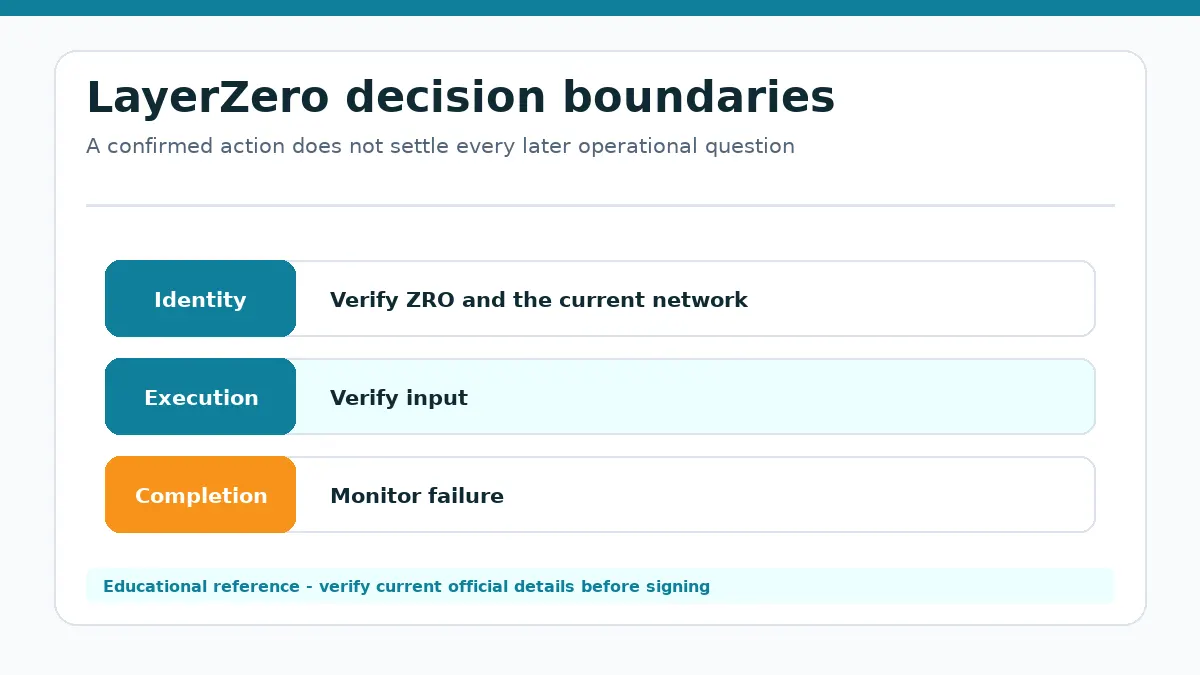
LayerZero confirmation does not settle every later operational question.
Endpoints and omnichain applications
An OApp calls the LayerZero endpoint on a source chain with a destination endpoint ID, receiver, message and execution options. The endpoint records the packet and hands verification and delivery jobs to the configured services. The destination application decides what the received message is allowed to do.
LayerZero does not merge two chains or make their finality identical. Each source and destination transaction follows its own network. A token bridge built with LayerZero can include mint, burn or lock logic controlled by that application, so users must review the OApp rather than treating protocol support as an asset guarantee.
Verification and destination execution are intentionally separate services.
Configurable security and permissionless delivery
Decentralized Verifier Networks observe source-chain events and submit verification according to the OApp's required and optional DVN configuration. Message libraries coordinate thresholds and confirmation requirements. Different pathways can therefore use different security assumptions even when both display the LayerZero name.
After verification is committed, an executor can call the destination endpoint to deliver the message. Execution is permissionless, so another caller can deliver it when properly configured, but gas, payload options or receiving-contract logic can still cause failure. Verification does not promise successful application execution.
Where LayerZero Differs for Users
The application and pathway configuration determine the practical risk.
What LayerZero users should verify and why this design differs
Use a small test for a new route and track the message GUID through an official explorer. Do not assume a completed source transaction means destination execution succeeded. Avoid copied bridge sites, unverified token representations and applications that hide their security configuration.
Verify both OApp addresses.
Review the DVN pathway.
Budget destination execution.
Track verification and delivery separately.
LayerZero Infrastructure use FAQ
What happens if a LayerZero data or message path is delayed?
The consuming application can receive stale, incomplete or unavailable information even when its host chain continues producing blocks.
Known Limitations
Pathway configuration varies by OApp.
The page does not audit a bridge.
Quotes and supported deployments change.
Market Data Methodology
The page uses a CoinGecko aggregated ZRO/USD snapshot. No exchange chart is rendered for this entity.
Market Snapshot Source
CoinGecko aggregated market data (ZRO/USD)
Cache
Snapshot cache is approximately 60 seconds.
Failure Handling
Verified cached data is labeled Cached or Delayed. Missing values remain unavailable.