Axelar (AXL): Cross-Chain Gas Covers More Than One Execution Environment
Axelar is a proof-of-stake network that coordinates cross-chain messages and token movement. AXL is its native fee, staking and governance asset. This page focuses on cross-Chain Gas Covers More Than One Execution Environment and the checks users need before integrating the service or using the token.
Understand how an Axelar cross-chain call is approved, relayed, funded and completed.
Subject:
Axelar
Market mode:
Snapshot Only
Fee asset:
AXL
Timezone:
UTC
This page does not relay a message, estimate every route fee, verify a gateway contract, select a validator or guarantee destination execution.
Content ownership: BitcoinToolkit Editorial TeamTechnical references: Official protocol and developer documentation.Review approach: Technical explanations are checked against primary sources and updated when the network or asset changes.Last content review: Data integration last tested:
Cross-Chain Gas Covers More Than One Execution Environment
The sender, Axelar network and destination chain do not share one universal gas meter.
Gas service and local fees
Connected-chain transactions use the source chain fee asset. Axelar network activity has AXL-denominated economics, while destination execution requires the destination chain gas asset. Axelar Gas Service integrations can accept supported payment and coordinate later execution, but the route still reflects changing gas prices and application complexity.
Review the current estimator and transaction preview rather than assuming a fixed fee. Underpayment can delay execution, while a refund or top-up depends on the integration and message state. A token symbol named in the cross-chain payload is not necessarily the asset used for either source or destination gas.
General Message Passing Connects Source and Destination Contracts
A cross-chain call moves through multiple systems before the destination action completes.
Call, approve and execute
A source application calls an Axelar gateway or supported service and emits a cross-chain request. Axelar validators observe relevant gateway events and approve the message through the network. A relayer then submits the approved command to the destination gateway, where the target application can validate the origin and execute its own logic.
Track the source transaction, command or message identifier and destination execution separately. An approved Axelar command does not prove that the target contract succeeded. Destination contracts can reject a call, and a relayer may wait for sufficient gas or chain conditions before submission.
Validators and Gateways Define the Axelar Trust Path
Interoperability adds controls beyond each connected chain.
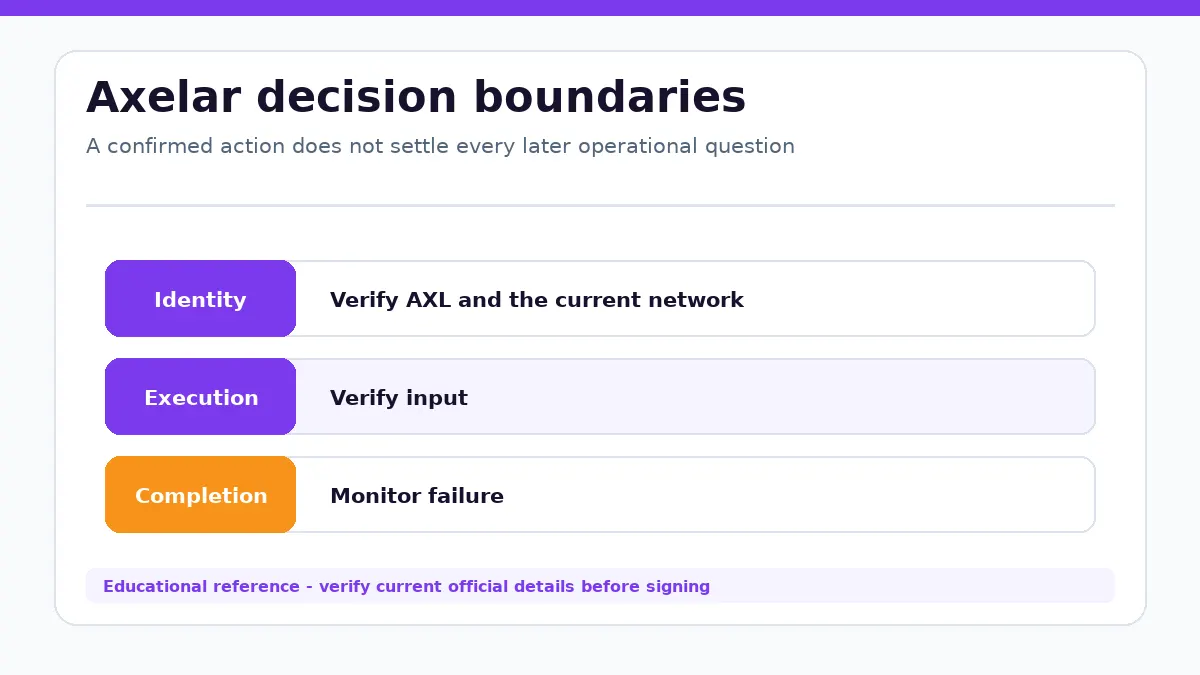
Axelar confirmation does not settle every later operational question.
Stake, key shares and application checks
Axelar validators bond AXL, participate in network consensus and collectively authorize supported cross-chain events. Gateway controls and key-management procedures protect commands on connected chains. Applications must still verify source-chain and source-address parameters before accepting a message; an authenticated Axelar message is not automatically authorized for every target action.
Users should verify official gateway addresses and the application route, not only the Axelar brand. Validator concentration, gateway upgrades, relayer availability, connected-chain finality and target-contract code are distinct dependencies. Staking AXL exposes delegators to validator and protocol rules in addition to market risk.
Choose the Next Axelar Check
Use the message stage to choose the right diagnostic.
Before or after sending
Before sending, confirm both chain identifiers, gateway, target contract, payload and gas plan. After sending, check source finality, validator approval, relayer status and destination receipt in order. Preserve every identifier before requesting support. For staking, use current validator and unbonding information rather than a cross-chain application screen.
Do not retry blindly when a destination call is pending, because a second source transaction may create a separate command. Use official Axelar status tooling and connected-chain explorers, and keep the local fee asset available if a destination action or recovery step must be submitted manually.
Axelar (AXL) pays the applicable network fee. Verify the selected network before signing because a later approval, bridge, claim or exit can require another transaction.
What happens if a Axelar data or message path is delayed?
The consuming application can receive stale, incomplete or unavailable information even when its host chain continues producing blocks.
How does Axelar differ from Quant?
Compare Quant application interoperability with Axelar message routing, validation and destination execution. Compare the exact network, permissions, fee path, final state and exit requirement rather than token price alone.
Known Limitations
Gateway deployments, gas services and connected chains can change.
Message approval and destination execution are separate states.
The page does not relay, retry or refund a message.
Market Data Methodology
The page uses a CoinGecko aggregated AXL/USD snapshot. No exchange chart is rendered for this entity.
Market Snapshot Source
CoinGecko aggregated market data (AXL/USD)
Cache
Snapshot cache is approximately 60 seconds.
Failure Handling
Verified cached data is labeled Cached or Delayed. Missing values remain unavailable.