Skip to content
BitcoinToolkit

Uniswap (UNI): How Swaps and Liquidity Pools Work

Uniswap is a family of automated market maker smart contracts deployed on Ethereum and other supported networks. UNI is a governance token; it is not the gas currency for swaps and does not represent a claim on every liquidity position. This page focuses on how Uniswap Swaps and Liquidity Pools Work and the checks users need before using the protocol or evaluating the token role.

Use Uniswap while separating protocol activity, UNI governance, pool fees and host-chain gas.

Subject:
Uniswap
Market mode:
Snapshot Only
Fee asset:
Varies
Timezone:
UTC

This page does not provide a swap quote, recommend a pool, value a liquidity position or verify an interface domain.

Content ownership: BitcoinToolkit Editorial Team Technical references: Official protocol and developer documentation. Review approach: Technical explanations are checked against primary sources and updated when the network or asset changes. Last content review: Data integration last tested:

How Uniswap Swaps and Liquidity Pools Work

Uniswap pools were designed so on-chain assets could trade against deposited liquidity without requiring a continuously managed order book.

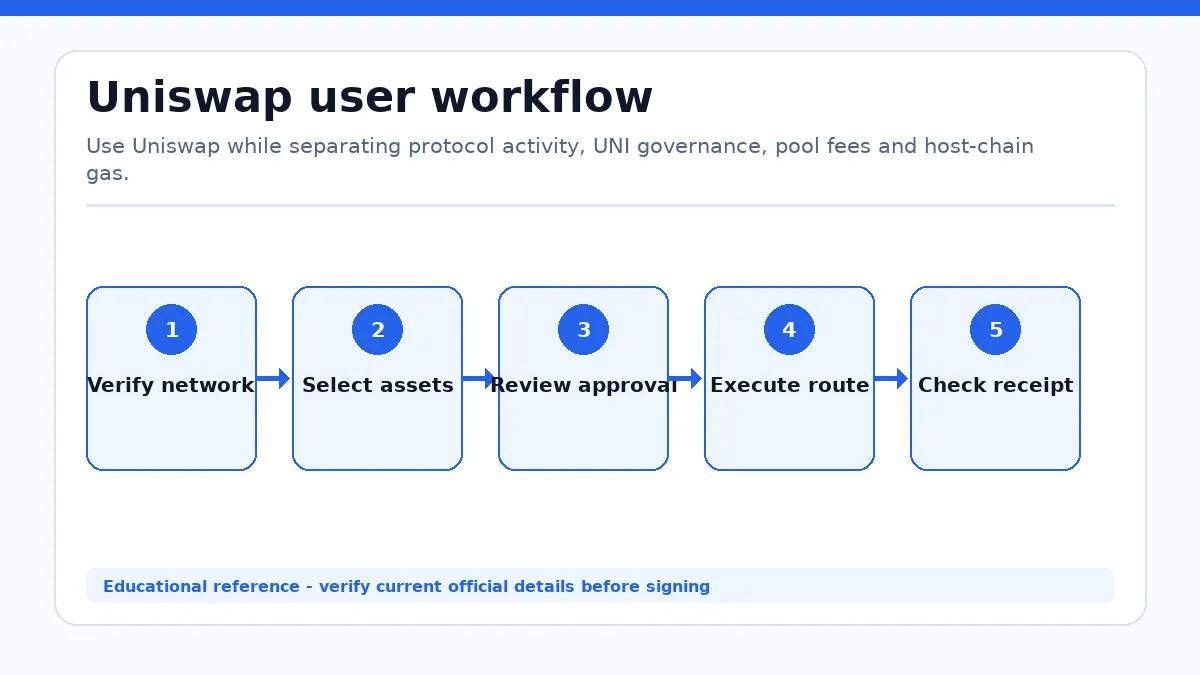
Uniswap workflow showing Verify network, Select assets, Review approval, Execute route, Check receipt
Uniswap workflow from the first user decision to a verified outcome.

Pools quote from balances and rules

An automated market maker uses pool state and contract math to quote an exchange. Liquidity providers deposit assets into a pool; traders change the pool balances when they swap and pay fees according to the selected pool. Arbitrage activity helps reconnect pool prices with external markets.

This makes a market available whenever the chain and contracts operate, but the cost is visible price impact and liquidity-provider exposure. The pool does not know an asset's fair value and cannot stop a user from trading an imitation token.

Concentrated liquidity changes the LP job

Concentrated-liquidity pools let providers allocate capital to selected price ranges rather than every possible price. That can improve capital efficiency and quotes inside the range, while requiring active range selection and leaving a position inactive when price moves outside it.

The design benefits traders and LPs differently. Better local depth can reduce price impact for a swap, but it does not remove loss from relative price movement or poor range management.

The Next Uniswap Step

Uniswap is a set of automated exchange contracts and interfaces, not a blockchain or a broker that guarantees execution at a displayed price.

Useful for self-directed on-chain exchange

A swap can fit a user who already holds assets on a supported network, can verify the token contract and accepts pool-based pricing. The wallet submits a transaction to a route of liquidity pools, and the final output depends on the quoted route, price movement, fees, slippage protection and successful execution.

The protocol removes a centralized order custodian, but it does not check whether a token is authentic or suitable. The person signing remains responsible for network choice, approvals and minimum output.

When to pause

A user should pause when a pool is thin, the token contract is uncertain, price impact is large or there is not enough native gas to approve and swap. Liquidity provision is a separate decision from swapping and introduces inventory exposure that a one-time trader does not take.

Uniswap is also a poor substitute for a guaranteed-price order. A quote can expire or execute differently within the signed slippage boundary.

  • Verify chain and token contract.
  • Review route, fee tier and price impact.
  • Set a deliberate slippage limit.
  • Keep gas for approval and swap transactions.

How Users Move Through a Uniswap Route

A quote is only the start of the transaction path.

From wallet balance to output token

The user selects the input and output contracts on one network, enters an amount and reviews the proposed route. If the router needs permission to move an ERC-20 token, the wallet signs an approval before the swap transaction. Native network fees are paid separately from the swap amount.

The signed swap sets constraints such as the maximum input or minimum output. Contracts execute one or more pool steps, transfer the output asset and revert if the constraints are not met. A reverted swap still may consume gas because validators processed the attempted transaction.

  • Token and network verification
  • Allowance or permit
  • Route and fee tiers
  • Price impact and slippage
  • Receipt and balance-change check

Liquidity providers follow another path

An LP chooses a pair, fee tier and, for concentrated liquidity, a price range. The position earns a share of pool fees while active, but its asset mix changes as traders move the price. Collecting fees or withdrawing liquidity requires additional transactions.

A high displayed fee rate can reflect volatility or short-lived activity. It should be evaluated alongside inventory change, range management and contract risk.

UNI Is a Governance Token, Not Swap Fuel

Using Uniswap and holding UNI are separate activities.

What UNI can do

UNI supports protocol governance, delegation and voting over eligible proposals and treasury decisions. Governance can influence protocol-level settings and deployments within its authority, but a token holder's practical power depends on delegated voting weight and the proposal process.

Traders do not need UNI merely to swap, and liquidity providers earn according to their pool position rather than because they hold UNI. Developers integrate contracts and routing interfaces without treating UNI as an API key.

What UNI does not do

UNI does not pay Ethereum, Base, Arbitrum or Polygon gas; the native fee asset of the selected network does. It does not guarantee a share of swap fees, ownership in a company, protection from a malicious token or reversal of a completed trade.

Token research should therefore separate governance participation from swap demand and liquidity-provider economics.

Risks for Traders, Liquidity Providers and Integrators

Different Uniswap users carry different risks even when they touch the same pool.

Trading risks

A trader can lose value through price impact, an overly broad slippage setting, adverse movement before inclusion or a fraudulent token. Routing across more pools can improve a quote but adds contract interactions and makes receipt review more important.

Approval signatures deserve the same scrutiny as swaps. Unlimited allowances can remain active after a trade, and phishing interfaces can request permission for an unintended spender.

Liquidity risks and common mistakes

LPs face relative-price movement, out-of-range positions, fee-tier competition, token-specific risk and smart-contract failure. Calling the change impermanent does not mean it will reverse before withdrawal. Concentrated liquidity can magnify both fee efficiency and management error.

Common mistakes include comparing fee income without inventory change, choosing a familiar ticker instead of a verified contract, and assuming every Uniswap deployment has identical liquidity.

Active providers should also account for rebalancing transactions, gas and time spent managing a range. A position can collect substantial fees yet underperform holding if prices move through the range or management costs absorb the income. Passive users should prefer a range and pool whose maintenance demands they can realistically meet.

  • Pool depth and price impact
  • Range and inventory exposure
  • Token and approval risk
  • Network and deployment differences
  • MEV and transaction ordering

Why Uniswap's Design Matters

The best route depends on the assets and available liquidity, not a universal DEX ranking.

What Uniswap users should verify and why this design differs

Uniswap supports broad token pairs and multiple pool designs, including concentrated liquidity. Curve is known for liquidity designs focused on correlated assets such as stablecoins and wrapped representations. Either venue can offer the better quote for a particular trade because depth, fees and routing change by pool.

Users should compare the exact route and output. LPs should compare the curve, inventory behavior and incentive structure rather than treating all AMMs as the same product.

Uniswap Swaps and liquidity FAQ

What should I verify before a Uniswap transaction?

Check the official destination, current network, asset representation, amount, recipient and requested permissions. Swaps execute against liquidity pools according to protocol version and pool configuration. Users pay pool fees through the traded assets and host-network gas through the network native currency, while token approvals can grant contracts ongoing spending authority. After confirmation, inspect the resulting balance or protocol state instead of relying only on a wallet success message.

Can a Uniswap swap succeed at a worse price than the preview?

Yes. Pool state, routing, price impact, slippage settings, fees and transaction ordering can change execution.

Known Limitations

Market Data Methodology

The page uses a CoinGecko aggregated UNI/USD snapshot. No exchange chart is rendered for this entity.

Market Snapshot Source
CoinGecko aggregated market data (UNI/USD)
Cache
Snapshot cache is approximately 60 seconds.
Failure Handling
Verified cached data is labeled Cached or Delayed. Missing values remain unavailable.
Snapshot Status
Delayed
Report Issue
Report a market-data problem →

Technical Sources

Selected primary sources support the operational explanations. Market-provider attribution remains separate.

Editorial Information

Verified technical content, reviewed sources and update history.

Published
Last Review
Data Verification
Sources
Official documentation