Optimism (OP): How OP Mainnet Transactions and Withdrawals Work
OP Mainnet is an Ethereum Layer 2 rollup that executes EVM transactions and publishes transaction data to Ethereum. OP is a governance token; ETH is normally used for OP Mainnet gas.
Use this guide to check fee components, sequencer status, Ethereum-backed finality and the additional stages required for a canonical withdrawal.
Network:
OP Mainnet, chain ID 10
Gas asset:
ETH
Settlement:
Ethereum
Market context:
CoinGecko OP/USD snapshot, separate from network gas
This guide explains transaction and canonical bridge states. It does not validate a token contract, bridge domain or wallet request.
Content ownership: BitcoinToolkit Editorial TeamTechnical references: Official protocol and developer documentation.Review approach: Technical explanations are checked against primary sources and updated when the network or asset changes.Last content review: Data integration last tested:
OP Mainnet Fee Components
An OP Mainnet wallet estimate is denominated in ETH and can include more than the execution gas shown in a standard EVM receipt.
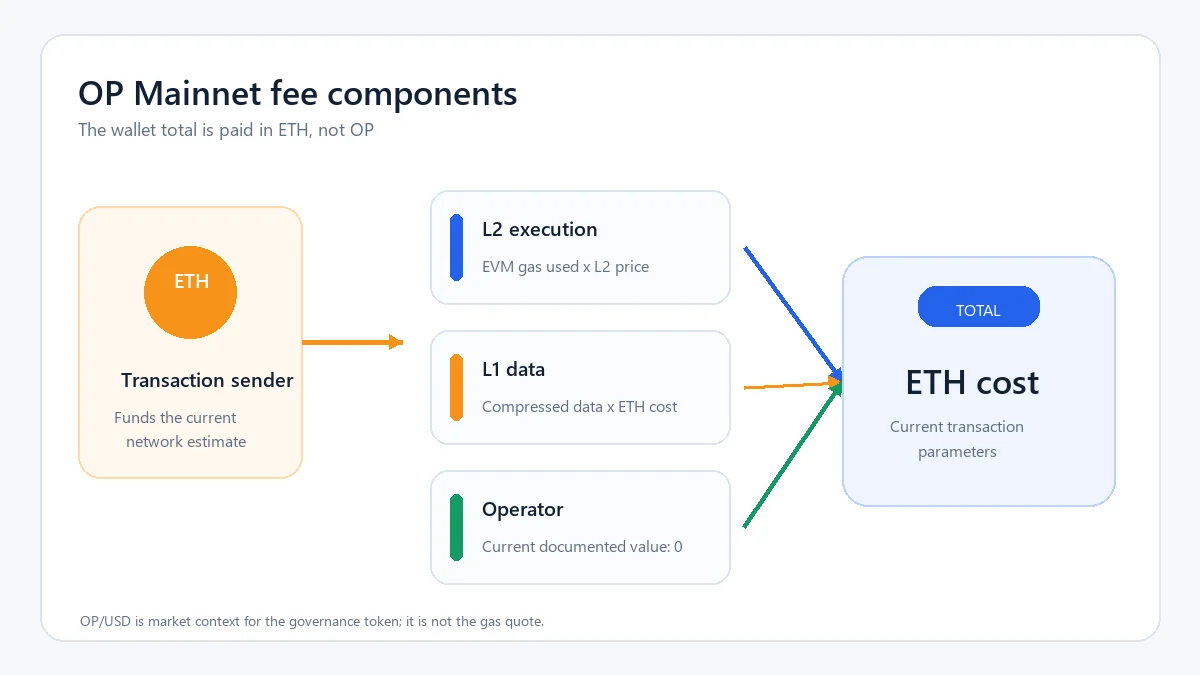
OP Mainnet transaction cost combines L2 execution and Ethereum data costs; the currently documented operator parameters produce a zero operator fee.
Execution and Ethereum data costs
The L2 execution portion pays for EVM computation on OP Mainnet. It depends on gas used and the effective L2 gas price. The L1 data portion pays for making compressed transaction data available through Ethereum, so transaction size, compression and current Ethereum calldata or blob costs can change the estimate.
Official OP Stack documentation also defines configurable operator-fee parameters. The current OP Mainnet values listed in the official fee configuration set both the operator scalar and constant to zero, which makes that component zero under the published configuration. Because those parameters can change, a current wallet or RPC estimate should remain the final check before signing.
Fee asset: ETH on OP Mainnet
Execution portion: gas used multiplied by the effective L2 gas price
L1 data portion: compressed transaction data priced against Ethereum data costs
Operator portion: configurable, but zero under the currently documented OP Mainnet values
Why the OP market price is separate
The OP/USD snapshot on this page describes the market for the OP governance token. It is supporting market information, not a quote for OP Mainnet gas. Sending OP or another token still requires enough ETH for network fees, while swap charges, application fees and slippage are separate costs.
This evidence block applies the fields documented by Optimism without inventing a transaction hash or total.
What the official model supports
For an ordinary OP Mainnet transaction, official documentation separates the ETH-denominated total into L2 execution, L1 data and any configured operator portion. A real total depends on the signed payload, gas consumed and fee parameters at execution, so no fixed amount is presented here.
A receipt and current fee estimate are still required to verify an individual transaction. This example explains the accounting model only; it is not an internally tested transfer or a public explorer transaction.
Field
Documented interpretation
Evidence type
Official documentation example
Network
OP Mainnet
Fee asset
ETH
Execution portion
Gas used multiplied by the effective L2 gas price
L1 data portion
Compressed transaction data priced using Ethereum data-cost inputs
Operator portion
Zero under the currently listed OP Mainnet scalar and constant
Total
The sum returned for the actual transaction under current parameters
Verification date
July 29, 2026
Evidence limitation: this is a documented fee model, not a measured transaction record. Recheck the current estimate and configuration before signing.
OP Mainnet, OP Stack and OP Token
The network, its software framework and its governance asset have different jobs.
Three names, three roles
OP Mainnet is the live Ethereum Layer 2 network addressed by chain ID 10. The OP Stack is the open-source rollup framework used to build OP Mainnet and other OP Chains. OP is the governance token used for voting or delegation where the current Optimism governance process permits it.
ETH normally pays OP Mainnet transaction fees. A user can transfer assets, call contracts or use applications without holding OP, but cannot send an ordinary transaction without enough ETH for gas. Another OP Stack chain can have different bridge, governance and fee settings, so wallet checks must identify OP Mainnet specifically.
Sequencer Status and Finality
OP Mainnet shows increasing levels of certainty as a transaction moves from sequencer inclusion to Ethereum finality.
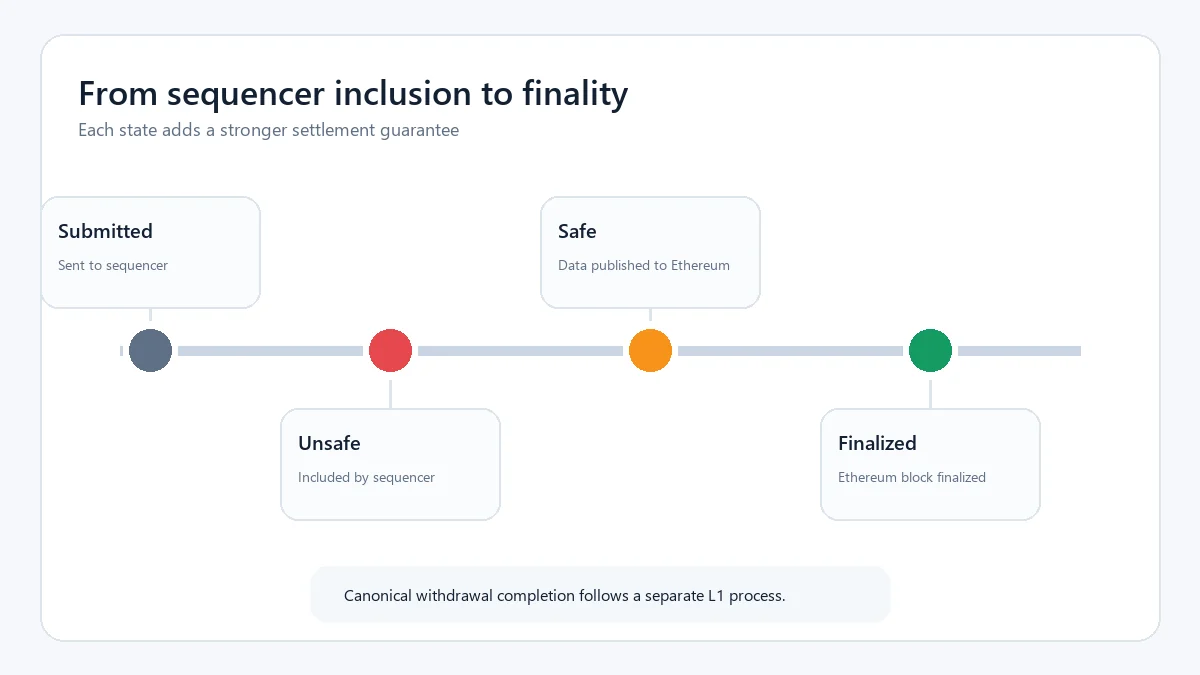
Transaction certainty increases from sequencer inclusion to Ethereum publication and finality; canonical withdrawal completion is a separate process.
Unsafe, safe and finalized
After submission, the sequencer can include the transaction in an OP Mainnet block. At this unsafe stage the transaction is visible and useful for many low-risk interactions, but its block data has not yet been published to Ethereum and the unsafe chain can still be reorganized.
The transaction becomes safe after the sequenced block data is included on Ethereum. It becomes finalized after the corresponding Ethereum block is finalized. Applications handling large value or irreversible follow-up actions should choose the status that matches their risk, rather than treating the first wallet confirmation as the strongest state.
Pending: submitted but not yet included by the sequencer
Unsafe: included by the sequencer, before Ethereum data publication
Safe: transaction data published in an Ethereum block
Finalized: the corresponding Ethereum block has reached finality
Finality is not withdrawal completion
An ordinary OP Mainnet transaction does not wait through the full canonical withdrawal challenge period. A withdrawal adds separate L1 proof and finalization transactions after its initiating L2 transaction, so its asset-release timeline must be checked independently.
Ethereum-to-OP Mainnet deposits and OP Mainnet-to-Ethereum withdrawals travel in opposite directions and require different checks.
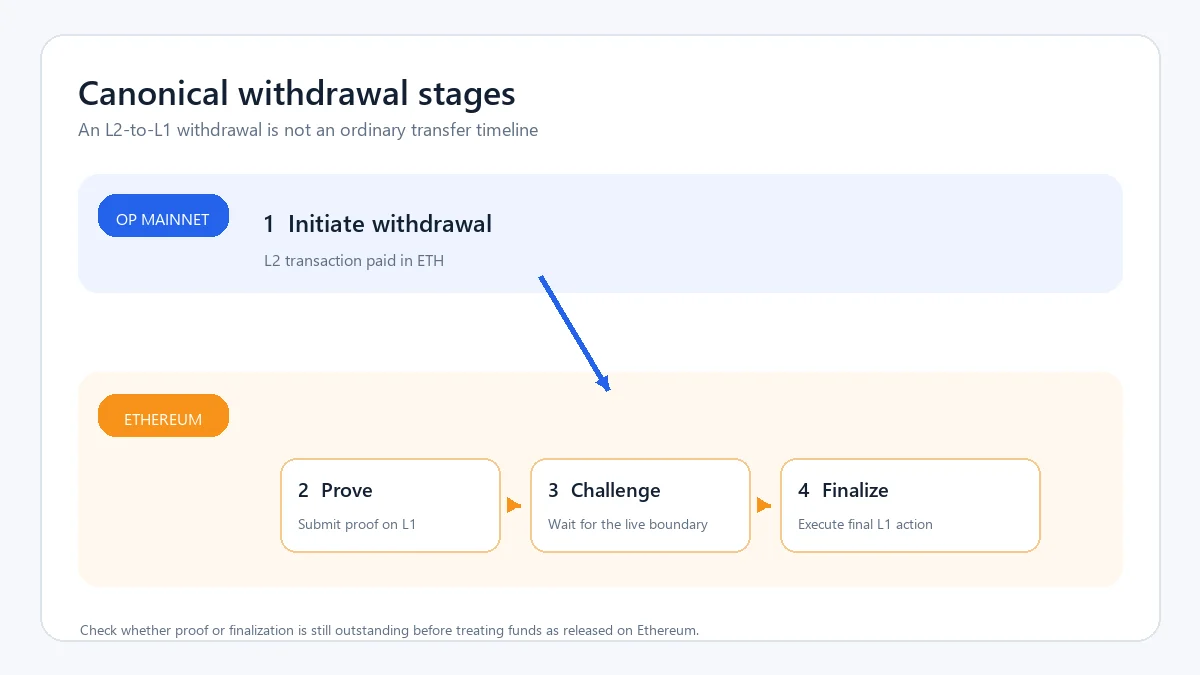
A canonical OP Mainnet withdrawal adds L1 proof, a challenge-period boundary and L1 finalization after the initiating L2 transaction.
Depositing from Ethereum
A canonical deposit starts with an Ethereum transaction, so the sender needs ETH for L1 gas. The bridge message is then derived into OP Mainnet. After arrival, the user also needs ETH on OP Mainnet for later transfers, approvals or contract calls.
Before signing, verify the bridge domain, source and destination networks, token mapping, recipient and amount. A third-party liquidity bridge may use a faster or different route, but it adds its own contracts, relayers and liquidity assumptions.
Withdrawing to Ethereum
A canonical withdrawal begins with an L2 initiation transaction. The withdrawal must then be proven on Ethereum, wait through the applicable fault-challenge boundary and be finalized with another Ethereum transaction before the L1 action is complete.
The user may need ETH on OP Mainnet for initiation and ETH on Ethereum for proof or finalization. Interfaces can automate parts of the process, but the explorer or bridge status should show whether proving or finalization is still outstanding.
The currently documented OP Mainnet challenge period can change through protocol governance or upgrades. Confirm live bridge status instead of relying on a copied duration.
Before You Sign on OP Mainnet
A short pre-signing check prevents most network, fee-asset and bridge-state mistakes.
Transaction checklist
Confirm that the wallet shows OP Mainnet and chain ID 10, then review the contract, token representation, recipient and requested approval. Keep enough ETH for the current action and for any later proof or finalization transaction required by the chosen route.
Confirm OP Mainnet and chain ID 10
Verify the token contract and bridge domain
Review the wallet's current ETH fee estimate
Check the explorer for unsafe, safe or finalized status
For a withdrawal, confirm whether proof or finalization remains
Do not use an OP balance as a substitute for ETH gas
Common Failure Paths
Most preventable errors come from mixing up the network, fee asset, token representation or completion state.
What goes wrong
When a transaction appears stuck, first identify its network and current status. Repeatedly resubmitting without checking the nonce, receipt or bridge stage can create duplicate intent or unnecessary approvals.
The wallet is connected to another OP Stack chain instead of OP Mainnet
The account holds OP but has no ETH available for gas
A token contract is confused with another representation of the same symbol
A sequencer-confirmed transaction is treated as finalized
Ordinary transfer finality is confused with canonical withdrawal completion
A third-party bridge route is assumed to have the canonical bridge's guarantees
ETH for a later Ethereum proof or finalization transaction was not prepared
What the OP Token Does
OP supports Optimism governance, while ETH remains the normal transaction fee asset on OP Mainnet.
Governance without gas confusion
Current Optimism governance allows OP holders to vote or delegate voting power for eligible Token House decisions. The exact proposal scope and voting process can evolve, so holders should use current governance documentation when taking part.
Holding OP is not required for every OP Mainnet transaction, and OP does not normally pay network gas. Its market price also does not determine the fee for an individual transaction; that fee is estimated in ETH from the transaction and current network parameters.
OP Mainnet Transaction FAQ
Direct answers about gas, status, withdrawals and the OP token.
What pays gas on OP Mainnet?
ETH normally pays OP Mainnet gas. OP is a governance token, so holding OP without ETH does not fund an ordinary transfer, approval or contract call.
What makes up an OP Mainnet transaction fee?
The total can include L2 execution and L1 data costs plus any configured operator portion. Current official OP Mainnet parameters list a zero operator scalar and constant, but users should recheck the live estimate because configuration and data costs can change.
What do unsafe, safe and finalized mean on Optimism?
Unsafe means the sequencer included the transaction before its data was published to Ethereum. Safe means the data is included on Ethereum. Finalized means the corresponding Ethereum block has reached finality.
How do I know when an OP Mainnet transaction is final?
Check an OP Mainnet explorer or RPC for the finalized block state. A wallet confirmation or unsafe receipt is useful for many interactions, but it is not the strongest Ethereum-backed status.
Why can an OP Mainnet withdrawal take longer than a normal transfer?
A canonical L2-to-L1 withdrawal adds an Ethereum proof, the applicable challenge-period boundary and a finalization transaction. Those are separate from the finality of the initiating OP Mainnet transaction, and the current timing should be checked in the live bridge interface.
Do I need ETH on both Ethereum and OP Mainnet?
It depends on the route. OP Mainnet actions use ETH for L2 gas, while an Ethereum deposit, withdrawal proof or withdrawal finalization can require ETH for L1 gas.
What is the OP token used for?
OP is used in Optimism governance, including voting or delegation where the current process allows it. It is not the normal gas asset for OP Mainnet transactions.
Optimism vs Arbitrum: what is the practical difference?
Both are Ethereum Layer 2 networks, but they use different rollup implementations, fee parameters, bridge contracts and operating systems. Verify the selected chain, fee estimate and withdrawal route instead of assuming a transaction behaves identically on both.
Known Limitations
Fee parameters, bridge contracts and protocol behavior can change through network upgrades or governance.
The market snapshot covers OP/USD and does not estimate an ETH-denominated transaction fee.
This page cannot verify a wallet request, token contract, bridge domain or individual transaction.
Market Data Methodology
The page uses a CoinGecko aggregated OP/USD snapshot. No exchange chart is rendered for this entity.
Market Snapshot Source
CoinGecko aggregated market data (OP/USD)
Cache
Snapshot cache is approximately 60 seconds.
Failure Handling
Verified cached data is labeled Cached or Delayed. Missing values remain unavailable.