Skip to content
BitcoinToolkit

Aerodrome Finance (AERO): Aerodrome Sends Emissions and Fees to Different Participants

Aerodrome Finance is a liquidity marketplace and decentralized exchange on Base. AERO is emitted to incentivize liquidity, while locked veAERO positions vote on pool gauges. This page focuses on aerodrome Sends Emissions and Fees to Different Participants and the checks users need before using the protocol or evaluating the token role.

Use Aerodrome or lock AERO while understanding how fees, emissions, votes and Base gas flow to different participants.

Subject:
Aerodrome Finance
Market mode:
Snapshot Only
Fee asset:
ETH
Timezone:
UTC

This page does not quote a swap, value a veAERO position, recommend a gauge, calculate LP returns or verify a token contract.

Content ownership: BitcoinToolkit Editorial Team Technical references: Official protocol and developer documentation. Review approach: Technical explanations are checked against primary sources and updated when the network or asset changes. Last content review: Data integration last tested:

Where Aerodrome Finance Differs for Users

Liquidity providers and veAERO voters earn through separate protocol paths.

Pools, gauges and weekly votes

Liquidity providers deposit into stable, volatile or concentrated-liquidity pools and can stake eligible positions in gauges. Weekly AERO emissions are directed according to veAERO voting. Traders pay swap fees, and the protocol routes pool fees and external voting incentives to voters supporting those gauges under current rules.

A high gauge vote can attract more emissions without making the pool low risk. Liquidity providers should separate projected AERO rewards from trading-fee income and changing token values. Voters should identify which fees and incentives a pool generated rather than treating every vote as a guaranteed return.
veAERO Converts Liquid AERO Into Time-Locked Voting Power

Lock duration creates governance power and a liquidity constraint.

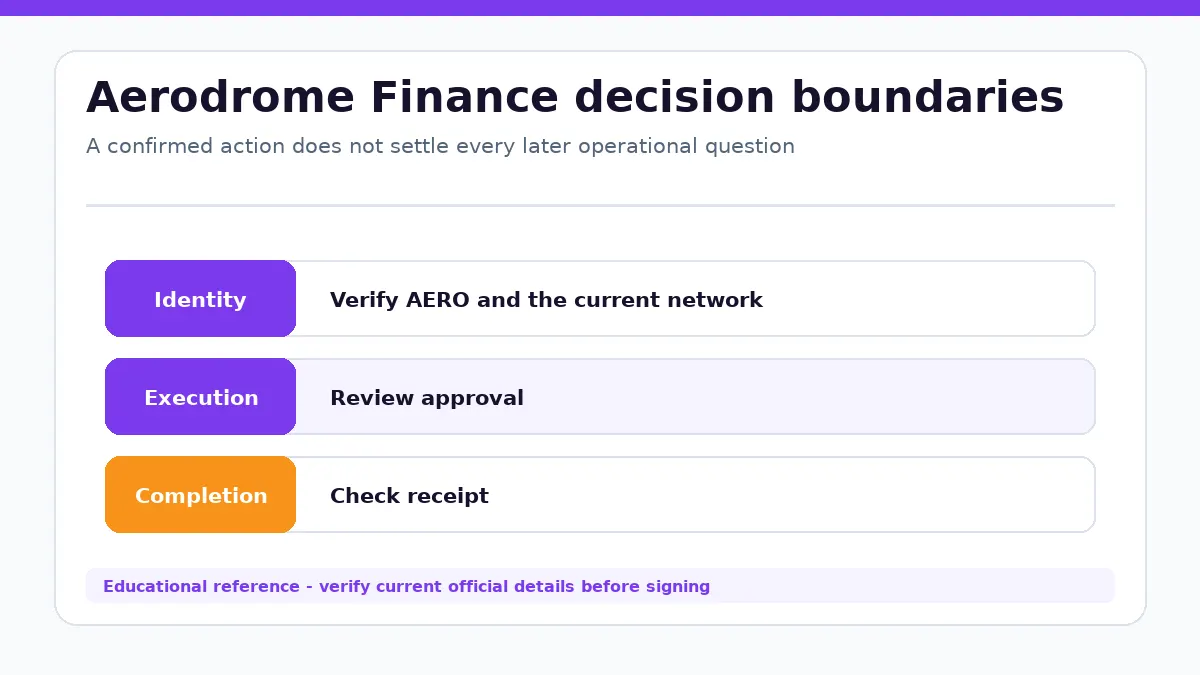
Aerodrome Finance decision diagram separating identity, execution and completion checks
Aerodrome Finance confirmation does not settle every later operational question.

Lock, NFT and voting state

Check lock end, voting state, marketplace support and delegation before committing. An NFT transfer can transfer governance rights and future claims. Do not sign a position-management action as if it were a simple token approval, and do not rely on current incentives to remain above the opportunity cost of an illiquid lock.

Pool Design Determines LP Exposure

A stable pair, volatile pair and concentrated range need different risk controls.

Swap and liquidity checks

Stable pools target correlated assets, volatile pools use a broader constant-product shape, and concentrated positions deploy capital within chosen ranges. All can experience smart-contract, token and market risk. Base ETH pays transaction gas, while pool fees and price impact are economic costs inside the swap.

Verify both token contracts, pool address, fee setting, gauge and reward tokens. Compare minimum received with route price impact before swapping. Liquidity providers should monitor reserve composition, depeg exposure, range status and whether incentives are funded for the full displayed period.

Why Aerodrome Finance's Design Matters

Start with the role: trader, liquidity provider or voter.

What Aerodrome Finance users should verify and why this design differs

Traders should review route, fee, price impact and minimum output. Liquidity providers should compare pool type, gauge emissions and asset risk. AERO lockers should record lock expiry and assess the pools they plan to vote for. Every role needs ETH on Base for gas.

Do not confuse AERO emissions with Base network rewards, send AERO on an unsupported chain, or assume veAERO can be redeemed immediately. Use current Aerodrome contracts and Base explorers, then continue to trading or wallet tools for operational checks.

Aerodrome Finance Swaps and liquidity FAQ

What pays transaction fees when using Aerodrome Finance?

Ether on Base (ETH) pays the applicable network fee. ETH pays Aerodrome transaction fees on Base. Verify the selected network before signing because a later approval, bridge, claim or exit can require another transaction.

Can a Aerodrome Finance swap succeed at a worse price than the preview?

Yes. Pool state, routing, price impact, slippage settings, fees and transaction ordering can change execution.

Known Limitations

Market Data Methodology

The page uses a CoinGecko aggregated AERO/USD snapshot. No exchange chart is rendered for this entity.

Market Snapshot Source
CoinGecko aggregated market data (AERO/USD)
Cache
Snapshot cache is approximately 60 seconds.
Failure Handling
Verified cached data is labeled Cached or Delayed. Missing values remain unavailable.
Snapshot Status
Delayed
Report Issue
Report a market-data problem →

Technical Sources

Selected primary sources support the operational explanations. Market-provider attribution remains separate.

Editorial Information

Verified technical content, reviewed sources and update history.

Published
Last Review
Data Verification
Sources
Official documentation