Monad (MON): Monad Keeps the Familiar EVM Transaction Model
Monad is an EVM-compatible Layer 1 designed around parallel execution and pipelined consensus. MON is its native gas and staking asset. This page focuses on monad Keeps the Familiar EVM Transaction Model and the checks users need before sending funds, paying fees or using the network.
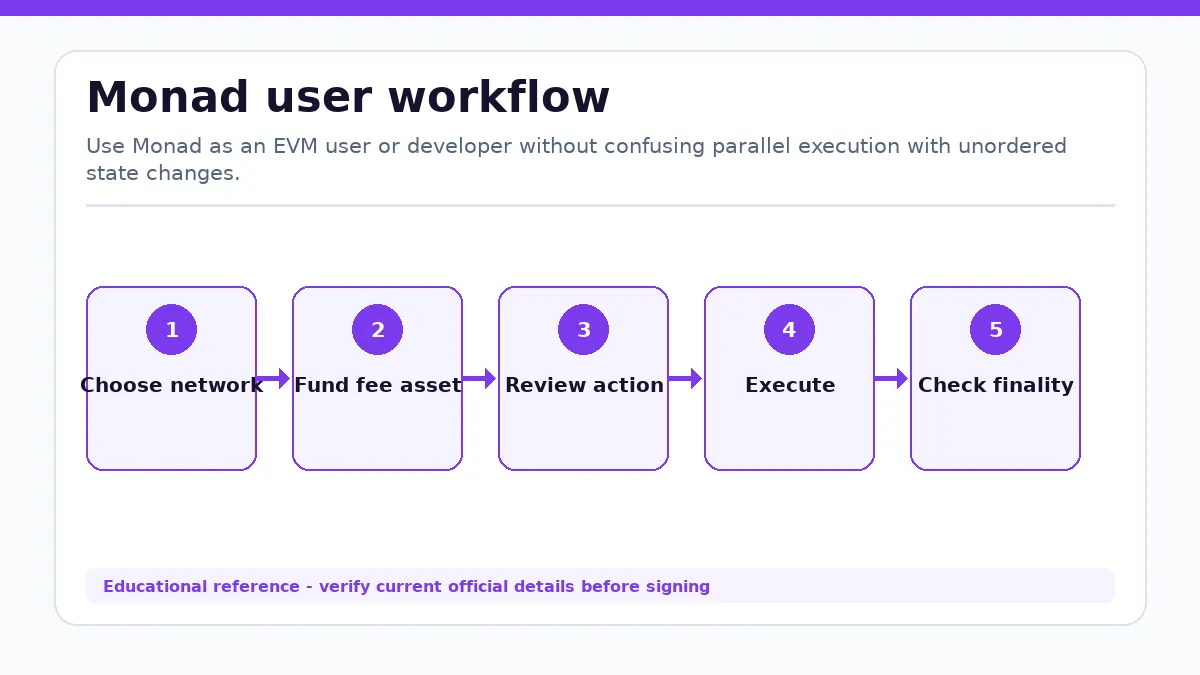
Use Monad as an EVM user or developer without confusing parallel execution with unordered state changes.
Subject:
Monad
Market mode:
Snapshot Only
Fee asset:
MON
Timezone:
UTC
This page does not deploy a contract, estimate live gas, select a validator, bridge an asset or claim that parallel execution removes transaction conflicts.
Content ownership: BitcoinToolkit Editorial TeamTechnical references: Official protocol and developer documentation.Review approach: Technical explanations are checked against primary sources and updated when the network or asset changes.Last content review: Data integration last tested:
Monad Keeps the Familiar EVM Transaction Model
Compatibility preserves Ethereum-style accounts and contracts while the client changes how work is processed.
Monad workflow from the first user decision to a verified outcome.
Account, nonce and gas
A Monad user signs an EVM transaction with chain ID, sender nonce, destination, value, calldata, gas limit and fee fields. An externally owned account or contract account changes state through EVM bytecode and Ethereum-compatible RPC methods. MON pays the gas and value fields where a native currency is required.
Confirm chain ID, RPC, contract address and MON balance before sending. A transaction with the wrong nonce can wait behind earlier transactions from the same account. EVM compatibility does not make an Ethereum address balance portable: assets and contracts must exist on Monad, and bridge or exchange routes define their own representations.
Performance comes from executing independent work together and reconciling conflicts.
Optimistic scheduling and deterministic results
Monad can begin executing transactions before the previous block has finished and schedule transactions in parallel. It records the state each transaction reads and writes. Independent transactions can complete concurrently; conflicting work is detected and re-executed as necessary. Final state is committed in the consensus-defined serial order, preserving deterministic EVM behavior.
Developers should still design for shared-state contention, nonce order, reverts and reentrancy. A popular contract can become a conflict hotspot even when the chain processes unrelated contracts quickly. Benchmark complete application paths, including RPC latency, storage access and event indexing, instead of translating an advertised network throughput into a guaranteed contract call rate.
Consensus, Execution and Staking Have Separate Timelines
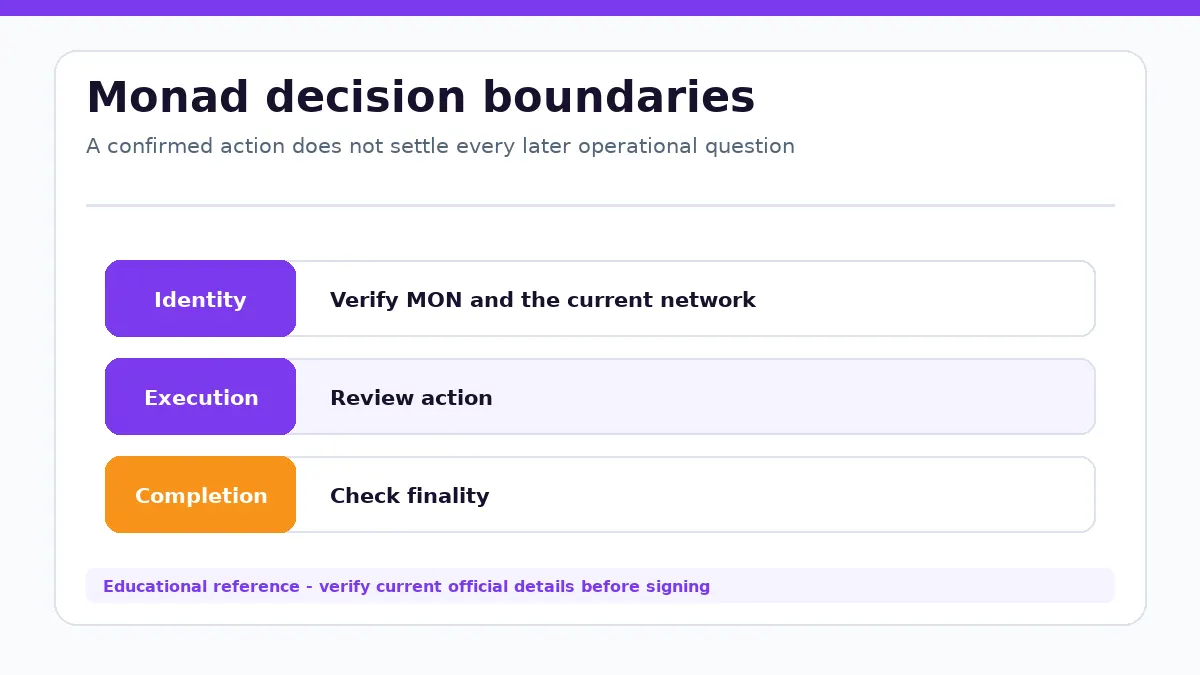
A fast included block and an activated staking change are different states.
Monad confirmation does not settle every later operational question.
MonadBFT and epochs
MonadBFT validators agree on block order and finality while execution is pipelined behind consensus. Applications should use the documented finality and RPC semantics for deposits, bridges and irreversible actions. Native staking is exposed through a system precompile, with delegations, undelegations and validator changes activating around epoch boundaries rather than immediately.
Before delegating, verify validator identity, commission, status and the current withdrawal delay. Preserve the withdrawal ID for an undelegation and check the active epoch before expecting funds. Smart-contract developers should not assume the staking precompile behaves like ordinary deployed bytecode in forked testing or supports every call type.
Match the next record to a transfer, contract or staking task.
User, developer or delegator
Users should verify the destination network, token representation, gas estimate and transaction receipt. Developers should test contract behavior, conflict-heavy calls, RPC support and event consumers. Delegators should review epoch timing, validator performance and two-step withdrawals. Every workflow should keep enough MON for follow-up transactions.
Do not send an Ethereum-only token contract to Monad, interpret a pending execution response as final settlement or expect a staking update inside the same block. Preserve chain ID, transaction hash and contract version when reporting a problem, then use developer or wallet tools for the exact address and calldata involved.
Does Monad reorder transactions to run them in parallel?
No. Parallel work is reconciled to the consensus-defined transaction order.
What pays Monad gas?
MON is the native gas asset.
Do staking changes activate immediately?
No. Many staking actions take effect around documented epoch boundaries and withdrawal delays.
What should I verify before a Monad transaction?
Check the official destination, current network, asset representation, amount, recipient and requested permissions. MonadBFT orders blocks, asynchronous execution processes the ordered transactions, optimistic parallel execution schedules independent work, and the final state preserves deterministic transaction order. After confirmation, inspect the resulting balance or protocol state instead of relying only on a wallet success message.
Known Limitations
Network parameters and tooling can change.
Parallel execution does not eliminate contract contention.
The page does not inspect a transaction or validator.
Market Data Methodology
The page uses a CoinGecko aggregated MON/USD snapshot. No exchange chart is rendered for this entity.
Market Snapshot Source
CoinGecko aggregated market data (MON/USD)
Cache
Snapshot cache is approximately 60 seconds.
Failure Handling
Verified cached data is labeled Cached or Delayed. Missing values remain unavailable.