Avalanche (AVAX): How C-Chain Transactions and Finality Work
Avalanche is a network of interoperable Layer 1 blockchains. Its Primary Network includes the EVM-compatible C-Chain, while AVAX is the native utility asset used for fees, staking and value transfer across the Primary Network. This page focuses on how Avalanche C-Chain Transactions and Finality Work and the checks users need before sending funds, paying fees or using the network.
Help users understand how Avalanche C-Chain works and make safer usage and transaction decisions for Avalanche.
Snapshot:
CoinGecko - USD
Chart:
Binance Spot - AVAX/USDT
Timezone:
UTC
Use this page to understand Avalanche, inspect sourced market references and learn how the C-Chain handles accounts, gas and transactions. It does not provide executable quotes, price predictions or investment advice.
Content ownership: BitcoinToolkit Editorial TeamTechnical references: Avalanche Builder Hub documentation and the AvalancheGo source repository.Review approach: Technical explanations are checked against Avalanche Builder Hub documentation and the AvalancheGo source repository.Last content review: Data integration last tested:
How Avalanche C-Chain Transactions and Finality Work
BitcoinToolkit separates CoinGecko's aggregated USD reference from the Binance Spot AVAX/USDT market and explains C-Chain accounts, AVAX units, dynamic gas fees, transactions, contracts and finality.
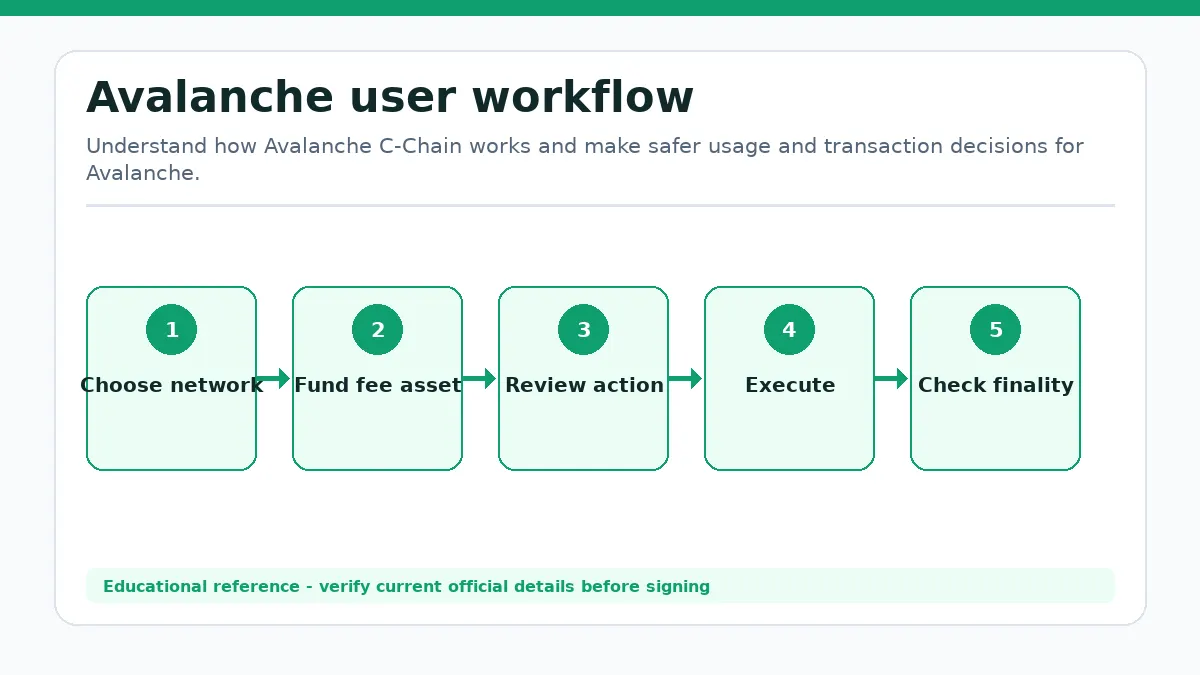
Avalanche workflow from the first user decision to a verified outcome.
What the Avalanche user is confirming
Avalanche is a network of interoperable Layer 1 blockchains.
Avalanche Primary Network validators stake AVAX and use Snowman consensus to order and finalize blocks. The C-Chain applies that consensus to account-based transactions and smart-contract execution through the EVM.
AVAX and transaction costs
Avalanche (AVAX) is the asset profiled on this page.
Avalanche (AVAX) pays the applicable transaction cost.
Historical Binance Spot candles are available. JavaScript is required for current-candle updates.
Historical Binance Spot candles are available. JavaScript is required for current-candle updates.
Recent OHLC and volume data
Time (UTC)
Open (USDT)
High (USDT)
Low (USDT)
Close (USDT)
Volume (AVAX)
Oct 11, 2026 05:00:00 UTC
10.29 USDT
10.32 USDT
10.27 USDT
10.28 USDT
47,950.28 AVAX
Oct 11, 2026 04:00:00 UTC
10.20 USDT
10.30 USDT
10.19 USDT
10.29 USDT
63,215.93 AVAX
Oct 11, 2026 03:00:00 UTC
10.33 USDT
10.34 USDT
10.20 USDT
10.21 USDT
106,072.97 AVAX
Oct 11, 2026 02:00:00 UTC
10.36 USDT
10.36 USDT
10.32 USDT
10.33 USDT
60,711.06 AVAX
Oct 11, 2026 01:00:00 UTC
10.34 USDT
10.41 USDT
10.34 USDT
10.36 USDT
74,562.22 AVAX
Market data: Binance Spot AVAX/USDT
Charting library: TradingView Lightweight Charts
Avalanche, C-Chain and AVAX
Avalanche is a multi-chain network platform, its Primary Network C-Chain provides EVM execution, and AVAX is the native utility asset used for fees, staking and value transfer.
Page subject
Avalanche C-Chain
Market pair
AVAX/USDT
Network family
EVM Layer 1
Network
The Avalanche Primary Network runs the C-Chain, P-Chain and X-Chain. This page uses the EVM-L1 module for C-Chain execution while identifying the broader network boundary.
Role distinction
Native AVAX is not an ERC-20 token. Wrapped AVAX is a separate contract token used where an ERC-20 interface is required.
Avalanche C-Chain Accounts
The C-Chain tracks EVM account state containing AVAX balances, nonces, contract code and contract storage.
Account-based state
The C-Chain maps EVM addresses to account data and updates that state when accepted transactions execute.
Externally owned accounts
Externally owned accounts are controlled by private keys and can create signed C-Chain transactions.
Contract accounts
Contract accounts contain EVM bytecode and execute only when called by a transaction or another contract.
Nonce
A sender nonce orders transactions from one externally owned account and prevents replay on the C-Chain.
Balance
An EVM account balance records native AVAX available on the C-Chain, not AVAX held on another Primary Network chain.
Code execution
Coreth executes compatible EVM bytecode when a transaction or contract call reaches the account.
Contract storage
Smart contracts maintain persistent storage that changes only after successful execution and block acceptance.
AVAX Units on the C-Chain
One AVAX equals 10^18 wei in C-Chain EVM interfaces; one nAVAX, also represented as one gwei, equals 10^9 wei or 10^-9 AVAX.
Decimal precision18 decimal places in EVM interfaces
AVAX (AVAX)10^18 wei | 18 decimals
NanoAVAX (nAVAX / gwei)10^9 wei | 9 decimals
Wei (wei)1 wei | 0 decimals
C-Chain wallets usually display AVAX, fee interfaces commonly quote nAVAX or gwei, and raw EVM values use wei. Confusing nAVAX with AVAX changes a value by one billion times.
Avalanche C-Chain Gas and Fees
C-Chain transactions meter EVM work in gas and pay dynamic fees in AVAX.
Gas
Gas measures the computational work requested by a C-Chain transaction.
Gas limit
The gas limit caps how much work the transaction may consume; it is not the amount that must be used.
Gas used
Gas used records the work consumed by execution and is combined with the effective per-gas price to determine the fee.
Base fee
The C-Chain adjusts a base fee according to network utilization using its dynamic fee mechanism.
Priority fee
A priority fee can influence transaction ordering; wallets should estimate it from current C-Chain conditions.
Max fee
The maximum fee per gas limits what the sender permits the transaction to pay.
Max priority fee
The maximum priority fee caps the optional tip component of a dynamic-fee transaction.
Execution cost
The final fee depends on gas used and the effective gas price, not simply the submitted gas limit.
Avalanche C-Chain Transactions
A C-Chain transaction is created, signed, validated, propagated, executed by Coreth, included in a block and accepted through Snowman consensus.
Transaction creationThe sender constructs recipient, value, data, nonce, chain ID and dynamic gas fields.
SigningThe sender signs the transaction with the key controlling the EVM account.
Nonce validationNodes verify the account nonce, signature, balance and transaction rules.
BroadcastThe signed transaction is submitted to an Avalanche C-Chain RPC endpoint.
Node propagationEligible pending transactions propagate between AvalancheGo nodes tracking the C-Chain.
ExecutionCoreth applies EVM execution against the current account state and meters gas.
Receipt generationExecution produces a receipt with status, gas usage, logs and contract events.
What Avalanche users should verify and why this design differs
The CoinGecko USD snapshot and Binance Spot AVAX/USDT chart are separate datasets and can differ. Market reference data may be delayed or unavailable when a provider cannot return validated values.
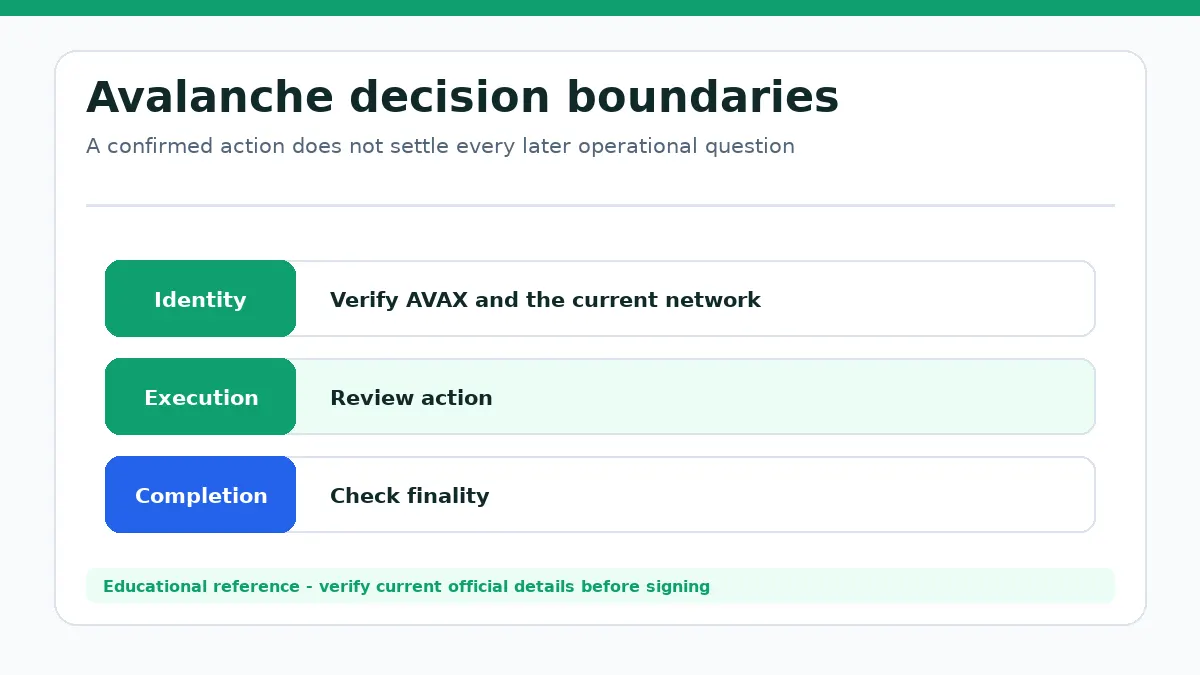
For Avalanche, the practical sequence is Choose network, Fund fee asset, Review action, Execute, Check finality. Confirm the official destination and current network, then inspect the final balance, position, receipt or documented exit state that actually completes the task: Understand how Avalanche C-Chain works and make safer usage and transaction decisions for Avalanche.
Avalanche Network use FAQ
What is Avalanche?
Avalanche is a multi-chain network platform. Its Primary Network runs the C-Chain, P-Chain and X-Chain, while additional Avalanche Layer 1 blockchains can operate with their own rules.
What is the difference between Avalanche and the C-Chain?
Avalanche is the broader network platform. The C-Chain is the EVM-compatible blockchain on the Avalanche Primary Network used for Solidity smart contracts and account-based transactions.
Is native AVAX an ERC-20 token?
No. AVAX is the native asset that pays C-Chain gas. Wrapped AVAX is a separate ERC-20 contract representation used by applications that require a token interface.
How are Avalanche C-Chain fees calculated?
C-Chain execution is measured in gas. The final AVAX fee depends on gas used and the effective dynamic price per gas, including the network base fee and any permitted priority component.
Are the USD snapshot and AVAX/USDT chart the same market?
No. CoinGecko supplies an aggregated USD reference, while the chart represents the Binance Spot AVAX/USDT market.
How does Avalanche transaction finality work?
Primary Network validators use Snowman consensus. Once a C-Chain block is accepted, finality is irreversible rather than dependent on a separate settlement window.
Known Limitations
Applications should wait for node-reported acceptance and handle RPC or network delays.
Market Data Methodology
The snapshot uses CoinGecko aggregated USD data. The chart uses Binance Spot AVAX/USDT data. Provider coverage, venue and quote currencies differ, so values can differ. Missing, malformed or provider-inconsistent values remain unavailable instead of being replaced with zero.
The snapshot is CoinGecko aggregated USD data. The chart is Binance Spot AVAX/USDT data. Providers, venue coverage and quote currencies differ, so displayed values can differ.
Market Snapshot Source
CoinGecko aggregated market data (USD)
Candlestick Source
Binance Spot market data
Pair
AVAX/USDT
Venue
Binance Spot
Market Type
Spot
Timezone
UTC
Cache
Snapshot cache is approximately 60 seconds; historical candle cache varies by interval.
Failure Handling
Verified cache is labeled Cached or Delayed. Missing or provider-inconsistent values remain unavailable.