Skip to content
BitcoinToolkit

Lido DAO (LDO): How Lido on Ethereum Accounts for Staking

Lido is an Ethereum liquid-staking protocol. LDO is its governance token; stETH and wstETH represent staking positions, while ETH is the deposited asset and gas currency. This page focuses on how Lido on Ethereum Accounts for Staking and the checks users need before using the protocol or evaluating the token role.

Use Lido or evaluate LDO without confusing governance ownership with an ETH staking claim.

Subject:
Lido DAO
Market mode:
Snapshot Only
Fee asset:
ETH
Timezone:
UTC

This page does not quote staking returns, recommend a DeFi position, verify a contract address, process a withdrawal or provide investment advice.

Content ownership: BitcoinToolkit Editorial Team Technical references: Official protocol and developer documentation. Review approach: Technical explanations are checked against primary sources and updated when the network or asset changes. Last content review: Data integration last tested:

How Lido on Ethereum Accounts for Staking

Lido coordinates pooled Ethereum staking and issues stETH as a liquid representation. LDO governs parts of the protocol; it is not the staking receipt and does not represent Ethereum.

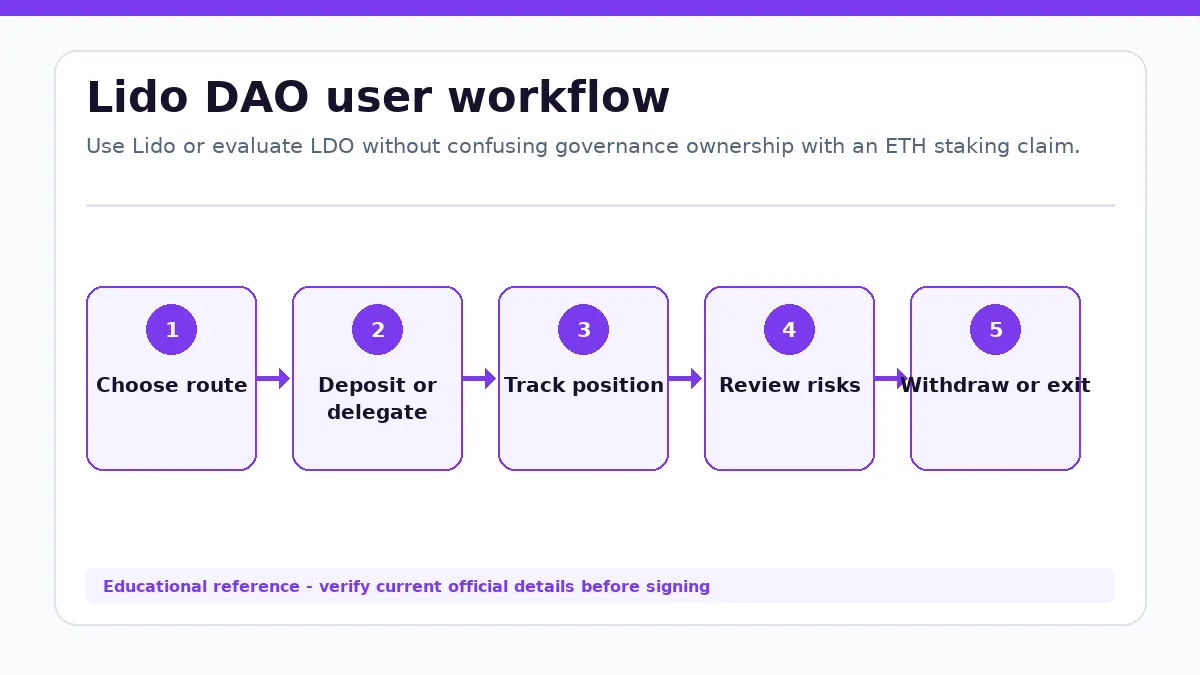
Lido DAO workflow showing Choose route, Deposit or delegate, Track position, Review risks, Withdraw or exit
Lido DAO workflow from the first user decision to a verified outcome.

Why a user might choose liquid staking

Lido can fit an ETH holder who wants staking exposure without operating validator infrastructure and who understands that stETH introduces protocol, oracle, operator and liquidity dependencies beyond native ETH. The receipt can remain transferable or be used in compatible applications while the underlying ETH participates in staking.

The convenience is not free of trade-offs. stETH can trade away from its protocol redemption value, DeFi integrations add new smart contracts, and an exit through the withdrawal queue may not be immediate.

Who should be cautious

Lido is a poor fit for someone who requires direct control over validator keys, instant guaranteed redemption or no exposure beyond Ethereum consensus. A user moving stETH to another network must also evaluate the bridge and representation rather than assuming all stETH balances are identical.

Before staking, decide how you expect to exit: protocol withdrawal, secondary-market swap or continued use of stETH. Each path has different timing and price risks.

  • Confirm the official staking route.
  • Understand stETH and wstETH accounting.
  • Plan for queue or market liquidity.
  • Check every downstream DeFi integration separately.

Lido DAO Guidance for Holders

Ethereum staking normally locks capital into validator operations and exit mechanics. Lido separates the user's liquid position from the infrastructure that performs validation.

Pooled deposits and distributed operation

Users deposit ETH into protocol contracts and receive stETH accounting for their share of pooled staking. The protocol routes eligible ETH to validator operators through its staking architecture, while oracle reports update protocol accounting for rewards, penalties and validator state.

This lowers the operational threshold for the depositor, but responsibility shifts rather than disappears. Smart contracts, governance processes, node-operator performance and oracle reporting become part of the staking position.

Liquidity changes the use of staked capital

A transferable receipt allows a holder to use or exchange a staking position without waiting for every underlying validator to exit. DeFi protocols can accept stETH or wstETH as collateral or liquidity, creating composability that native validator balances do not have.

The cost is layered risk. A lending position backed by stETH depends on Ethereum staking, Lido, the receipt token, the lending market and its oracle at the same time.

From ETH Deposit to stETH Withdrawal

The entry and exit paths use different protocol processes.

Deposit and hold

A user connects an Ethereum wallet, verifies the official Lido contract path, submits ETH and receives stETH. The rebasing stETH balance reflects protocol accounting updates; wstETH wraps that position into a non-rebasing share format used by many applications and networks.

Holding the receipt requires ETH for future transaction fees. Using it elsewhere requires approvals and creates the risk profile of the destination protocol in addition to Lido's own risks.

  • Deposit ETH
  • Receive stETH
  • Optionally wrap to wstETH
  • Use or hold the receipt
  • Choose an exit path

Request, finalize and claim

A protocol withdrawal locks the submitted stETH in the withdrawal process and creates a claim that is finalized when the protocol can satisfy it under Ethereum exit and liquidity conditions. Once finalized, the user claims ETH in a later transaction.

A secondary-market swap can be faster but uses available pool liquidity and a market exchange rate. It is not the same as protocol redemption, especially during stress.

What LDO Governs and What stETH Holders Use

LDO, stETH and ETH occupy different roles in the same system.

Governance versus staking receipt

LDO is used in Lido DAO governance over eligible protocol decisions. stETH is the user's liquid staking receipt, and ETH is the asset deposited, withdrawn and used for Ethereum gas. A holder can interact with one role without holding all three assets.

Governance can influence protocol configuration and upgrades through established processes. It does not let one LDO holder redirect an individual stETH balance or guarantee a validator outcome.

What LDO does not do

LDO does not represent staked ETH, pay normal Ethereum gas, create an automatic staking reward or grant ownership of the Ethereum network. Buying LDO is not the same activity as depositing ETH for stETH.

Investors researching LDO should separate governance relevance from stETH adoption, validator economics and the risks of the broader staking system.

Lido Risks for Stakers and DeFi Users

A liquid staking position combines consensus exposure with protocol and market dependencies.

Protocol, operator and exit risk

Validator penalties or slashing can affect pooled results. Smart-contract or oracle failures can disrupt accounting and withdrawals. Governance and operator concentration matter because protocol decisions and validator performance are not distributed in the same way as solo staking.

Withdrawal timing depends on protocol liquidity and Ethereum's validator exit conditions. A market exit depends on stETH liquidity and can occur below the protocol redemption value. Neither route guarantees immediate ETH.

  • Validator and slashing exposure
  • Smart-contract and oracle behavior
  • Withdrawal queue timing
  • stETH market liquidity
  • Bridge and integration risk

Mistakes that add unnecessary layers

Users often confuse stETH with ordinary ETH, bridge an unsupported representation, or use the receipt as collateral without accounting for liquidation risk. Another mistake is treating a quoted staking rate as fixed after fees, penalties and changing validator conditions.

Map every contract and exit path before combining liquid staking with leverage.

Why Lido DAO's Design Matters

Liquid staking choices differ in operator admission, token accounting, governance and integration risk.

What Lido DAO users should verify and why this design differs

Lido coordinates pooled staking through its protocol and operator architecture. Rocket Pool uses a different node-operator and collateral model. Ether.fi emphasizes its own staking and restaking pathways. Their receipt tokens, withdrawal processes and downstream integrations should be reviewed separately.

A user should compare control, liquidity, operator assumptions and exit mechanics rather than selecting only by the displayed reward rate.

Solo staking offers direct validator control but requires operational skill and the protocol minimum. Centralized staking can simplify custody and operations while adding an account provider. Liquid staking makes the receipt transferable and composable, but adds smart contracts, governance and secondary-market pricing. The relevant choice is therefore about responsibility and failure paths, not only convenience.

Institutions and larger holders should also inspect operator concentration, key management, reporting, withdrawal planning and whether downstream DeFi use is permitted by their controls. Smaller users should decide whether stETH liquidity is genuinely needed; adding a tradable receipt creates no benefit when the intended action is simply to hold until withdrawal.
Lido DAO Staking and yield FAQ

What pays transaction fees when using Lido DAO?

Ether (ETH) pays the applicable network fee. ETH pays Ethereum gas for Lido interactions. Verify the selected network before signing because a later approval, bridge, claim or exit can require another transaction.

What should I verify before a Lido DAO transaction?

Check the official destination, current network, asset representation, amount, recipient and requested permissions. Users deposit ETH through protocol contracts, receive stETH or wstETH accounting, and can request ETH through a withdrawal queue. Node operators, oracles and governance support the system. After confirmation, inspect the resulting balance or protocol state instead of relying only on a wallet success message.

Can Lido DAO rewards or withdrawal timing change after staking?

Yes. Reward rates, validator performance, slashing exposure, liquidity and exit queues can change while the position remains open.

Known Limitations

Market Data Methodology

The page uses a CoinGecko aggregated LDO/USD snapshot. No exchange chart is rendered for this entity.

Market Snapshot Source
CoinGecko aggregated market data (LDO/USD)
Cache
Snapshot cache is approximately 60 seconds.
Failure Handling
Verified cached data is labeled Cached or Delayed. Missing values remain unavailable.
Snapshot Status
Delayed
Report Issue
Report a market-data problem →

Technical Sources

Selected primary sources support the operational explanations. Market-provider attribution remains separate.

Editorial Information

Verified technical content, reviewed sources and update history.

Published
Last Review
Data Verification
Sources
Official documentation