KuCoin Token is the native gas and staking asset of KCC and an ecosystem utility token associated with KuCoin products. Network use and exchange-account benefits are separate roles. This page focuses on common KCS Transfer Mistakes and the checks users need before using the protocol or evaluating the token role.
Use KCS on KCC or KuCoin while keeping gas, staking, platform utility and custody roles distinct.
Subject:
KuCoin Token
Market mode:
Snapshot Only
Fee asset:
KCS
Timezone:
UTC
This page does not calculate exchange benefits, predict staking rewards, verify a validator or execute a KCS transfer.
Content ownership: BitcoinToolkit Editorial TeamTechnical references: Official protocol and developer documentation.Review approach: Technical explanations are checked against primary sources and updated when the network or asset changes.Last content review: Data integration last tested:
Common KCS Transfer Mistakes
Most avoidable losses come from confusing custody location and transport network.
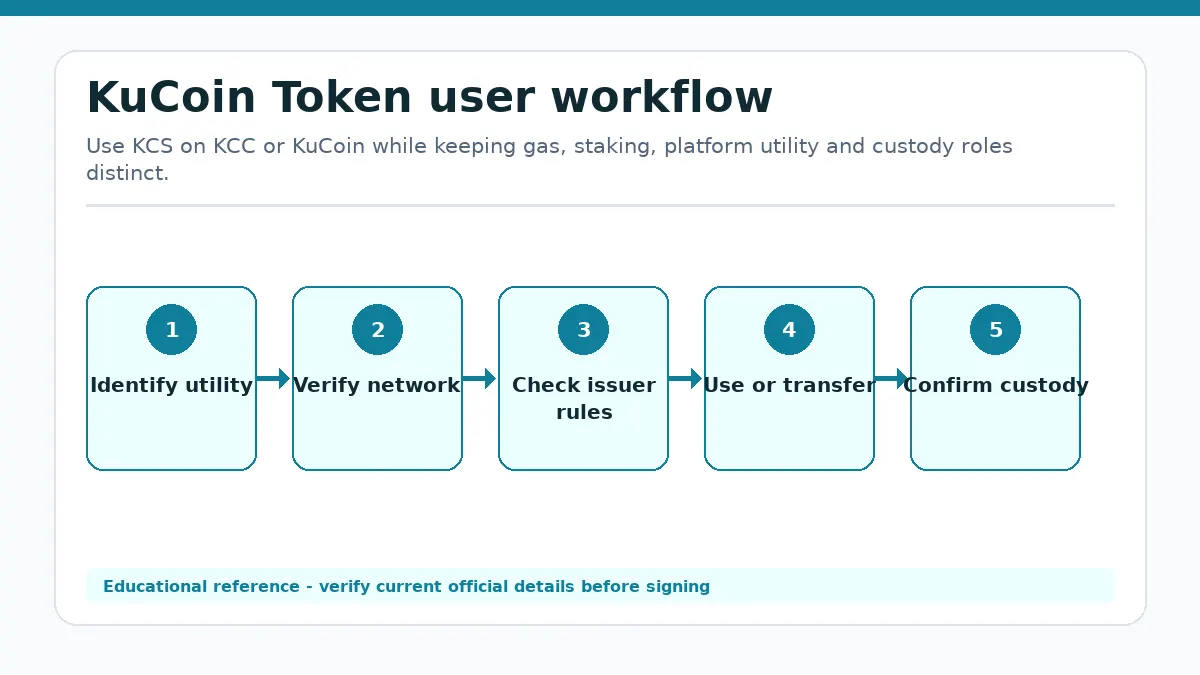
KuCoin Token workflow from the first user decision to a verified outcome.
Before you send or stake
Confirm that both sender and receiver support KCC, verify the address and selected withdrawal network, and keep enough KCS for follow-up gas. Do not assume that choosing KCS by ticker selects the intended network. Check any memo requirement at the receiving service.
Use official KCC staking and explorer links, reject copied validator pages, and never disclose a seed phrase. Test a small transfer when appropriate and confirm the transaction on the KCC explorer before relying on an exchange credit.
KuCoin Token Transaction and Fee Checks
KCC network activity and KuCoin account activity use the same asset in different systems.
EVM execution with KCS gas
KCC is compatible with Ethereum tooling but maintains its own chain state, contracts, transaction history and chain ID. Ordinary transfers and contract calls consume gas denominated in KCS. Holding an ERC-20 token on Ethereum or a balance inside KuCoin does not by itself fund a self-custody KCC transaction.
Before adding KCC to a wallet, use the current official RPC and explorer details. Contract addresses can differ from Ethereum even when an application uses familiar EVM interfaces. A successful KCC transaction proves execution on KCC, not that a token contract or decentralized application is economically safe.
Network asset versus account benefit
Native KCS can pay gas without being deposited at KuCoin. By contrast, exchange benefits depend on the current product, region, account status and where the balance is held. A self-custody balance and a custodial account balance should not be assumed to receive identical treatment.
KCS is not equity in KuCoin and does not guarantee revenue, rewards or a fixed market outcome. Users should review current product terms rather than relying on historical descriptions of bonuses, discounts or promotions.
Delegating KCS supports validator selection but creates a separate onchain position.
Delegation is not an exchange deposit
KCC documentation allows KCS holders to stake to validator candidates, with voting weight linked to the amount delegated. The wallet signs an onchain transaction and needs additional KCS for gas. Rewards, claim timing and redemption rules belong to the current staking contracts and validator program.
Validator performance, contract behavior and rule changes can affect outcomes. A displayed annual rate is not fixed, and delegation does not transfer general control of a wallet. Verify the validator destination and staking application before approving any transaction.
A burn program changes reported supply but does not determine user returns.
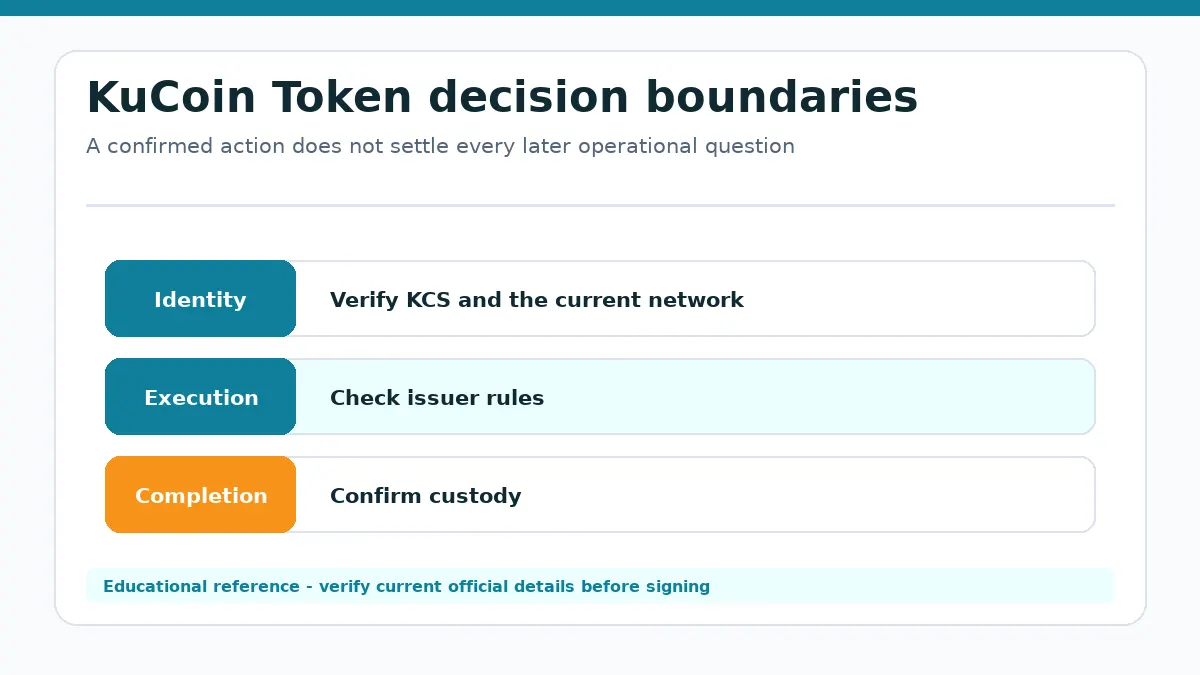
KuCoin Token confirmation does not settle every later operational question.
Read each burn as a dated event
KuCoin has described buyback-and-burn activity and a long-term supply target for KCS. Users should verify current announcements and onchain evidence rather than projecting an old schedule indefinitely. A future target is not the same as tokens already removed from circulation.
Burns do not guarantee price appreciation or offset custody, liquidity, regulatory or network risk. Platform utility can change independently of KCC gas demand, so the two sources of use should be evaluated separately.
Choose the Next KCS Check
Continue with the resource that matches the planned action.
Network, staking or transfer
Use KCC documentation for network and staking rules, KuCoin terms for account benefits, and the tools directory for general address and fee utilities. Compare BNB Chain when evaluating a different exchange-linked EVM ecosystem.
KCC is EVM compatible and charges KCS for transaction execution. Holders can delegate KCS to validator candidates, while KuCoin defines separate account-based token uses and operates a documented supply-reduction program.
Holding KCS does not guarantee exchange custody, withdrawal availability, discounts, redemption or issuer support. KCS is the asset shown in the market snapshot. KCS pays KCC transaction and smart-contract gas.
What KuCoin Token users should verify and why this design differs
KuCoin product eligibility and KCC staking parameters can change. Burn targets do not predict market value.
For KuCoin Token, the practical sequence is Identify utility, Verify network, Check issuer rules, Use or transfer, Confirm custody. Confirm the official destination and current network, then inspect the final balance, position, receipt or documented exit state that actually completes the task: Use KCS on KCC or KuCoin while keeping gas, staking, platform utility and custody roles distinct.
Network use and exchange-account benefits are separate roles.
KuCoin Token Ecosystem use FAQ
What pays gas on KCC?
KCS pays ordinary KCC transaction and smart-contract gas.
Can KCS be delegated on KCC?
Yes. Current KCC documentation describes delegation to validator candidates.
Does KCS guarantee KuCoin benefits?
No. Benefits depend on current product and account rules.
Known Limitations
KuCoin product eligibility and KCC staking parameters can change.
Burn targets do not predict market value.
The page does not validate a withdrawal network, validator or account.
Market Data Methodology
The page uses a CoinGecko aggregated KCS/USD snapshot. No exchange chart is rendered for this entity.
Market Snapshot Source
CoinGecko aggregated market data (KCS/USD)
Cache
Snapshot cache is approximately 60 seconds.
Failure Handling
Verified cached data is labeled Cached or Delayed. Missing values remain unavailable.