GateToken is the native gas, staking and governance asset of Gate Chain and the gas asset used by Gate Layer. It also appears in Gate exchange products, which are separate from protocol-level ownership. This page focuses on gT Fees and Base-Fee Burns and the checks users need before using the protocol or evaluating the token role.
Use GT across Gate Chain and Gate Layer while understanding gas, staking and network boundaries.
Subject:
GateToken
Market mode:
Snapshot Only
Fee asset:
GT
Timezone:
UTC
This page does not estimate Gate fees, operate a bridge, calculate exchange benefits or recommend a validator.
Content ownership: BitcoinToolkit Editorial TeamTechnical references: Official protocol and developer documentation.Review approach: Technical explanations are checked against primary sources and updated when the network or asset changes.Last content review: Data integration last tested:
GT Fees and Base-Fee Burns
Both networks use GT, but each transaction is priced and recorded on its selected layer.
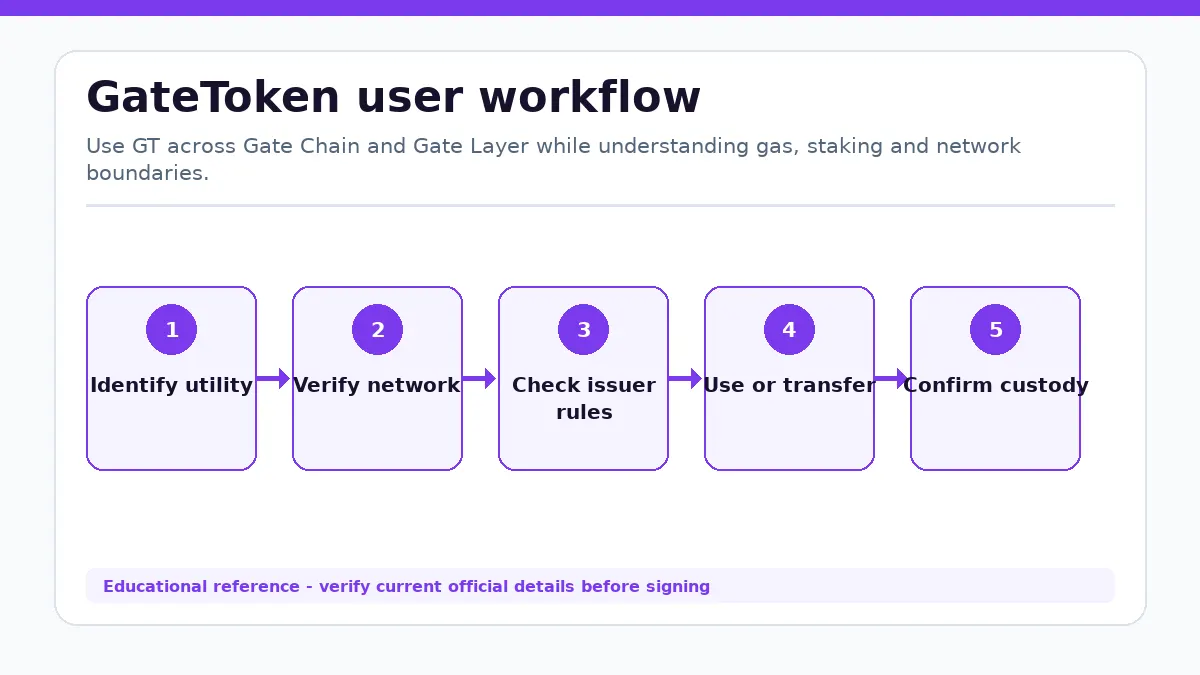
GateToken workflow from the first user decision to a verified outcome.
Dynamic gas pricing
Gate Chain documentation describes an EIP-1559-style fee model with a dynamically adjusted base fee and an optional priority tip. The base-fee component is burned under the documented mechanism. Wallet estimates should use the current network rather than a hardcoded GT amount.
Gate Layer also charges GT for L2 execution and can include a settlement or data component. A low displayed L2 fee does not remove bridge fees, exchange withdrawal charges or the cost of a separate L1 transaction. Users should keep enough GT on the destination layer for follow-up actions.
Why GateToken's Design Matters
The same GT symbol appears on two connected execution layers.
Gate Chain is the base layer
Gate Chain is an EVM-compatible Layer 1 that uses GT for value, transaction fees, staking and governance. Its validators and consensus rules secure the base chain. A Gate Chain address can use familiar EVM tooling, but users must still select the correct network and official chain parameters.
Gate Layer is an OP Stack Layer 2 that uses Gate Chain for settlement and data availability under the documented architecture. It has its own chain state and transaction explorer. A GT balance on Gate Chain does not automatically appear on Gate Layer without a supported transfer or bridge route.
Exchange custody is a third context
A GT balance shown inside Gate is a custodial account entry until withdrawn. The exchange can support specific networks, minimums and product benefits that differ from self-custody protocol behavior. Always select the actual withdrawal network instead of relying on the shared ticker.
GT does not represent shares in Gate and does not guarantee access to every exchange or network product. Regional eligibility, custody and platform terms remain separate risks.
GT staking affects base-layer consensus rather than merely earning an account promotion.
Validator and delegation roles
Current Gate Chain materials describe GT staking as the basis for validator participation and governance weight. Validators propose and validate blocks, while delegators depend on validator performance and the active reward and slashing rules. Gate Layer execution ultimately relies on the connected base architecture.
Staking returns are variable, and delegation can involve lock, unbonding or validator risk. Verify the official staking destination and current terms. A high reward display does not prove validator reliability or compensate for market and custody risk.
L1, L2 and exchange support must be checked independently.
Before transferring GT
Confirm Gate Chain or Gate Layer, verify the recipient supports that exact network, and inspect the explorer after sending. Do not send directly between layers as an ordinary transfer. Review any bridge route, token representation and minimum received amount before signing.
Keep GT for gas, reject copied staking sites, and do not interpret a supply burn as a guaranteed return. When depositing to Gate, follow the current memo and network instructions shown for the account.
Choose the Next GT Resource
Match the next step to the active network.
L1, L2 or tools
Use Gate Chain documentation for consensus and gas, Gate Layer documentation for L2 transfers, and the tools directory for general transaction and address checks. Review Optimism for broader OP Stack context without assuming identical settlement rules.
Gate Chain provides the base settlement and staking layer, while Gate Layer is an OP Stack Layer 2 connected to it. Both use GT for fees, but they maintain different chain states, transaction histories and bridge workflows.
Holding GT does not guarantee exchange custody, withdrawal availability, discounts, redemption or issuer support. GT is the asset shown in the market snapshot. GT pays execution fees on Gate Chain and Gate Layer.
What GateToken users should verify and why this design differs
Gate Chain and Gate Layer parameters can change. Exchange product access depends on current account rules.
For GateToken, the practical sequence is Identify utility, Verify network, Check issuer rules, Use or transfer, Confirm custody. Confirm the official destination and current network, then inspect the final balance, position, receipt or documented exit state that actually completes the task: Use GT across Gate Chain and Gate Layer while understanding gas, staking and network boundaries.
GateToken Ecosystem use FAQ
What pays gas on Gate Chain?
GT pays Gate Chain transaction and contract-execution fees.
Does Gate Layer also use GT?
Yes. Current Gate Layer documentation identifies GT as its native gas token.
Are Gate Chain and Gate Layer balances identical?
No. They are separate network balances connected through supported transfer routes.
Known Limitations
Gate Chain and Gate Layer parameters can change.
Exchange product access depends on current account rules.
The page does not verify a bridge, validator or deposit route.
Market Data Methodology
The page uses a CoinGecko aggregated GT/USD snapshot. No exchange chart is rendered for this entity.
Market Snapshot Source
CoinGecko aggregated market data (GT/USD)
Cache
Snapshot cache is approximately 60 seconds.
Failure Handling
Verified cached data is labeled Cached or Delayed. Missing values remain unavailable.