Conflux (CFX): CFX Gas and Core Space Storage Collateral
Conflux is a public smart-contract network with Core Space and an EVM-compatible eSpace. CFX is the native asset used for fees and economic participation, while Core Space adds a distinct storage-collateral model. This page focuses on cFX Gas and Core Space Storage Collateral and the checks users need before sending funds, paying fees or using the network.
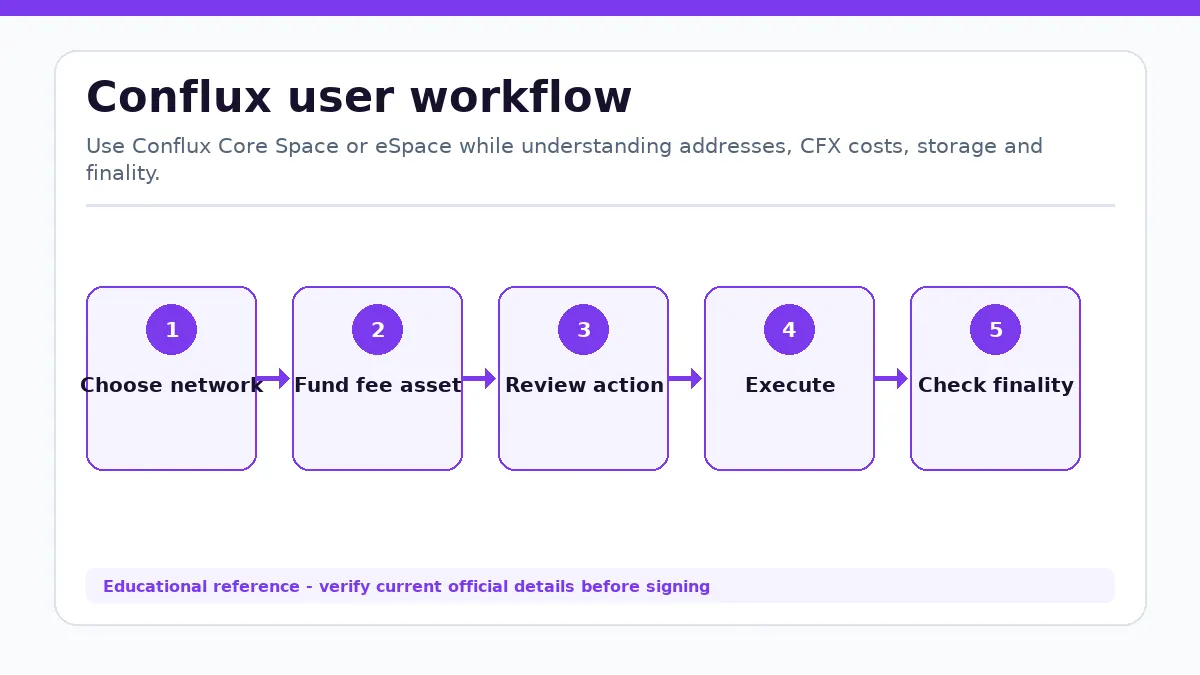
Use Conflux Core Space or eSpace while understanding addresses, CFX costs, storage and finality.
Subject:
Conflux
Market mode:
Snapshot Only
Fee asset:
CFX
Timezone:
UTC
This page does not estimate a live transaction, sponsor a contract, bridge CFX or verify a Conflux address.
Content ownership: BitcoinToolkit Editorial TeamTechnical references: Official protocol and developer documentation.Review approach: Technical explanations are checked against primary sources and updated when the network or asset changes.Last content review: Data integration last tested:
CFX Gas and Core Space Storage Collateral
Core Space can require refundable collateral in addition to execution gas.
Conflux workflow from the first user decision to a verified outcome.
Two different cost components
CFX pays gas in both spaces. In Core Space, writing new persistent state can also lock CFX as storage collateral. The collateral is based on storage occupied and can be returned when the state is removed or ownership changes. It should not be counted as a permanently spent fee in every case.
A Core Space transaction includes gas, gas price and storage limit considerations. The official estimate method returns gas and collateral information, but estimates can still require a margin. eSpace follows a more familiar Ethereum-style gas model and does not use the same storage-collateral mechanism.
Sponsorship can change who pays
Conflux contracts can have sponsors that cover gas or storage collateral for eligible users. A sponsored interaction can succeed without the sender paying every cost, but sponsorship has limits and can be exhausted. Users should not assume every call to the same application remains sponsored.
Wallet displays should distinguish estimated gas, locked collateral and sponsored amounts. The CFX market snapshot does not estimate any of them.
Conflux Transaction and Fee Checks
One consensus system supports two logically independent spaces.
Core Space uses Conflux-native conventions
Core Space is the original Conflux environment. It uses Conflux transaction formats and Base32 addresses beginning with a network prefix such as cfx. Its virtual machine resembles the EVM but includes Conflux-specific internal contracts, sponsorship and storage collateral.
eSpace exposes Ethereum-compatible RPC, transaction and address behavior for Solidity applications. It is not Ethereum Mainnet, and a 0x address on eSpace has its own balance and contracts. Core Space and eSpace communicate through the documented CrossSpaceCall mechanism rather than sharing application state automatically.
Address format is part of the route
Wallets and exchanges may support only one space or require an explicit network selection. Copying a Core Space address into an eSpace workflow, or assuming the matching account has the intended balance, can fail or send funds through an unsupported route.
Confirm the space, address format, explorer and token representation before transferring. An exchange can perform a supported conversion internally, but an ordinary transaction cannot cross spaces without the designated mechanism.
Mining orders activity while the PoS layer strengthens finality.
Concurrent blocks are not simply discarded
Conflux miners create proof-of-work blocks that can reference other recent blocks. Tree-Graph and the GHAST rule select a pivot chain and order the wider block graph into a deterministic transaction sequence, allowing concurrent blocks to contribute rather than treating every non-tip block as wasted.
PoS nodes sign pivot blocks to finalize the proof-of-work ordering. Mining and finality therefore have different roles. A wallet confirmation count and a PoS-finalized state are not necessarily the same signal, so high-value applications should use the documented finality status.
Space selection and storage accounting produce most avoidable errors.
Before signing
Check Core Space or eSpace, the address format, chain configuration and destination support. On Core Space, estimate both gas and storage collateral. Keep CFX available even if an application usually sponsors fees, because sponsorship can be unavailable.
Do not treat CrossSpaceCall as a general bridge guarantee or assume contracts share addresses and state. Verify token mappings, approvals and the final receiving balance on the correct explorer.
Use Conflux documentation for current RPC estimates and cross-space calls. Review Ethereum when comparing eSpace behavior, and use address or fee tools only after selecting the correct Conflux space. Confirm the destination explorer before broadcasting.
Proof-of-work miners produce concurrent blocks organized through Tree-Graph and GHAST ordering. A proof-of-stake layer signs pivot blocks for finality. Core Space and eSpace share underlying consensus but keep logically separate accounts, contracts and transaction formats.
A Conflux transaction can execute successfully while the application state, contract permission or later exit remains wrong for the user's goal. CFX is the asset shown in the market snapshot. CFX pays gas; Core Space can also lock CFX as storage collateral.
What Conflux users should verify and why this design differs
Conflux parameters and space tooling can change. Sponsored gas and collateral are conditional.
For Conflux, the practical sequence is Choose network, Fund fee asset, Review action, Execute, Check finality. Confirm the official destination and current network, then inspect the final balance, position, receipt or documented exit state that actually completes the task: Use Conflux Core Space or eSpace while understanding addresses, CFX costs, storage and finality.
Conflux Network use FAQ
Does CFX pay fees in both Conflux spaces?
Yes. CFX is the native fee asset, while Core Space can also require storage collateral.
Are Core Space and eSpace the same account state?
No. They are logically separate spaces with different transaction and address conventions.
What gives Conflux finality?
PoW miners order blocks through Tree-Graph and GHAST, while PoS voting finalizes pivot blocks.
Known Limitations
Conflux parameters and space tooling can change.
Sponsored gas and collateral are conditional.
The page does not estimate or validate a specific transaction.
Market Data Methodology
The page uses a CoinGecko aggregated CFX/USD snapshot. No exchange chart is rendered for this entity.
Market Snapshot Source
CoinGecko aggregated market data (CFX/USD)
Cache
Snapshot cache is approximately 60 seconds.
Failure Handling
Verified cached data is labeled Cached or Delayed. Missing values remain unavailable.