What the BNB Chain user is confirming
BNB Smart Chain validators use Proof of Staked Authority to propose blocks and cast Fast Finality votes, while EVM execution processes transactions and smart-contract calls against account-based state.
BNB Smart Chain is an EVM-compatible Layer 1 blockchain within the BNB Chain ecosystem, and BNB is its native asset. The network uses an account-based state model where externally owned accounts and contract accounts interact through transactions executed by the EVM. This page focuses on how BNB Smart Chain Gas and Transactions Work and the checks users need before sending funds, paying fees or using the network.
Help users understand how BNB Smart Chain gas works and make safer usage and transaction decisions for BNB Chain.
Use this page to check reference market data and understand how BNB Smart Chain accounts, gas and transactions work. It is educational reference material, not an executable exchange quote or trading recommendation.
BitcoinToolkit separates CoinGecko's aggregated USD reference from the Binance Spot BNB/USDT market, shows the source and age of each dataset, and provides sourced explanations of BNB units, gas, accounts, transactions and finality.
BNB Smart Chain validators use Proof of Staked Authority to propose blocks and cast Fast Finality votes, while EVM execution processes transactions and smart-contract calls against account-based state.
BNB Chain (BNB) is the asset profiled on this page.
BNB Chain (BNB) pays the applicable transaction cost.
BNB/USDT · Binance Spot · UTC
Long ranges automatically use a compatible candle interval so the chart stays within the supported candle limit.
Historical Binance Spot candles are available. JavaScript is required for current-candle updates.
| Time (UTC) | Open (USDT) | High (USDT) | Low (USDT) | Close (USDT) | Volume (BNB) |
|---|---|---|---|---|---|
| Oct 11, 2026 05:00:00 UTC | 748.41 USDT | 749.00 USDT | 747.33 USDT | 747.56 USDT | 1,097.30 BNB |
| Oct 11, 2026 04:00:00 UTC | 745.29 USDT | 748.68 USDT | 744.77 USDT | 748.41 USDT | 2,046.87 BNB |
| Oct 11, 2026 03:00:00 UTC | 748.84 USDT | 748.84 USDT | 745.13 USDT | 745.28 USDT | 2,854.09 BNB |
| Oct 11, 2026 02:00:00 UTC | 748.81 USDT | 749.52 USDT | 748.14 USDT | 748.84 USDT | 1,337.21 BNB |
| Oct 11, 2026 01:00:00 UTC | 747.78 USDT | 749.55 USDT | 747.46 USDT | 748.80 USDT | 1,979.99 BNB |
Market data: Binance Spot BNB/USDT
Charting library: TradingView Lightweight Charts
BNB Smart Chain is the EVM-compatible network, BNB is its native asset, and BEP-20 token balances are maintained by smart-contract state.
BNB Smart Chain
BNB/USDT
EVM Layer 1
BNB Smart Chain executes account-based transactions and EVM smart contracts within the broader BNB Chain ecosystem.
Native BNB is not a BEP-20 token. Native balances belong to protocol account state, while BEP-20 balances belong to token-contract storage.
BNB Smart Chain tracks account-based state containing balances, nonces, contract code and contract storage.
The network state maps addresses to account data and changes as valid transactions execute.
Externally owned accounts are controlled by private keys and can originate signed transactions.
Contract accounts are controlled by deployed EVM bytecode and execute when called.
A sender nonce orders transactions from an externally owned account and prevents replay on the same chain.
An account balance records native BNB assigned to the account.
Contract bytecode executes in the EVM when a call reaches the contract.
Contracts can maintain persistent storage that changes after successful execution.
One BNB equals 1,000,000,000,000,000,000 wei on BNB Smart Chain.
Wallets display BNB, gas prices are commonly quoted in gwei, and raw EVM transaction and RPC values use wei.
Transactions pay for EVM computation in gas, using BNB as the native fee asset.
Gas measures computational work.
The gas limit caps how much work a transaction may consume.
Gas used records the metered work consumed by execution.
Gas price states the amount of BNB-denominated value offered per unit of gas.
The execution fee is determined by gas used and the effective per-gas price; wallet estimates can differ from final usage.
A transaction is created, signed, validated, propagated, executed by the EVM, recorded in a receipt, included in a block and later finalized.
BNB Smart Chain runs EVM smart contracts deployed as contract accounts.
Contract accounts contain code and can be called by transactions or other contracts.
Compiled bytecode executes in the EVM.
Contracts can read and update persistent storage.
Calls pass BNB value and encoded input data to contract code.
BEP-20 contracts maintain token balances, transfers and allowances.
Native BNB belongs to protocol state; BEP-20 balances are managed by token contracts.
BNB Smart Chain uses Proof of Staked Authority for block production and Fast Finality votes to finalize blocks when the required validator threshold is reached.
Proof of Staked Authority combines validator staking, elected validator participation and authority-based block production.
Active validators take turns proposing blocks and use separate voting keys to participate in Fast Finality voting under protocol rules.
A scheduled validator proposes a block containing an execution payload.
Fast Finality normally finalizes the chain within two blocks when at least two-thirds of validators vote normally. If finality votes are insufficient, the chain falls back to probabilistic finality, where additional confirmations increase confidence.
Applications requiring guaranteed finality should query the finalized block tag and must not treat block inclusion alone as finality.
Compare fees, execution, security and user workflow before choosing between BNB Chain and Avalanche.
The CoinGecko USD snapshot and Binance Spot BNB/USDT chart are separate datasets and can differ. Market reference data may be delayed or unavailable when a provider cannot return validated values.
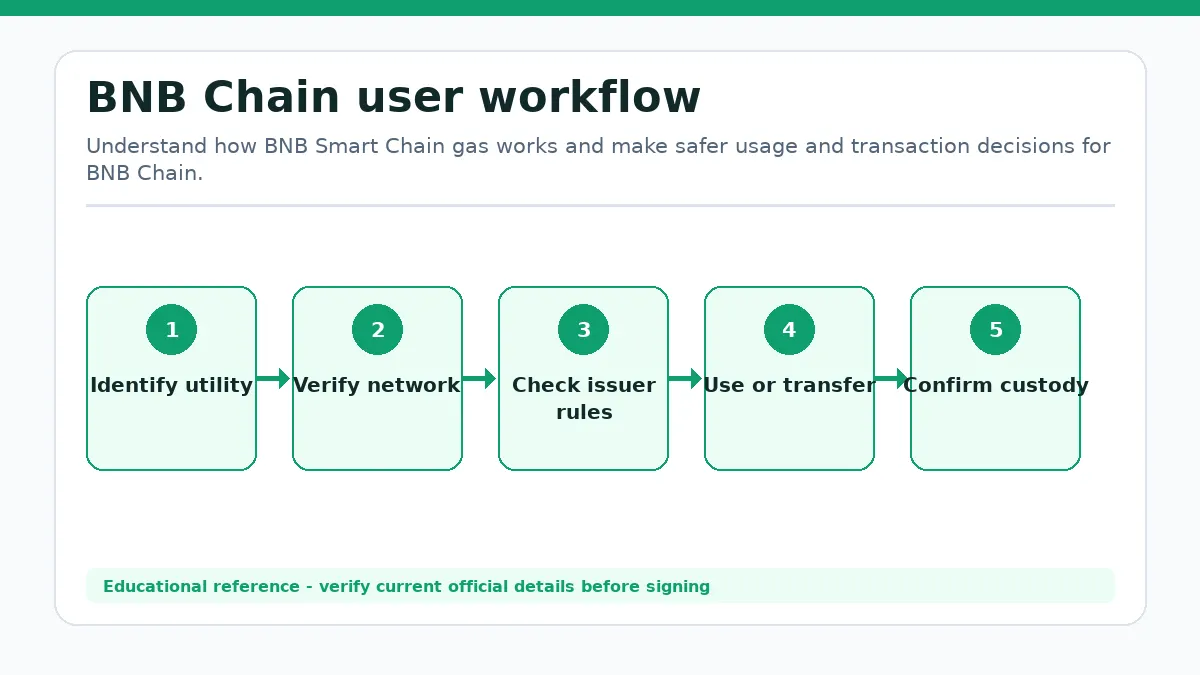
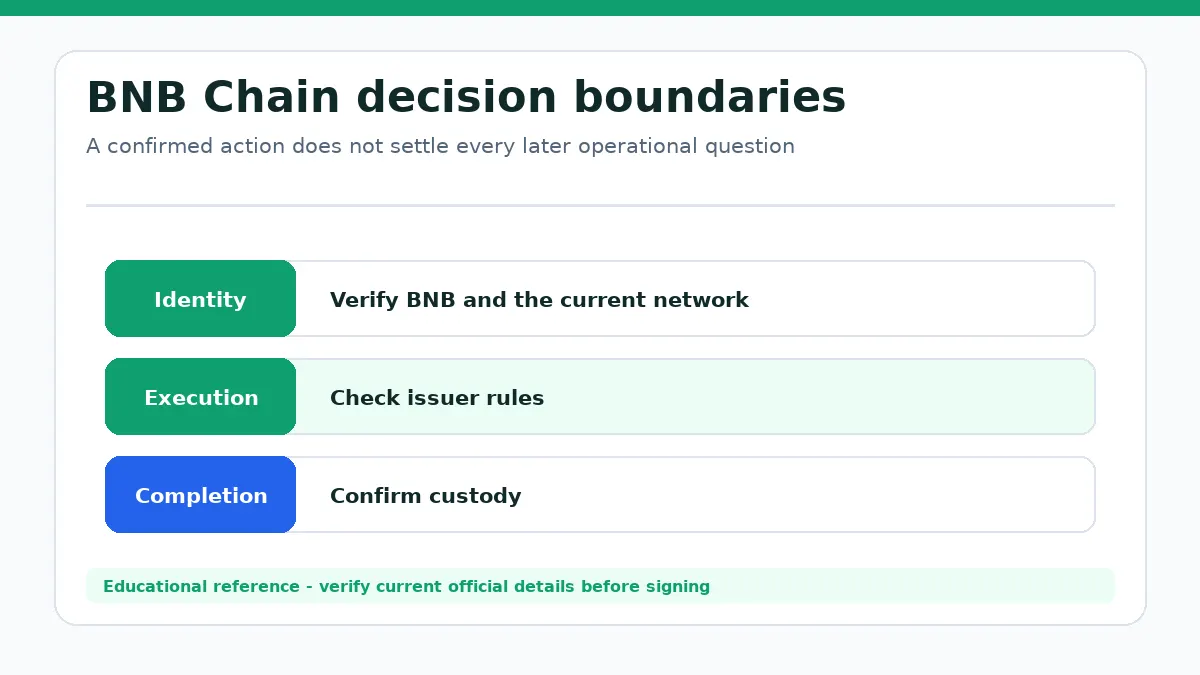
For BNB Chain, the practical sequence is Identify utility, Verify network, Check issuer rules, Use or transfer, Confirm custody. Confirm the official destination and current network, then inspect the final balance, position, receipt or documented exit state that actually completes the task: Understand how BNB Smart Chain gas works and make safer usage and transaction decisions for BNB Chain.
Before treating the BNB Chain task as complete, confirm each of these states separately: Identify utility, Verify network, Check issuer rules, Use or transfer, Confirm custody. The final check should use the current official interface, explorer or documented accounting state rather than a copied ticker or an interface notification alone.
When an action fails, preserve the transaction hash or application reference, then compare it with the current official documentation before retrying. Repeating the same action without identifying the failed step can duplicate approvals, fees, deposits or position changes.
The fee asset and the profiled BNB asset should be treated as separate roles unless current documentation proves they are the same for this route. A user may hold the market asset and still lack the network balance, allowance or service payment required to finish the action.
Use dated primary sources for parameters that can change, including supported networks, contract addresses, validator rules, withdrawal timing, service availability and fee behavior. A previously valid workflow can become incomplete after a migration, upgrade or application-policy change.
Native BNB is the protocol asset used for value transfer and gas. BEP-20 token balances are maintained by contracts.
Transaction execution fees are paid in native BNB and depend on gas used and the effective gas price.
No. CoinGecko supplies an aggregated USD reference, while the chart represents Binance Spot BNB/USDT.
The snapshot uses CoinGecko aggregated USD data. The chart uses Binance Spot BNB/USDT data. Their providers, venue coverage and quote currencies differ, so displayed values can differ. Missing or malformed values remain unavailable; verified cached data must be labeled Cached or Delayed.
The snapshot is CoinGecko aggregated USD data. The chart is Binance Spot BNB/USDT data. Their providers, venue coverage and quote currencies differ, so displayed values can differ.
Selected primary sources support the operational explanations. Market-provider attribution remains separate.
Verified technical content, reviewed sources and update history.