Mina Protocol (MINA): MINA Transactions Use Accounts, Nonces and Fees
Mina Protocol is a proof-of-stake Layer 1 that uses recursive zero-knowledge proofs to let users verify a compact proof of the current chain state. MINA pays fees and participates in staking. This page focuses on mINA Transactions Use Accounts, Nonces and Fees and the checks users need before sending funds, paying fees or using the network.
Use MINA and evaluate zkApps or delegation while understanding the succinct proof model.
Subject:
Mina Protocol
Market mode:
Snapshot Only
Fee asset:
MINA
Timezone:
UTC
This page does not generate a proof, deploy a zkApp, calculate staking returns, select a producer or recover a Mina account.
Content ownership: BitcoinToolkit Editorial TeamTechnical references: Official protocol and developer documentation.Review approach: Technical explanations are checked against primary sources and updated when the network or asset changes.Last content review: Data integration last tested:
MINA Transactions Use Accounts, Nonces and Fees
The native asset funds both ordinary payments and programmable account updates.
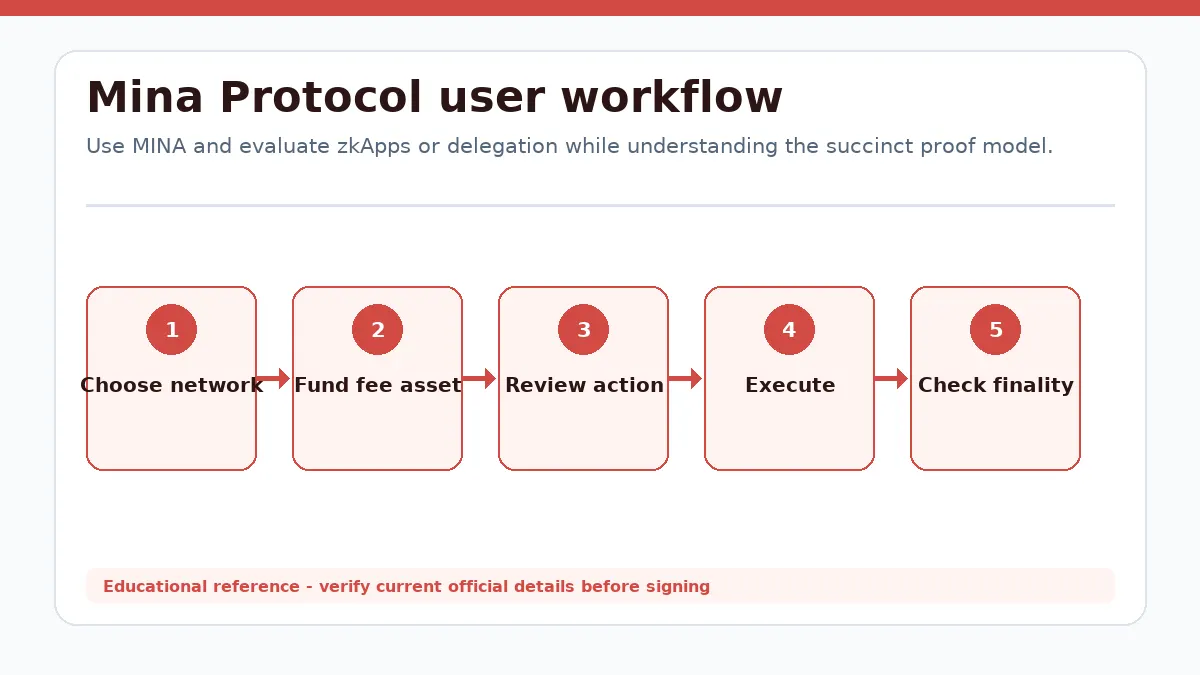
Mina Protocol workflow from the first user decision to a verified outcome.
Before sending
A Mina payment identifies a sender, receiver, amount, fee and account nonce. MINA pays the fee. A stale nonce, insufficient available balance or incorrect network can prevent inclusion. Newly funded accounts can also involve account-creation cost behavior that wallets should present before signing.
Use the wallet preview to check the receiving public key, total debit and fee. Do not copy Ethereum gas fields or Bitcoin UTXO assumptions onto Mina. Wait for the receiving service to recognize the transaction and required chain depth before treating a deposit as available.
Where Mina Protocol Differs for Users
A recursive proof represents the validity of the current state transition history.
What the compact proof means
Mina recursively combines proofs so a verifier can check a small cryptographic proof of the current ledger state instead of replaying every historical block. This makes verification lighter for clients. It does not mean every transaction, archive, index or application data set is compressed into one tiny downloadable file.
Archive nodes and data services remain important for historical queries, analytics and application indexing. A wallet verifying the chain proof still depends on correct account data and network access. Succinct verification reduces one resource burden; it does not remove key security, endpoint reliability or application-level risk.
Mina programs describe state changes and the authorization required for them.
Proofs, signatures and permissions
A zkApp transaction can contain multiple account updates. Each update declares changes and satisfies the account permissions through a proof, a signature or another allowed authorization. Zero-knowledge logic can prove that a condition is true without exposing every private input used to establish it.
Privacy is not automatic for every field. Public keys, fees and declared state changes can still be visible, while an application chooses which values remain private. Users should inspect the action, contract address, permissions and fee payer rather than assuming the zkApp label makes an interaction private or safe.
Block Producers and SNARK Workers Have Different Jobs
Consensus participation and proof production are connected but distinct.
Delegation and proof-market checks
Block producers are selected under Mina proof-of-stake rules and include transactions, fees and required proof work. Holders can delegate staking power without giving the producer permission to spend their MINA. SNARK workers separately produce proofs and can sell completed work through the protocol marketplace.
Delegation rewards depend on producer performance, commission and payout practice, and are not guaranteed by a wallet interface. Verify the producer key, payment policy and timing. For node operation, current hardware, archive and uptime requirements matter even though end-user verification remains succinct.
Match the check to a payment, zkApp or delegation workflow.
A practical sequence
For a payment, verify the public key, nonce, fee and available balance. For a zkApp, inspect every account update and authorization request. For delegation, confirm the producer identity and payout terms while retaining enough liquid MINA for future fees.
Do not treat succinct verification as a complete historical index, or zero knowledge as universal transaction privacy. Use current Mina documentation for protocol behavior and developer tools for contract testing before committing mainnet funds.
Block producers order transactions and maintain consensus, while SNARK work proves ledger transitions so the current state can be verified without downloading an ever-growing full history. zkApps express programmable account updates with zero-knowledge proofs.
A Mina Protocol transaction can execute successfully while the application state, contract permission or later exit remains wrong for the user's goal. MINA is the market asset shown in the snapshot. MINA pays transaction and zkApp account-update fees.
What Mina Protocol users should verify and why this design differs
Protocol upgrades can change zkApp and node behavior. Delegation payouts depend on the selected producer.
For Mina Protocol, the practical sequence is Choose network, Fund fee asset, Review action, Execute, Check finality. Confirm the official destination and current network, then inspect the final balance, position, receipt or documented exit state that actually completes the task: Use MINA and evaluate zkApps or delegation while understanding the succinct proof model.
Mina Protocol Network use FAQ
What pays Mina fees?
MINA pays native payment and zkApp transaction fees.
Does Mina store no history?
No. Succinct proofs make state verification compact, while archive services still retain historical data.
Does delegation let a producer spend my MINA?
Delegation assigns staking power and does not grant ordinary spending authority.
Known Limitations
Protocol upgrades can change zkApp and node behavior.
Delegation payouts depend on the selected producer.
The page does not inspect a proof or account update.
Market Data Methodology
The page uses a CoinGecko aggregated MINA/USD snapshot. No exchange chart is rendered for this entity.
Market Snapshot Source
CoinGecko aggregated market data (MINA/USD)
Cache
Snapshot cache is approximately 60 seconds.
Failure Handling
Verified cached data is labeled Cached or Delayed. Missing values remain unavailable.