MultiversX (EGLD): EGLD Pays Network and Contract Costs
MultiversX is a smart-contract network that partitions accounts and execution across shards. EGLD is its native currency for fees, staking, validator security and transferable value. This page focuses on eGLD Pays Network and Contract Costs and the checks users need before sending funds, paying fees or using the network.
Use or stake EGLD while understanding sharding, fees, token handling and finality.
Subject:
MultiversX
Market mode:
Snapshot Only
Fee asset:
EGLD
Timezone:
UTC
This page does not estimate a live fee, select a staking provider, validate an ESDT identifier or audit a smart contract.
Content ownership: BitcoinToolkit Editorial TeamTechnical references: Official protocol and developer documentation.Review approach: Technical explanations are checked against primary sources and updated when the network or asset changes.Last content review: Data integration last tested:
EGLD Pays Network and Contract Costs
Fees combine minimum execution and data-related components.
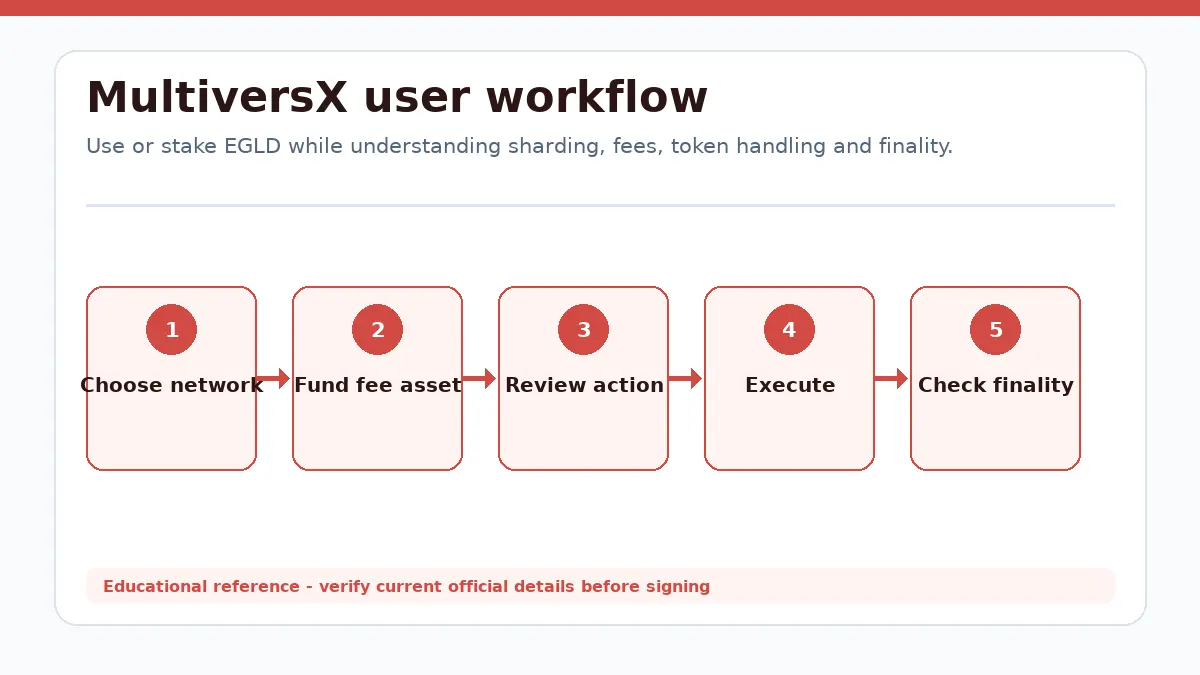
MultiversX workflow from the first user decision to a verified outcome.
Gas limit and processing cost
A simple EGLD transfer uses a protocol minimum gas allowance plus any cost for attached data. Smart-contract and token operations consume more gas according to the work performed. EGLD pays these fees even when the transferred asset is an ESDT token.
Wallets estimate gas before signing, but contract paths and cross-shard messages can affect the total workflow. Keep liquid EGLD for fees and distinguish gas from application charges, swap price impact and any amount locked in staking.
MultiversX Risks Before Completion
A MultiversX address belongs to one execution shard at a time.
Execution shards and the Metachain
MultiversX distributes accounts, smart contracts and transaction processing across execution shards. Address-derived shard assignment determines where state is held. The Metachain coordinates validator assignments, shard headers and other network-level information rather than executing ordinary user contracts in the same way as an execution shard.
Adaptive sharding allows the system to reorganize validator and state responsibilities as protocol conditions change. This is not the same as running independent blockchains: the shards form one network and communicate through authenticated cross-shard messages.
Cross-shard actions have stages
A transfer between accounts in different shards produces a source-shard transaction and destination-shard processing. Smart-contract calls can create additional asynchronous results. An explorer may therefore show related hashes and stages rather than one immediate state change everywhere.
Applications should wait for the required destination result before treating the workflow as complete. A source transaction that is final does not always mean every cross-shard effect has already executed.
Validators secure individual shards while the protocol rotates assignments.
Validator selection and signatures
MultiversX Secure Proof of Stake selects validators using stake and verifiable randomness, then aggregates BLS signatures for blocks. Validators are shuffled among shards over time to reduce persistent control. Current documentation describes single-block deterministic finality after the Andromeda upgrade when the required validator threshold signs.
Delegators can participate through staking providers without operating a validator, but depend on provider performance, fees and contract behavior. Staking locks or delays access to EGLD and can expose participants to protocol penalties. Current minimums and unbonding rules should be checked before committing.
Token identity and asynchronous completion need explicit checks.
Before sending or staking
Confirm the bech32 address, ESDT identifier, amount and destination support. Keep EGLD for fees and wait for any destination-shard result. Do not select a token only by ticker or assume an EVM contract address maps to MultiversX.
For staking, review provider fee, performance, capacity and unbonding terms. Do not stake the entire liquid balance or treat an estimated reward as fixed. Verify every wallet and staking domain through current MultiversX resources.
Continue with sharding, staking or token handling.
Network docs or tools
Use current MultiversX documentation for transaction status, gas and validator rules. Compare NEAR for a different sharding approach, or use wallet tools after verifying the official ESDT identifier and network. Track destination-shard completion before continuing.
For a contract workflow, record the source transaction hash and any destination result so support teams can distinguish pending cross-shard delivery from an application-level failure.
Adaptive state sharding assigns accounts and transactions across execution shards, while a Metachain coordinates shard information. Secure Proof of Stake selects validators and, under the current Andromeda-era design, uses broad validator signing for deterministic block finality.
A MultiversX transaction can execute successfully while the application state, contract permission or later exit remains wrong for the user's goal. EGLD is the asset shown in the market snapshot. EGLD pays MultiversX transaction, data and smart-contract fees.
What MultiversX users should verify and why this design differs
Protocol parameters and validator requirements can change. Cross-shard completion depends on the full message path.
For MultiversX, the practical sequence is Choose network, Fund fee asset, Review action, Execute, Check finality. Confirm the official destination and current network, then inspect the final balance, position, receipt or documented exit state that actually completes the task: Use or stake EGLD while understanding sharding, fees, token handling and finality.
MultiversX Network use FAQ
What pays MultiversX fees?
EGLD pays transfers, data and smart-contract gas.
What is the Metachain?
It coordinates shard and validator information rather than serving as an ordinary execution shard.
Is a cross-shard transfer complete after the source step?
Not always. The destination shard must process the authenticated message and resulting state change.
Known Limitations
Protocol parameters and validator requirements can change.
Cross-shard completion depends on the full message path.
The page does not validate an ESDT token or staking provider.
Market Data Methodology
The page uses a CoinGecko aggregated EGLD/USD snapshot. No exchange chart is rendered for this entity.
Market Snapshot Source
CoinGecko aggregated market data (EGLD/USD)
Cache
Snapshot cache is approximately 60 seconds.
Failure Handling
Verified cached data is labeled Cached or Delayed. Missing values remain unavailable.