Tezos is a proof-of-stake smart-contract network with protocol-level governance and upgrades. XTZ, also called tez, is its native currency for fees, staking, delegation and governance weight. This page focuses on common Tezos Staking Mistakes and the checks users need before sending funds, paying fees or using the network.
Use and stake XTZ while understanding Tezos operations, baker risk, finality and self-amending governance.
Subject:
Tezos
Market mode:
Snapshot Only
Fee asset:
XTZ
Timezone:
UTC
This page does not estimate rewards, select a baker, simulate a contract or predict a governance outcome.
Content ownership: BitcoinToolkit Editorial TeamTechnical references: Official protocol and developer documentation.Review approach: Technical explanations are checked against primary sources and updated when the network or asset changes.Last content review: Data integration last tested:
Common Tezos Staking Mistakes
Delegation and staking labels are not interchangeable.
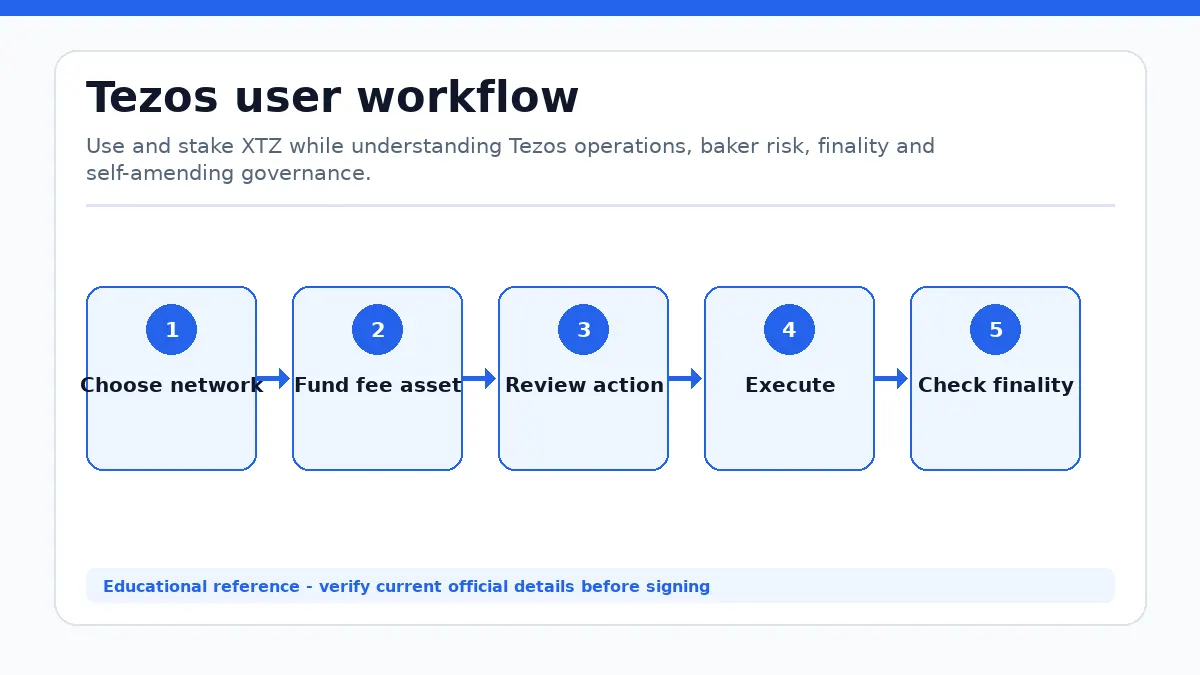
Tezos workflow from the first user decision to a verified outcome.
Before choosing a baker
Check whether the wallet action delegates, stakes or both. Review baker capacity, fees, reliability and slashing history. Keep liquid tez for transaction fees and understand the current unstaking delay before locking funds.
Use a current wallet and protocol source, verify the baker address, and do not assume a delegator is protected by the same rules as a direct staker. For contracts, verify the network, address and entrypoint instead of relying on a token ticker.
Why Tezos's Design Matters
Each participation method changes control, liquidity and risk differently.
Bakers produce and attest blocks
Tezos validators are called bakers. A baker runs node and baking software, supplies stake and is selected for block-production and attestation rights according to baking power. Misbehavior such as double signing can trigger slashing, while missed opportunities reduce rewards.
Running a baker requires operational infrastructure and the current minimum baking power. Holding XTZ alone does not make an account a baker. Protocol parameters can change through upgrades, so old staking thresholds and timing should not be treated as permanent.
Delegated tez stays liquid; staked tez is locked
Delegation assigns an account to one baker and contributes a reduced weight to baking power while the tez remains spendable. Any delegation reward is distributed by the baker under its policy. Direct staking with that baker locks the selected tez, gives stronger baking weight and receives protocol rewards automatically.
Staked tez can be exposed to slashing if the baker misbehaves and requires an unstaking delay before it becomes liquid. Keep an unstaked balance for future fees. Choosing a baker therefore involves performance, capacity, fee and security checks rather than only the advertised rate.
A Tezos transaction can include several kinds of protocol operation.
Fees are paid in tez
XTZ pays fees for transfers, contract calls, delegation changes and other manager operations. Wallets estimate gas and storage-related costs according to the active protocol. An operation can fail while still consuming part of its fee, and a batch can contain multiple operations with ordered effects.
Tezos documentation distinguishes operations from the narrower transaction operation even though users often use the words interchangeably. Smart contracts can emit internal operations after an entrypoint executes. Review the destination, entrypoint, amount, fee and storage impact before signing.
Governance can alter rules that other networks often change through offchain coordination.
Proposal through activation
Tezos delegates can submit protocol proposals and vote through structured periods. A proposal that passes the required stages can be activated automatically, changing the economic protocol without creating a separate chain by default. Voting power derives from the delegate staking balance under current rules.
Tenderbake introduced fast deterministic finality, and later upgrades changed block times, staking and Data Availability Layer behavior. Users and developers should identify the active protocol rather than assuming a 2021 explanation still describes current Tezos.
Continue with staking, governance or smart-contract context.
Baker, protocol or tools
Use current Tezos documentation and the official staking application for live rules. Compare Ethereum for a different proof-of-stake and contract model, or use wallet tools before signing an operation. Recheck the active protocol version first.
Bakers propose and attest blocks under the current proof-of-stake protocol. Users can delegate liquid tez or stake locked tez with a baker, while delegates participate in the self-amendment process that can activate protocol upgrades.
A Tezos transaction can execute successfully while the application state, contract permission or later exit remains wrong for the user's goal. XTZ is the asset shown in the market snapshot. XTZ pays Tezos operation and smart-contract fees.
What Tezos users should verify and why this design differs
Tezos parameters can change through protocol amendments. Baker policies and rewards vary.
For Tezos, the practical sequence is Choose network, Fund fee asset, Review action, Execute, Check finality. Confirm the official destination and current network, then inspect the final balance, position, receipt or documented exit state that actually completes the task: Use and stake XTZ while understanding Tezos operations, baker risk, finality and self-amending governance.
Tezos Network use FAQ
What pays Tezos transaction fees?
XTZ, also called tez, pays operation and contract fees.
Is delegation the same as staking?
No. Delegated tez stays liquid and has different reward and risk treatment from locked stake.
How does Tezos upgrade?
Delegates vote through the self-amendment process, and accepted protocols can activate onchain.
Known Limitations
Tezos parameters can change through protocol amendments.
Baker policies and rewards vary.
The page does not evaluate a baker, contract or governance proposal.
Market Data Methodology
The page uses a CoinGecko aggregated XTZ/USD snapshot. No exchange chart is rendered for this entity.
Market Snapshot Source
CoinGecko aggregated market data (XTZ/USD)
Cache
Snapshot cache is approximately 60 seconds.
Failure Handling
Verified cached data is labeled Cached or Delayed. Missing values remain unavailable.