Flow (FLOW): Specialized Nodes Process Different Parts of a Transaction
Flow is a proof-of-stake Layer 1 with a multi-role node architecture and two smart-contract environments: Cadence and Flow EVM. FLOW is the native asset used for fees and staking. This page focuses on specialized Nodes Process Different Parts of a Transaction and the checks users need before sending funds, paying fees or using the network.
Use FLOW, Cadence and Flow EVM with the correct account, fee and cross-VM workflow.
Subject:
Flow
Market mode:
Snapshot Only
Fee asset:
FLOW
Timezone:
UTC
This page does not deploy a contract, bridge an asset, sponsor a fee, delegate FLOW or validate an application.
Content ownership: BitcoinToolkit Editorial TeamTechnical references: Official protocol and developer documentation.Review approach: Technical explanations are checked against primary sources and updated when the network or asset changes.Last content review: Data integration last tested:
Specialized Nodes Process Different Parts of a Transaction
Flow pipelines work while retaining protocol-level verification.
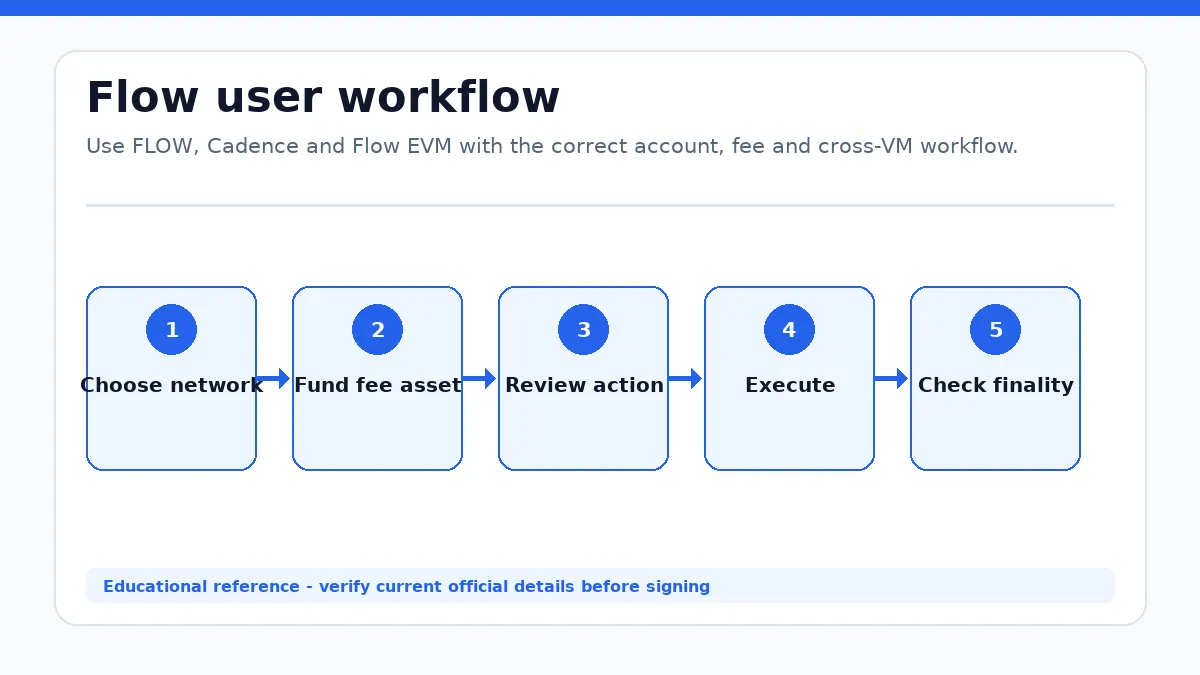
Flow workflow from the first user decision to a verified outcome.
Collection through access
Collection nodes batch transaction data, consensus nodes order collections, execution nodes compute state changes, verification nodes check execution and access nodes serve clients. Specialization allows heavy execution to scale without asking every participant to perform every role.
For users, submission and finalization are separate observations. An access endpoint can accept a transaction before the full execution result is sealed. Applications should surface status changes and error details instead of equating a transaction ID with success. Endpoint availability also remains an operational dependency.
Flow Transaction and Fee Checks
The intended application determines which runtime and wallet workflow to use.
Two execution environments
Cadence is Flow native programming with resource-oriented assets and capability-based access. Flow EVM supports Solidity and familiar EVM tooling. Both settle through Flow, but contracts, addresses, token representations and wallet connections are not automatically interchangeable between the environments.
Before signing, identify whether the application is Cadence or EVM, match the destination format and inspect any cross-VM conversion step. A wallet showing the same FLOW ticker in two interfaces does not prove that a token or NFT can be sent directly to the other runtime without a supported path.
Flow Accounts Support Keys, Resources and Fee Sponsorship
Account capabilities can improve usability but require precise permission review.
What to inspect before signing
Cadence accounts can hold several keys with weights and authorization scopes, while resources live in account storage and are exposed through capabilities. Flow transactions can separate proposer, payer and authorizer roles, allowing one account to sponsor fees for another user. FLOW remains the native fee asset at the protocol level.
Fee sponsorship is not proof that the application is trustworthy. Review the Cadence script, authorizers, storage changes and capability links. In Flow EVM, inspect ordinary EVM call data, allowances, nonce and gas behavior. The two signing experiences should not be collapsed into one generic approval message.
Node requirements and delegation outcomes depend on protocol epochs.
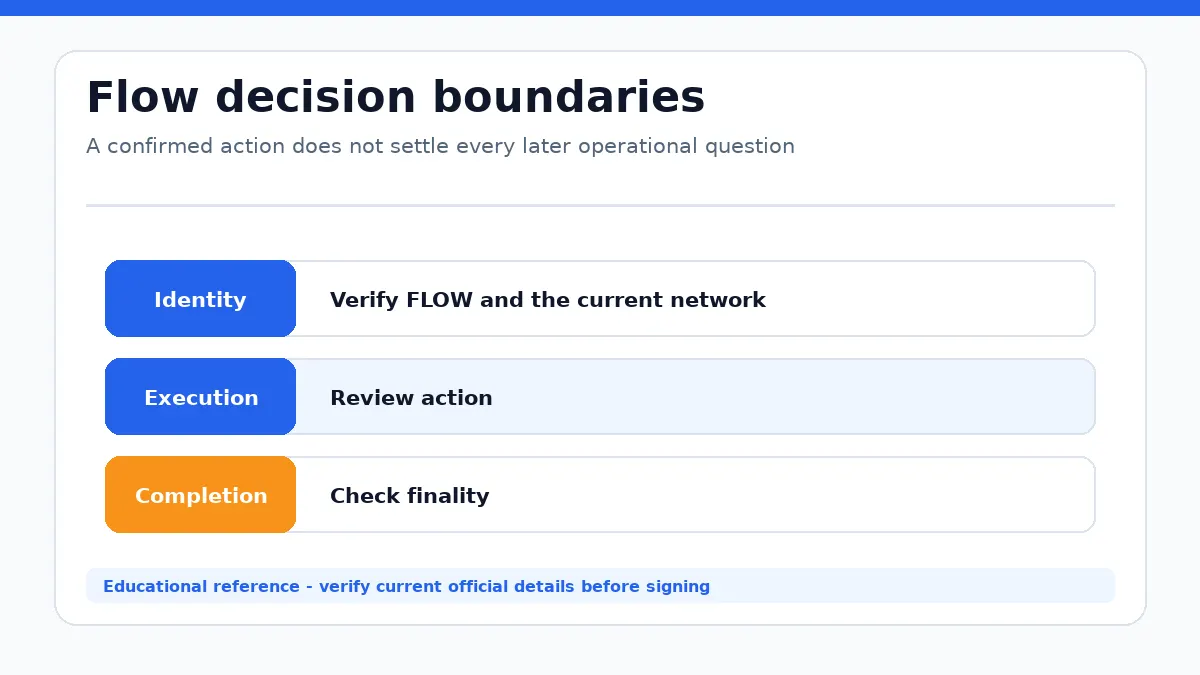
Flow confirmation does not settle every later operational question.
Staking and epoch checks
Flow node operators register a role, network information, keys and FLOW stake. Delegators can assign FLOW to an operator without running the infrastructure themselves. Rewards combine protocol issuance and fee-related economics, while slashing and removal rules address specified misbehavior.
Check the current epoch schedule, operator identity, commission, minimums and withdrawal timing before staking. A previous reward rate is not guaranteed, and delegation does not validate applications run on Flow. Keep enough liquid FLOW for transactions and account management.
Confirm the runtime before choosing a wallet or developer path.
Cadence, EVM or staking
For Cadence, verify the script, resources and account capabilities. For Flow EVM, verify the EVM address, chain configuration and token contract. For cross-VM movement, use the documented bridge or controlled-account path and confirm both resulting balances.
For staking, review the current node or delegation schedule. Do not paste a Cadence address into an EVM form, assume a sponsored transaction has no economic cost or treat transaction submission as final execution.
Flow separates collection, consensus, execution, verification and access responsibilities while preserving one protocol. Cadence uses resource-oriented accounts, and Flow EVM provides an EVM-equivalent environment connected through native cross-VM mechanisms.
A Flow transaction can execute successfully while the application state, contract permission or later exit remains wrong for the user's goal. FLOW is the asset shown in the market snapshot. FLOW pays Cadence and Flow EVM transaction fees.
What Flow users should verify and why this design differs
Runtime and cross-VM features can change after upgrades. Wallet support differs between Cadence and Flow EVM.
For Flow, the practical sequence is Choose network, Fund fee asset, Review action, Execute, Check finality. Confirm the official destination and current network, then inspect the final balance, position, receipt or documented exit state that actually completes the task: Use FLOW, Cadence and Flow EVM with the correct account, fee and cross-VM workflow.
Flow Network use FAQ
What pays fees on Flow?
FLOW is the native fee asset for Flow transactions, including the Flow EVM environment.
Are Cadence and Flow EVM addresses interchangeable?
No. They use different account and contract interfaces, with supported cross-VM mechanisms between them.
Does every Flow node perform the same role?
No. Flow separates collection, consensus, execution, verification and access work.
Known Limitations
Runtime and cross-VM features can change after upgrades.
Wallet support differs between Cadence and Flow EVM.
The page does not inspect a script, contract or staking operator.
Market Data Methodology
The page uses a CoinGecko aggregated FLOW/USD snapshot. No exchange chart is rendered for this entity.
Market Snapshot Source
CoinGecko aggregated market data (FLOW/USD)
Cache
Snapshot cache is approximately 60 seconds.
Failure Handling
Verified cached data is labeled Cached or Delayed. Missing values remain unavailable.