IOTA (IOTA): IOTA Pays Gas and Can Fund Storage Deposits
IOTA is now a programmable proof-of-stake Layer 1 using the Move object model. The IOTA token pays gas, supports staking and can be locked as a refundable storage deposit for onchain objects. This page focuses on iOTA Pays Gas and Can Fund Storage Deposits and the checks users need before sending funds, paying fees or using the network.
Use the current IOTA Move network with the correct object, gas and staking assumptions.
Subject:
IOTA
Market mode:
Snapshot Only
Fee asset:
IOTA
Timezone:
UTC
This page does not migrate legacy funds, inspect an object, delegate stake, estimate gas or validate a Move package.
Content ownership: BitcoinToolkit Editorial TeamTechnical references: Official protocol and developer documentation.Review approach: Technical explanations are checked against primary sources and updated when the network or asset changes.Last content review: Data integration last tested:
IOTA Pays Gas and Can Fund Storage Deposits
Execution cost and persistent state have related but distinct charges.
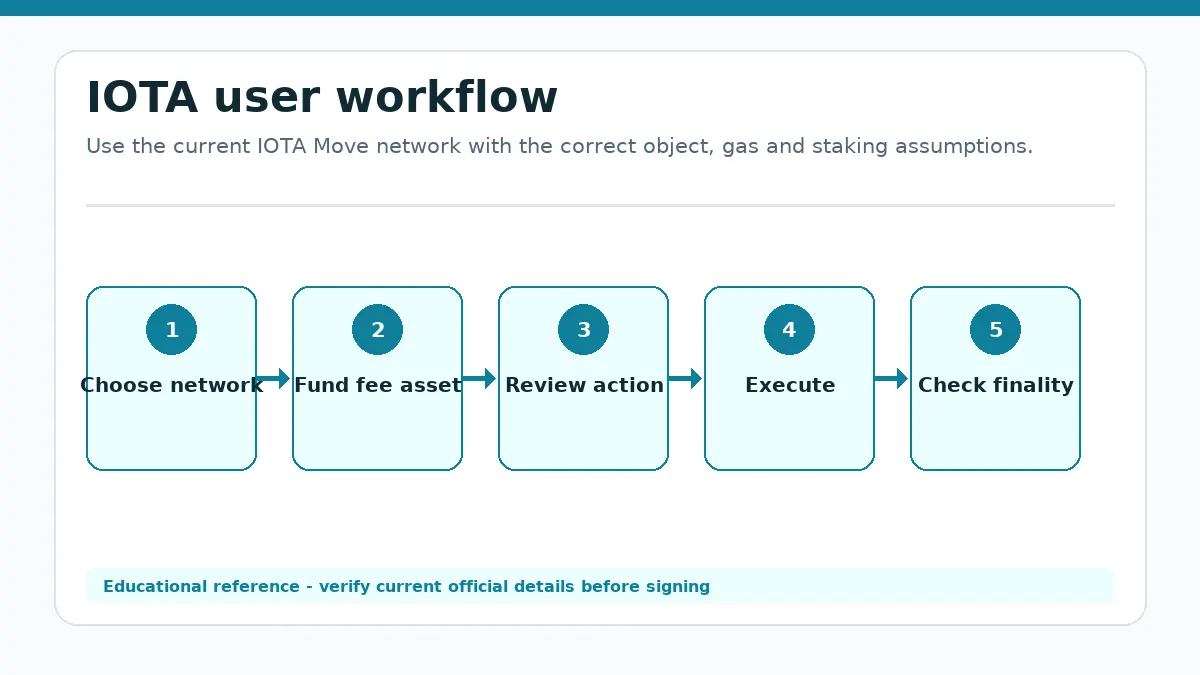
IOTA workflow from the first user decision to a verified outcome.
Computation, tips and storage
IOTA pays the gas budget for transaction computation, and a user may add a priority tip during congestion. Creating persistent objects can also lock IOTA as a storage deposit. That deposit is not identical to a burned fee and may be recoverable when the corresponding object data is deleted under protocol rules.
Check the total wallet preview rather than only the transfer amount. Keep a liquid IOTA balance for future execution and understand which objects will remain after the call. An application can create more state than a simple transfer, so its storage and gas impact can be different even when the asset amount is small.
IOTA Risks Before Completion
Older articles about fee-free coordinator-era IOTA do not describe the current transaction model.
Use current network assumptions
IOTA Rebased introduced a Move execution environment, delegated proof of stake, validators, gas fees and object-based state. Users should not rely on legacy wallet instructions, old address formats or claims that every transfer is feeless. The current IOTA token remains the network asset, but the protocol behavior around it has materially changed.
Before moving funds, confirm that the wallet, exchange and application support the current mainnet. Legacy migration can require a dedicated official path. Sending to a destination that only recognizes an older representation can create a support problem even when the ticker looks unchanged.
Object ownership determines how state can be accessed and ordered.
Move state and transaction inputs
An IOTA object has an identifier, owner, version and type. A transaction can consume object references, call Move functions and produce updated or new objects. Owned objects can often follow a direct owner-authorized path, while shared objects require network ordering because several users may attempt to change the same state.
Wallets should show the package, function, objects and expected effects before signing. A familiar token symbol does not reveal the object type or application authority. Developers must also account for object version changes and failed preconditions when constructing transactions.
Validators Order Shared Activity and Create Final Checkpoints
Consensus and application success are separate checks.
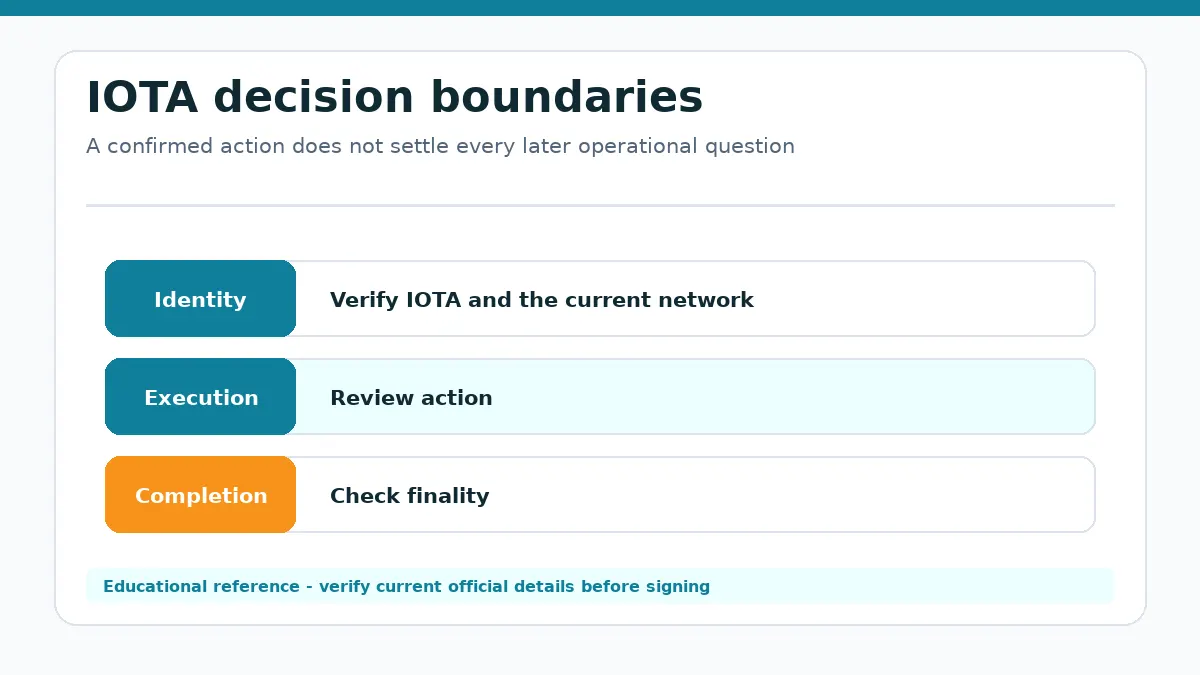
IOTA confirmation does not settle every later operational question.
Staking and settlement
Validators participate in delegated proof of stake and use the current Starfish consensus path to order transactions that touch shared objects. Executed effects are accumulated into checkpoints that provide an authenticated history. Delegators assign staking power to validators and receive protocol rewards after commission under current epoch rules.
Review validator performance, commission, epoch timing and withdrawal conditions before delegating. A finalized checkpoint proves protocol execution, not that a token, package or application is economically safe. Smart-contract, oracle and frontend risks remain outside consensus.
Use a current wallet path for the task in front of you.
Transfer, application or staking
For a transfer, verify the current network, recipient and total gas. For a Move application, inspect the package, function and object effects. For staking, confirm the validator and epoch rules. For legacy holdings, use only the current official migration guidance.
Do not assume old fee-free behavior, treat a storage deposit as a permanent fee or identify an object by ticker alone. Use IOTA documentation for current protocol behavior and wallet tools for destination checks.
Transactions create, mutate or transfer owned and shared objects. Shared-object activity passes through validator consensus, while checkpoints and execution results provide durable transaction records under the current Rebased architecture.
A IOTA transaction can execute successfully while the application state, contract permission or later exit remains wrong for the user's goal. IOTA is the market asset shown in the snapshot. IOTA pays gas and optional priority tips.
What IOTA users should verify and why this design differs
Rebased migration and protocol behavior can continue to evolve. Object effects depend on the Move package being called.
For IOTA, the practical sequence is Choose network, Fund fee asset, Review action, Execute, Check finality. Confirm the official destination and current network, then inspect the final balance, position, receipt or documented exit state that actually completes the task: Use the current IOTA Move network with the correct object, gas and staking assumptions.
IOTA Network use FAQ
Does current IOTA charge transaction fees?
Yes. IOTA pays gas, and transactions may also lock storage deposits for created objects.
What consensus does IOTA use?
Current documentation describes delegated proof of stake with Starfish consensus for shared-object ordering.
Can I use old IOTA wallet instructions?
Only if current official documentation explicitly says the legacy workflow remains supported.
Known Limitations
Rebased migration and protocol behavior can continue to evolve.
Object effects depend on the Move package being called.
The page does not inspect a transaction, object or validator.
Market Data Methodology
The page uses a CoinGecko aggregated IOTA/USD snapshot. No exchange chart is rendered for this entity.
Market Snapshot Source
CoinGecko aggregated market data (IOTA/USD)
Cache
Snapshot cache is approximately 60 seconds.
Failure Handling
Verified cached data is labeled Cached or Delayed. Missing values remain unavailable.