USDS is the native stablecoin of Sky Protocol. The canonical Ethereum token is an upgradeable ERC-20, and Sky also documents supported routes such as a canonical Ethereum-Solana bridge. This page focuses on common USDS Mistakes and the checks users need before choosing a network, redeeming or moving funds.
Use USDS safely while distinguishing its contracts, networks, conversion route and yield-bearing wrappers.
Subject:
USDS
Market mode:
Snapshot Only
Fee asset:
Varies
Timezone:
UTC
This page does not mint, redeem or bridge USDS, quote a savings rate, or verify a token address supplied by a third party.
Content ownership: BitcoinToolkit Editorial TeamTechnical references: Official protocol and developer documentation.Review approach: Technical explanations are checked against primary sources and updated when the network or asset changes.Last content review: Data integration last tested:
Common USDS Mistakes
Stablecoin errors often come from choosing the right ticker on the wrong route.
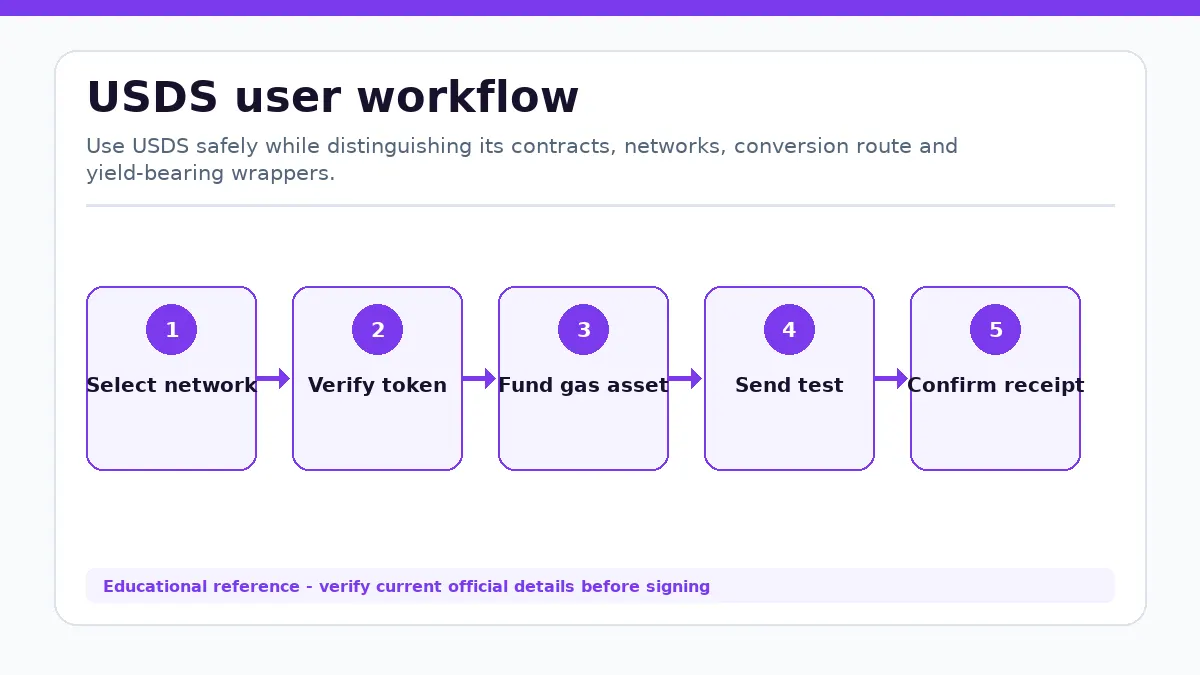
USDS workflow from the first user decision to a verified outcome.
Before transferring or supplying
Confirm the network, official USDS representation, destination support and required gas asset. Distinguish USDS from DAI, sUSDS, stUSDS and bridged copies. Review approvals and permits as spending permissions rather than harmless login signatures.
Do not infer direct bank-dollar redemption from a one-dollar target or DAI converter. Check jurisdiction and interface availability separately. For a bridge, wait for the route finality and verify the destination balance before using it in another protocol.
USDS and DAI: Convertible, Not Identical
The two stable assets share protocol infrastructure but retain separate contracts and product support.
The 1:1 converter route
Sky documentation describes an Ethereum converter that exchanges DAI for USDS and USDS for DAI at a fixed one-to-one ratio without a protocol fee on that route. The tokens still have separate addresses and features. USDS adds permit and smart-contract signature support through an upgradeable design, while DAI retains its established token contract.
Conversion requires a supported transaction and ETH gas. An exchange swap or third-party bridge is not automatically the same route and can add price impact, custody or contract risk. Before converting, confirm the current official contracts and whether the destination application supports USDS rather than only DAI.
The stable target comes from the protocol system
USDS targets one US dollar through Sky protocol collateral, accounting and liquidity mechanisms. A holder does not own a segregated dollar deposit for each token. The target can depend on collateral quality, governance parameters, oracles, smart contracts and market liquidity.
A market snapshot near one dollar does not guarantee every venue or exit path. Users should distinguish the protocol conversion rate from secondary-market prices and from eligibility to use a particular frontend or savings product.
Network selection determines the token format, fee asset and transfer path.
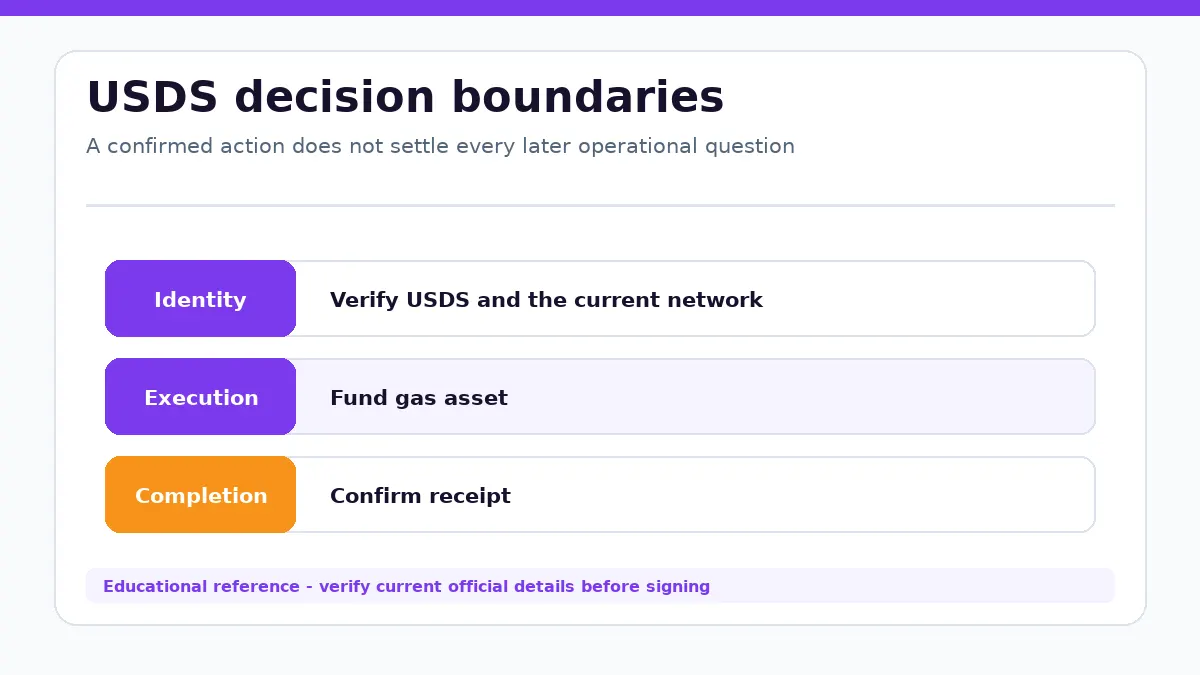
USDS confirmation does not settle every later operational question.
Host-chain fees remain separate
Bridging is a contract and messaging workflow, not an ordinary wallet transfer. Check the source and destination contracts, amount, recipient, finality steps and route limits. Sending an Ethereum token directly to a Solana address or selecting an unsupported exchange network can result in loss.
Yield-bearing products add contracts and changing economic terms.
Savings and staking wrappers
Supplying USDS to the Sky Savings Rate produces sUSDS exposure under the current product design. stUSDS is a different product tied to SKY-backed lending and variable utilization. Neither ticker should be treated as ordinary USDS, and neither return is guaranteed or fixed merely because the underlying stable asset targets one dollar.
Users should inspect the current rate source, wrapper contract, withdrawal path, availability restrictions and protocol risks. A third-party fixed-yield product can add another protocol and maturity on top of sUSDS, making its rate and exit path different again.
USDS Risks Before Completion
Continue with conversion, network or stablecoin comparison.
What USDS users should verify and why this design differs
Review DAI for the legacy token and converter relationship. Review Ethereum or Solana for the selected network fee and transaction model. Compare USDS with issuer-backed USDC, Tether, PYUSD or FDUSD to understand why reserve, redemption and control models differ.
USDS Transfers FAQ
How does USDS differ from Dai?
Compare the exact network, permissions, fee path, final state and exit requirement rather than token price alone.
Known Limitations
Supported networks, rates and converter behavior can change.
The page does not verify a bridge route or token address.
USDS is not presented as a bank deposit or universal direct redemption right.
Market Data Methodology
The page uses a CoinGecko aggregated USDS/USD snapshot. No exchange chart is rendered for this entity.
Market Snapshot Source
CoinGecko aggregated market data (USDS/USD)
Cache
Snapshot cache is approximately 60 seconds.
Failure Handling
Verified cached data is labeled Cached or Delayed. Missing values remain unavailable.