Sei is a proof-of-stake Layer 1 combining a parallelized EVM with Cosmos SDK functionality. SEI is the native gas and staking asset, and one account key can correspond to both an EVM-style 0x address and a Sei bech32 address. This page focuses on sei Checks Before You Sign and the checks users need before sending funds, paying fees or using the network.
Understand Sei dual addresses and parallel EVM behavior before transferring or using an application.
Subject:
Sei
Market mode:
Snapshot Only
Fee asset:
SEI
Timezone:
UTC
This page does not benchmark throughput, audit pointer contracts, choose a validator or validate a bridge.
Content ownership: BitcoinToolkit Editorial TeamTechnical references: Official protocol and developer documentation.Review approach: Technical explanations are checked against primary sources and updated when the network or asset changes.Last content review: Data integration last tested:
Sei Checks Before You Sign
Address format and asset representation are the main avoidable mistakes.
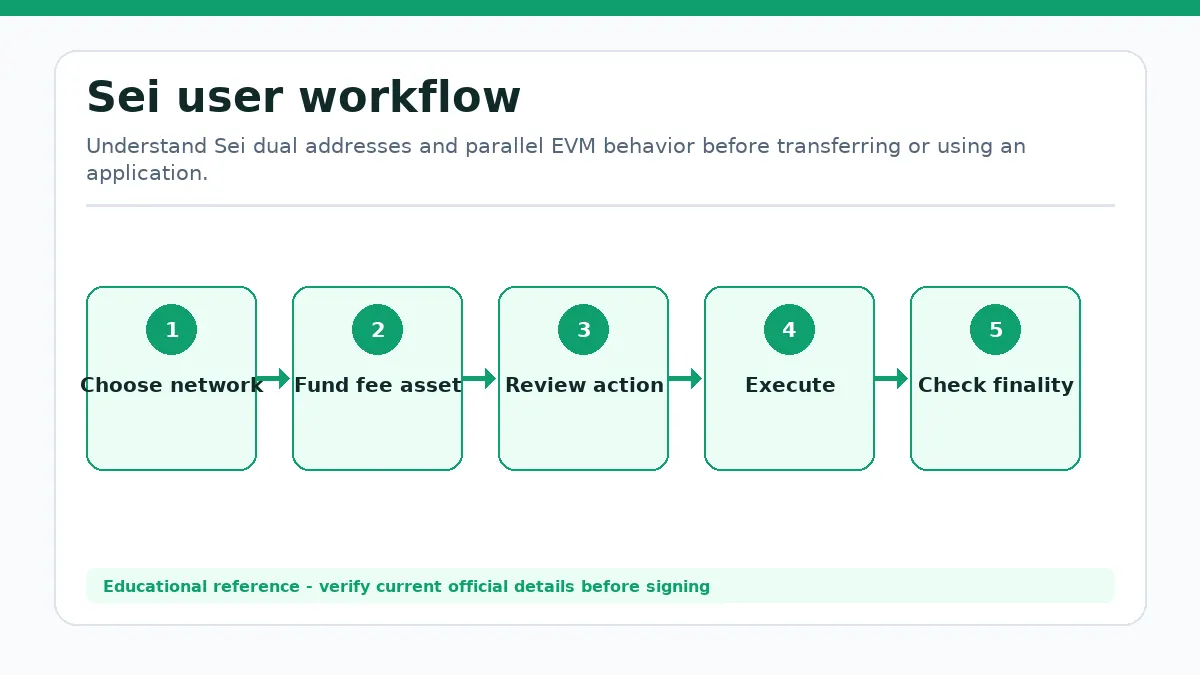
Sei workflow from the first user decision to a verified outcome.
Verify the execution path
Confirm Sei mainnet, the expected address form, chain ID, asset contract or denomination and fee balance. Review whether the action uses an EVM contract, precompile, native message, pointer asset or IBC route.
Link addresses only with official tools and never expose keys to a linking service. Simulate EVM calls where possible. For staking, review validator and unbonding risk. For transfers, confirm destination support rather than assuming every 0x address route accepts Sei.
Ethereum tooling is available, but Sei is not a copy of Ethereum mainnet.
One chain with interoperating environments
Sei supports standard EVM transactions and Solidity tools alongside Cosmos SDK modules and native asset standards. Native transactions can affect state visible to EVM applications. Precompiles expose staking, governance and other module functions to contracts.
Assets may exist as ERC tokens, native denominations or CW representations. Pointer contracts help one environment reference assets from another, but the user still needs the correct contract or denomination. A ticker match does not prove that two representations are interchangeable.
Two address formats can represent authority from the same public key.
Choose the format expected by the application
Sei accounts can derive an EVM-compatible 0x address and a sei-prefixed bech32 address. Linking makes their relationship visible to chain tooling. Users cannot arbitrarily pair unrelated addresses, and an exchange may accept only one deposit format.
SEI pays gas in both environments. EVM transactions use familiar gas limits and fee fields, while native transactions follow Cosmos SDK messages. Sponsored or abstracted application flows can change who submits a fee, but they do not make the network cost disappear.
Parallel scheduling improves throughput when state access does not conflict.
Consensus still validates one committed result
Sei classifies transactions and can execute independent state changes concurrently. Transactions touching overlapping state may require ordering. Developers should test contract assumptions about block fields and pending state because Sei documents divergences from Ethereum behavior.
Once a transaction is included and validated, Sei describes it as immediately final rather than using Ethereum commitment levels. Applications can still wait for indexing, bridge processing or their own risk checks. Rapid finality does not guarantee that an external route has completed.
Independent transactions can execute in parallel, while Twin Turbo consensus commits blocks with rapid finality. Precompiles and pointer contracts connect EVM and native modules, so EVM compatibility coexists with chain-specific assets, addresses and state behavior.
A Sei transaction can execute successfully while the application state, contract permission or later exit remains wrong for the user's goal. SEI is the market-profiled asset. SEI pays EVM and native transaction fees.
What Sei users should verify and why this design differs
EVM compatibility and APIs evolve. The page does not verify a pointer or contract.
For Sei, the practical sequence is Choose network, Fund fee asset, Review action, Execute, Check finality. Confirm the official destination and current network, then inspect the final balance, position, receipt or documented exit state that actually completes the task: Understand Sei dual addresses and parallel EVM behavior before transferring or using an application.
Sei Network use FAQ
Does Sei use ETH for gas?
No. SEI is the native gas asset for Sei EVM and native transactions.
Why does one Sei account have two addresses?
The same public key can map to a sei-prefixed native address and an EVM-compatible 0x address.
Is Sei EVM state the same as Ethereum?
No. Sei supports EVM tooling but has its own validators, state and finality.
Known Limitations
EVM compatibility and APIs evolve.
The page does not verify a pointer or contract.
External routes add separate finality.
Market Data Methodology
The page uses a CoinGecko aggregated SEI/USD snapshot. No exchange chart is rendered for this entity.
Market Snapshot Source
CoinGecko aggregated market data (SEI/USD)
Cache
Snapshot cache is approximately 60 seconds.
Failure Handling
Verified cached data is labeled Cached or Delayed. Missing values remain unavailable.