Injective (INJ): Injective Checks Before You Trade or Transfer
Injective is a Cosmos SDK Layer 1 focused on financial applications and on-chain market infrastructure. INJ is its native gas, staking and governance asset and also participates in the exchange-fee auction and burn process. This page focuses on injective Checks Before You Trade or Transfer and the checks users need before sending funds, paying fees or using the network.
Understand INJ roles and Injective market infrastructure before trading, staking or transferring.
Subject:
Injective
Market mode:
Snapshot Only
Fee asset:
INJ
Timezone:
UTC
This page does not recommend a market, forecast funding, choose a validator or guarantee IBC execution.
Content ownership: BitcoinToolkit Editorial TeamTechnical references: Official protocol and developer documentation.Review approach: Technical explanations are checked against primary sources and updated when the network or asset changes.Last content review: Data integration last tested:
Injective Checks Before You Trade or Transfer
Market identity, leverage and route details deserve separate confirmation.
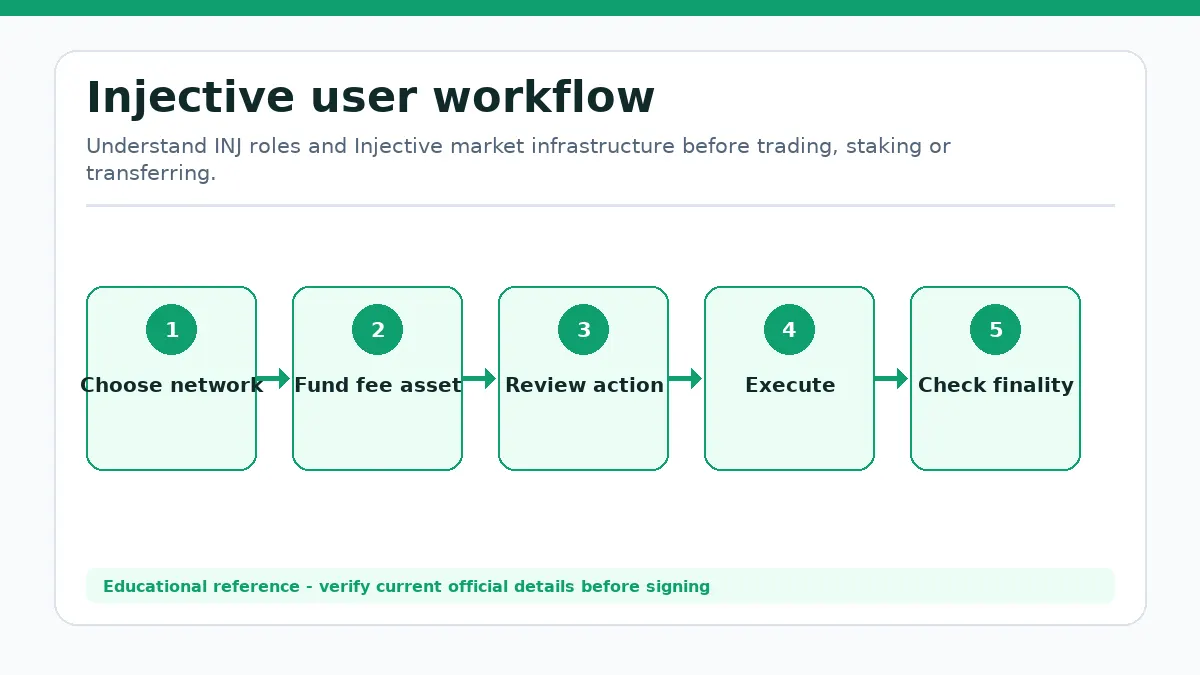
Injective workflow from the first user decision to a verified outcome.
Prepare the exact action
Confirm the network, market, asset denomination, oracle and fee balance in INJ. For derivatives, inspect leverage, margin, liquidation and funding terms. For IBC, verify the destination chain, channel and exchange memo requirements.
Use an official or independently verified frontend and review every wallet message. For staking, check validator commission, uptime and unbonding. Do not assume that EVM-compatible tooling means an Ethereum address, contract or bridge route is automatically valid on Injective.
The base network and the applications using its modules are related but not identical.
Native modules beneath multiple frontends
Injective includes protocol modules for orders, positions, markets, oracles and settlement. Applications can source activity into shared orderbooks and present different interfaces or policies. A frontend outage or listing decision does not necessarily describe the state of the underlying Injective market.
Users should identify the market identifier, quote asset, margin rules and oracle rather than relying on a familiar ticker. Derivatives can create liquidation and funding exposure even when the chain transaction finalizes correctly. The protocol state proves the position, not its suitability.
Network fees and protocol trading fees follow different paths.
A native asset with several economic roles
INJ pays transaction gas across Injective. Exchange applications also charge market fees under module parameters. Current documentation describes an application incentive share and an auction where the remaining fee basket is sold for INJ, with winning INJ burned.
The auction links protocol activity to INJ demand and supply mechanics, but it does not guarantee price appreciation or distribute every fee to token holders. Fee percentages and module parameters can change through upgrades or governance, so applications should query current state.
Validator security and cross-chain routing add separate decisions.
CometBFT commitment with external routes
Validators and delegators bond INJ to secure consensus. Delegators share rewards and can share slashing exposure, while unbonding delays access to stake. CometBFT provides rapid finality once the validator threshold commits a block.
IBC packets move assets or messages through configured clients, connections and channels. Source finality does not alone prove destination execution. A token arriving through a different channel can have a different denomination trace, and exchanges may support only native INJ deposits.
CometBFT validators finalize transactions, while protocol modules provide spot, derivatives, oracle, auction and other application primitives. IBC connects Injective with compatible chains, and EVM-related compatibility does not turn its native modules into Ethereum contracts.
A Injective transaction can execute successfully while the application state, contract permission or later exit remains wrong for the user's goal. INJ is the market-profiled asset. INJ pays network gas.
What Injective users should verify and why this design differs
Market parameters and application interfaces change. The page does not validate an oracle or market.
For Injective, the practical sequence is Choose network, Fund fee asset, Review action, Execute, Check finality. Confirm the official destination and current network, then inspect the final balance, position, receipt or documented exit state that actually completes the task: Understand INJ roles and Injective market infrastructure before trading, staking or transferring.
Injective Network use FAQ
What pays Injective gas?
INJ pays network transaction gas.
What happens in the Injective auction?
A basket of exchange-module fees is auctioned for INJ and the winning INJ is burned under current rules.
Is every Injective app the same exchange?
No. Multiple applications can use shared native market infrastructure while operating separate interfaces.
Known Limitations
Market parameters and application interfaces change.
The page does not validate an oracle or market.
IBC routes add external dependencies.
Market Data Methodology
The page uses a CoinGecko aggregated INJ/USD snapshot. No exchange chart is rendered for this entity.
Market Snapshot Source
CoinGecko aggregated market data (INJ/USD)
Cache
Snapshot cache is approximately 60 seconds.
Failure Handling
Verified cached data is labeled Cached or Delayed. Missing values remain unavailable.