Celestia (TIA): Celestia Checks for Rollup Operators
Celestia is a modular data-availability network that orders and publishes blobs while leaving application execution and settlement to layers built above it. TIA pays for blobspace, secures proof of stake and participates in governance. This page focuses on celestia Checks for Rollup Operators and the checks users need before sending funds, paying fees or using the network.
Understand what Celestia proves about published data and what a rollup must still provide.
Subject:
Celestia
Market mode:
Snapshot Only
Fee asset:
TIA
Timezone:
UTC
This page does not execute a rollup, price blobspace, guarantee permanent retrieval or choose a validator.
Content ownership: BitcoinToolkit Editorial TeamTechnical references: Official protocol and developer documentation.Review approach: Technical explanations are checked against primary sources and updated when the network or asset changes.Last content review: Data integration last tested:
Celestia Checks for Rollup Operators
Namespace management and historical retention should be designed before launch.
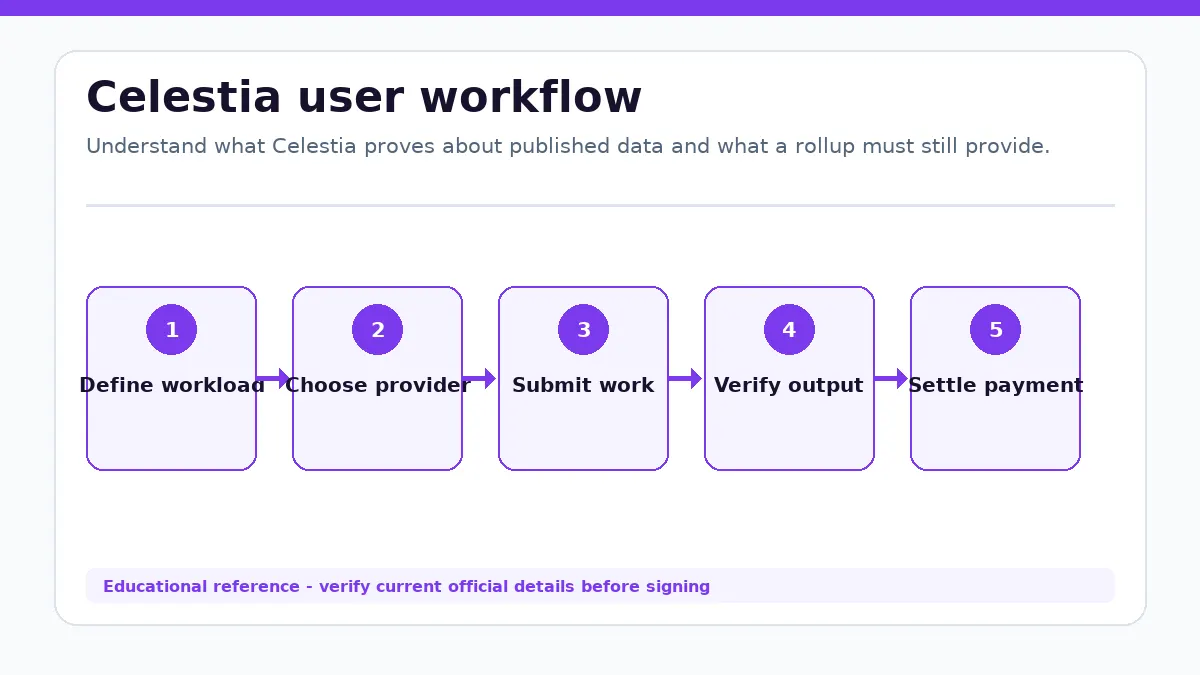
Celestia workflow from the first user decision to a verified outcome.
Plan more than the blob submission
Confirm mainnet, namespace format, blob size, fee balance and submission endpoint. Store the height and commitment returned by the transaction. Monitor sampling and node compatibility rather than assuming a successful RPC response proves inclusion.
Plan archival retrieval, independent endpoints and rollup state reconstruction. Keep execution and bridge monitoring separate from Celestia consensus. For TIA staking, review validator and unbonding risk. Never publish confidential plaintext merely because the network is a data layer.
A modular stack separates responsibilities that monolithic chains combine.
Consensus and availability below rollups
Celestia validators order transactions and make blob data available. A rollup or sovereign application above Celestia defines its own execution rules, state and user balances. Celestia consensus does not judge whether an application transaction is valid under the rollup rules.
This separation lets multiple execution layers share one data-availability service. It also means users must assess the rollup sequencer, settlement mechanism, bridge and fraud or validity proofs separately. Celestia inclusion is evidence of data publication, not a complete security review of the application.
Applications publish data under namespace identifiers for selective retrieval and proofs.
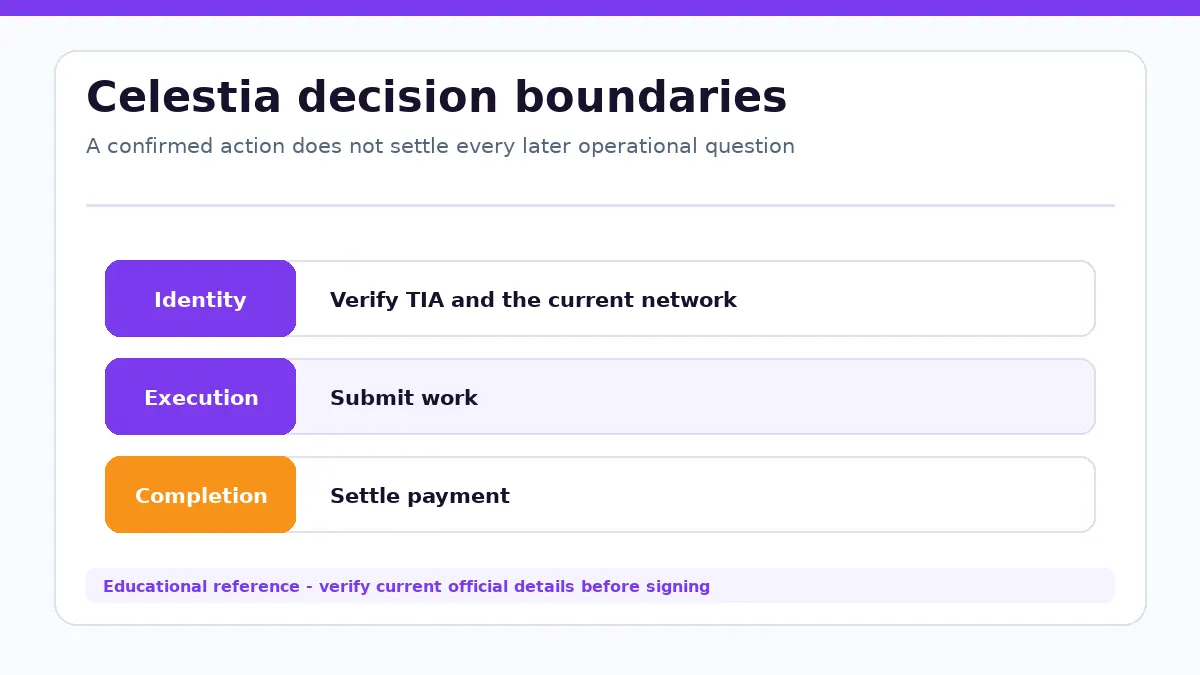
Celestia confirmation does not settle every later operational question.
Commitments bind data to a block
A PayForBlobs transaction contains sender authority, namespace, data size and commitments. TIA pays the fee according to the blob and transaction rules. Namespaced Merkle trees let an application request relevant shares and verify that the response covers its namespace range.
A namespace is not a private storage area. Published blobs may be accessible to network participants, and an incorrect namespace can make application data difficult to discover. Developers should keep commitments, heights and namespace identifiers needed for later retrieval.
Sampling answers whether data was published during the supported window, not whether every old blob remains online forever.
Recent confidence versus historical access
Celestia erasure-codes block data so light nodes can request random shares with proofs. Successful sampling raises confidence that enough data was available to reconstruct the block. More sampling supports larger blocks without every light node downloading all data.
Current documentation distinguishes availability from permanent retrievability. Light nodes sample within a rolling window and may prune older data. Rollup operators need archival nodes, providers or their own retention strategy so new nodes can reconstruct historical state.
The Next Celestia Step
The TIA result needs context
Blob transactions assign data to namespaces and commit it in erasure-coded blocks. Light nodes use data availability sampling to gain confidence that recent block data was published without downloading everything, while applications interpret and execute their own state.
A Celestia payment can settle even when useful work, storage, availability or output quality has not been verified for the user's requirement. TIA is the market-profiled asset. TIA pays transaction and blobspace fees.
What Celestia users should verify and why this design differs
Sampling windows and node behavior can change. The page does not audit a rollup.
For Celestia, the practical sequence is Define workload, Choose provider, Submit work, Verify output, Settle payment. Confirm the official destination and current network, then inspect the final balance, position, receipt or documented exit state that actually completes the task: Understand what Celestia proves about published data and what a rollup must still provide.
Before treating the Celestia task as complete, confirm each of these states separately: Define workload, Choose provider, Submit work, Verify output, Settle payment. The final check should use the current official interface, explorer or documented accounting state rather than a copied ticker or an interface notification alone.
Celestia Resource use FAQ
Does Celestia execute rollup transactions?
No. Celestia orders and publishes data while the rollup defines execution and state.
What pays for Celestia blobspace?
TIA pays fees for blob and network transactions.
Does Celestia permanently store every blob?
Data is published and sampled, but applications need an archival strategy for long-term retrievability.
Known Limitations
Sampling windows and node behavior can change.
The page does not audit a rollup.
Historical retrieval needs external planning.
Market Data Methodology
The page uses a CoinGecko aggregated TIA/USD snapshot. No exchange chart is rendered for this entity.
Market Snapshot Source
CoinGecko aggregated market data (TIA/USD)
Cache
Snapshot cache is approximately 60 seconds.
Failure Handling
Verified cached data is labeled Cached or Delayed. Missing values remain unavailable.