World Liberty Financial (WLFI): Governance Uses Proposals, Discussion and Voting
World Liberty Financial is an onchain financial ecosystem, while WLFI is its governance token. WLFI is not an independent blockchain, does not pay protocol gas and is separate from the USD1 stablecoin. This page focuses on governance Uses Proposals, Discussion and Voting and the checks users need before using the protocol or evaluating the token role.
Identify WLFI correctly and use its governance and multi-chain representations without confusing it with USD1 or gas assets.
Subject:
World Liberty Financial
Market mode:
Snapshot Only
Fee asset:
ETH / chain gas
Timezone:
UTC
This page does not verify a contract in a user wallet, bridge WLFI, vote, redeem USD1 or provide legal or investment advice.
Content ownership: BitcoinToolkit Editorial TeamTechnical references: Official protocol and developer documentation.Review approach: Technical explanations are checked against primary sources and updated when the network or asset changes.Last content review: Data integration last tested:
Governance Uses Proposals, Discussion and Voting
Token ownership provides participation under published rules, not unlimited operational authority.
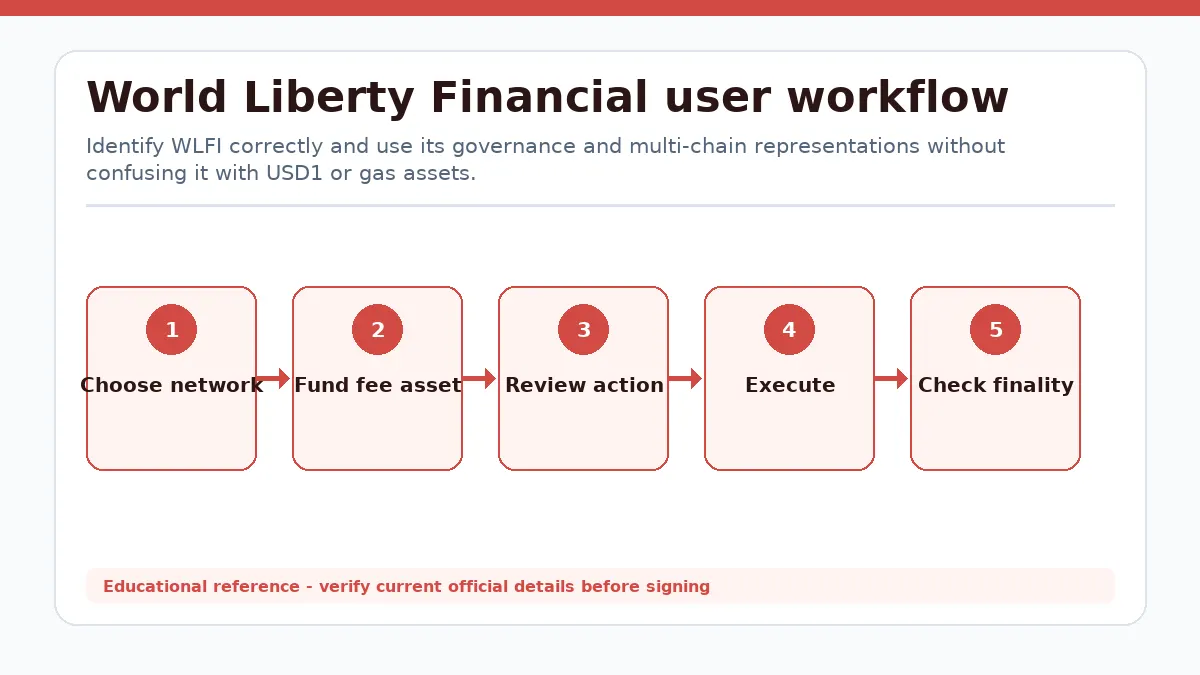
World Liberty Financial workflow from the first user decision to a verified outcome.
What a vote can represent
World Liberty Financial describes a process in which proposals are discussed, reviewed and voted on by eligible WLFI holders. Snapshot can collect signed offchain votes, reducing routine gas use, while implementation may still require authorized onchain actions and operational review.
Users should read the exact proposal, voting-power snapshot, quorum, caps and implementation conditions. A successful signal is not the same as immediate code execution. Governance rules can include limits on concentration or unlocked supply, and custody platforms may not pass voting rights through to beneficial holders.
Two products in the same ecosystem have materially different purposes.
Governance token versus stablecoin
WLFI is designed to provide voting power over specified World Liberty Financial governance matters. USD1 is a separate stablecoin product with its own issuer, backing, minting and redemption considerations. Holding WLFI does not create a USD1 claim, and holding USD1 does not automatically provide WLFI voting power.
Wallets and exchanges may display both assets under the same brand. Verify the symbol, contract, network and intended action before sending. A market price for WLFI should not be interpreted as a reserve value, redemption rate or right to protocol revenue.
The Host Chain Pays WLFI Transfer Fees
WLFI can appear on more than one supported network, but it is not the gas asset.
Contract and gas checks
ETH pays Ethereum execution. Another host chain uses its own native gas asset.
Confirm the canonical contract for the selected network and use only a currently supported bridge. Bridged representations can have separate custody, contract and liquidity dependencies. An exchange ticker does not prove that every deposit network is enabled, so match the deposit chain before withdrawing.
WLFI Ownership Has Defined Limits
Governance participation should not be presented as a financial entitlement.
What the token does not promise
Official disclosures describe WLFI utility around governance and state that the token does not provide a right to returns, dividends, airdrops or other distributions. Transferability and unlocked supply have also depended on governance and disclosure decisions, so historical lock conditions should not be assumed to be the current status of every token.
Check current official notices, contract state and custody restrictions before acting. Avoid look-alike contracts, false USD1 claims and messages promising a governance reward. Legal availability, voting eligibility and transfer support can differ by user and jurisdiction.
World Liberty Financial Operating Context
Verify identity before choosing a governance or transfer workflow.
What World Liberty Financial users should verify and why this design differs
For governance, read the active proposal and confirm eligible voting power. For a transfer, verify the host chain, contract and native gas balance. For USD1 activity, move to the stablecoin documentation and review backing and redemption separately.
Use Ethereum or the relevant blockchain guide for transaction behavior, wallet tools for address checks and official WLFI disclosures for current restrictions. Do not treat brand similarity as asset equivalence.
World Liberty Financial Network use FAQ
What pays transaction fees when using World Liberty Financial?
Host-chain gas (ETH / chain gas) pays the applicable network fee. The selected host chain, not WLFI, supplies transaction gas. Verify the selected network before signing because a later approval, bridge, claim or exit can require another transaction.
Does holding WLFI make every World Liberty Financial application transaction-ready?
No. The wallet still needs the correct network, fee asset, contract or program, and any application-specific token or permission.
How does World Liberty Financial differ from Safe?
Compare the exact network, permissions, fee path, final state and exit requirement rather than token price alone.
Known Limitations
Governance, unlock and supported-network rules can change.
Jurisdiction and custody can affect access and voting.
The page does not verify a contract or stablecoin reserve.
Market Data Methodology
The page uses a CoinGecko aggregated WLFI/USD snapshot. No exchange chart is rendered for this entity.
Market Snapshot Source
CoinGecko aggregated market data (WLFI/USD)
Cache
Snapshot cache is approximately 60 seconds.
Failure Handling
Verified cached data is labeled Cached or Delayed. Missing values remain unavailable.