Skip to content
BitcoinToolkit

Safe (SAFE): A Safe Approval Is Not Yet an Onchain Execution

Operate a Safe smart account without confusing owner approvals, onchain execution, modules and SAFE token governance.

Subject:
Safe
Market mode:
Snapshot Only
Fee asset:
Varies
Timezone:
UTC

This page does not inspect a live Safe, recover owner access, simulate a transaction, audit a module or determine organizational signing policy.

Content ownership: BitcoinToolkit Editorial Team Technical references: Official protocol and developer documentation. Review approach: Technical explanations are checked against primary sources and updated when the network or asset changes. Last content review: Data integration last tested:

A Safe Approval Is Not Yet an Onchain Execution

Owners sign a shared transaction intent before an executor submits it.

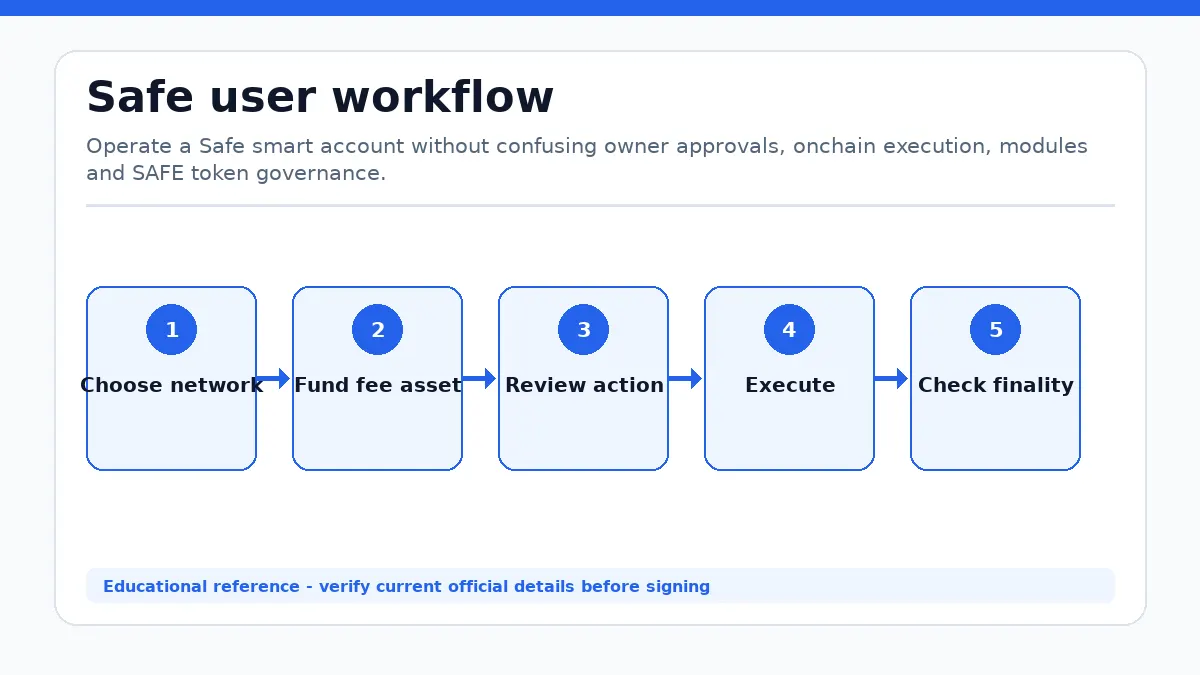
Safe workflow showing Choose network, Fund fee asset, Review action, Execute, Check finality
Safe workflow from the first user decision to a verified outcome.

Owners, threshold and executor

Each Safe Smart Account stores a set of owner addresses and a threshold. Owners sign the exact Safe transaction hash, including destination, value, calldata, operation, nonce and fee-related fields. Once enough valid signatures exist, any permitted executor can call the account contract to verify them and execute the requested operation.

Review the chain, Safe address, nonce, threshold and decoded payload before signing. An offchain signature does not change assets by itself, but it can authorize a later execution. Owners should reject unexpected delegatecalls, owner changes, threshold reductions and approvals even when the interface shows a familiar proposer name.
The Host Chain Pays for Safe Execution

SAFE governance and smart-account gas are different asset roles.

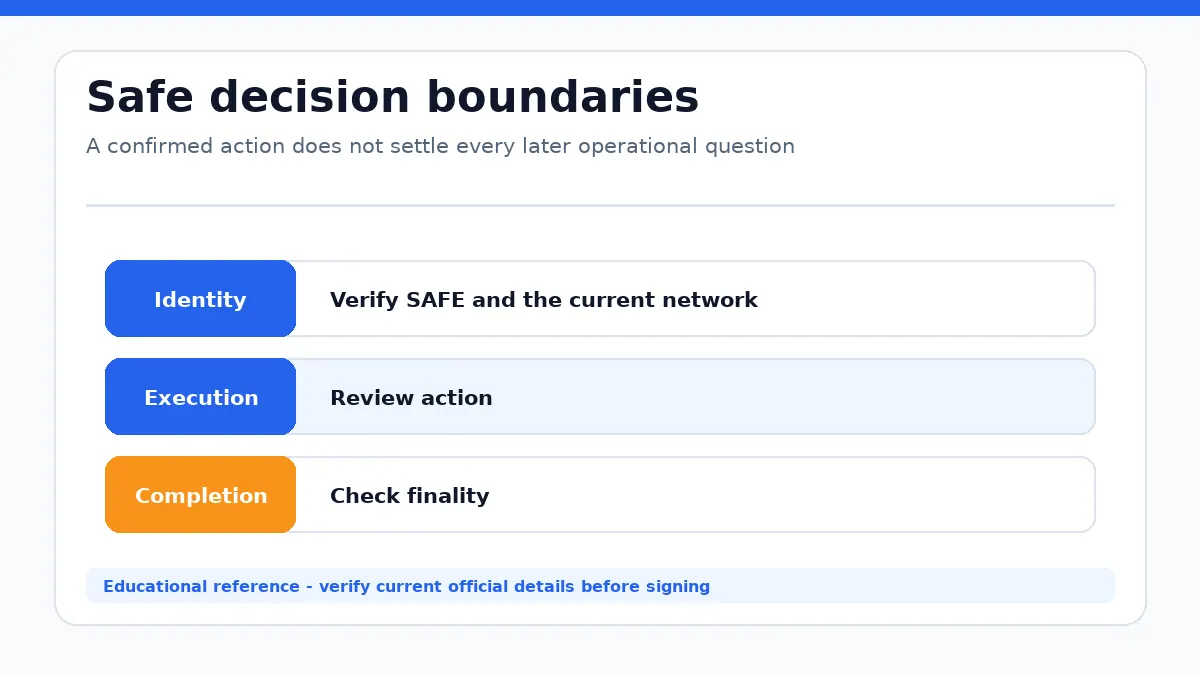
Safe decision diagram separating identity, execution and completion checks
Safe confirmation does not settle every later operational question.

Execution and reimbursement

A Safe lives separately on each supported EVM network. The transaction that calls execTransaction consumes that network's gas. Ethereum normally uses ETH, while another chain uses its own native fee asset. Safe transaction fields can define reimbursement behavior, including a gas token in supported legacy flows, but that arrangement must be reviewed explicitly.

SAFE token ownership does not automatically fund execution or confer control over a particular account. Account authority comes from the stored owners, threshold and enabled extensions. Keep the host-chain fee asset available and verify which address will receive any refund before approving the final payload.

Modules and Guards Can Change the Default Security Model

Extensions can add useful automation and powerful new authority.

Execution bypasses and transaction checks

Inventory every enabled module, guard and handler, verify its source and preserve a tested removal or recovery path. A malicious module can take over assets, while a broken guard can deny service. Raising the owner threshold does not neutralize authority already granted to an extension.

Safe Network use FAQ

Does holding SAFE make every Safe application transaction-ready?

No. The wallet still needs the correct network, fee asset, contract or program, and any application-specific token or permission.

Known Limitations

Market Data Methodology

The page uses a CoinGecko aggregated SAFE/USD snapshot. No exchange chart is rendered for this entity.

Market Snapshot Source
CoinGecko aggregated market data (SAFE/USD)
Cache
Snapshot cache is approximately 60 seconds.
Failure Handling
Verified cached data is labeled Cached or Delayed. Missing values remain unavailable.
Snapshot Status
Delayed
Report Issue
Report a market-data problem →

Technical Sources

Selected primary sources support the operational explanations. Market-provider attribution remains separate.

Editorial Information

Verified technical content, reviewed sources and update history.

Published
Last Review
Data Verification
Sources
Official documentation