Decred (DCR): DCR Transactions Spend UTXOs and Pay Size-Based Fees
Decred is a UTXO cryptocurrency that combines proof-of-work block production with proof-of-stake ticket voting. DCR pays fees, purchases tickets and participates in protocol and treasury governance. This page focuses on dCR Transactions Spend UTXOs and Pay Size-Based Fees and the checks users need before sending funds, paying fees or using the network.
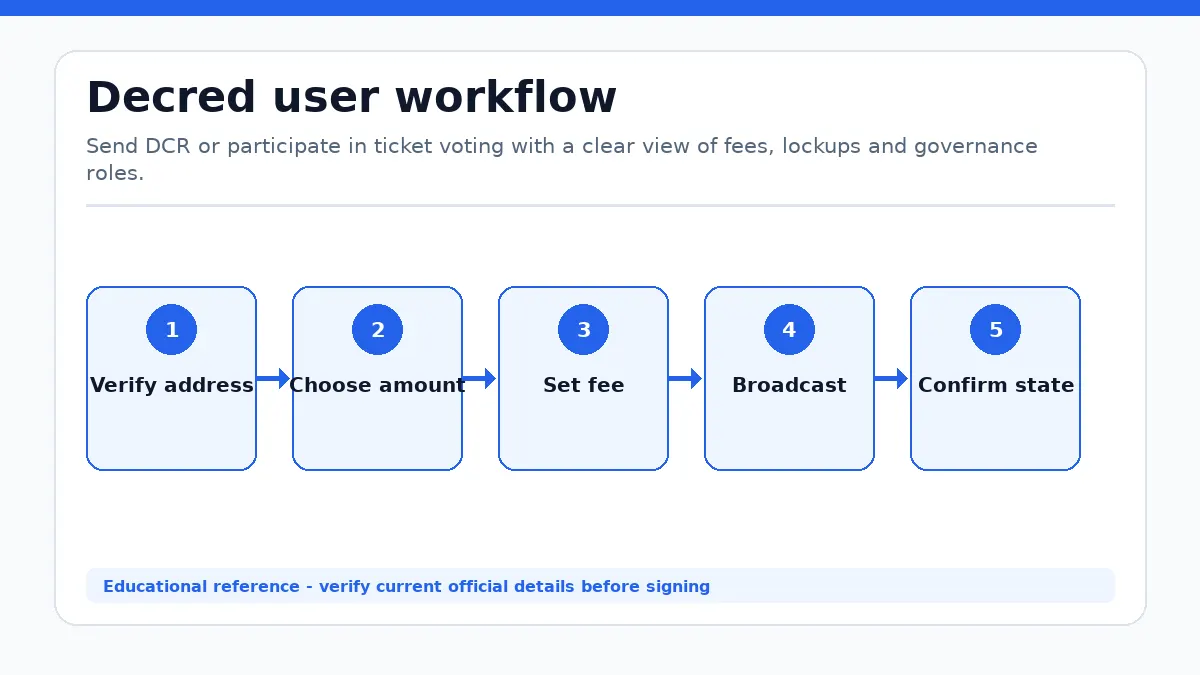
Send DCR or participate in ticket voting with a clear view of fees, lockups and governance roles.
Subject:
Decred
Market mode:
Snapshot Only
Fee asset:
DCR
Timezone:
UTC
This page does not purchase a ticket, select a voting service provider, mine DCR, vote on a proposal or estimate returns.
Content ownership: BitcoinToolkit Editorial TeamTechnical references: Official protocol and developer documentation.Review approach: Technical explanations are checked against primary sources and updated when the network or asset changes.Last content review: Data integration last tested:
DCR Transactions Spend UTXOs and Pay Size-Based Fees
Wallet balances are assembled from discrete outputs rather than one account number.
Decred workflow from the first user decision to a verified outcome.
Inputs, outputs and change
A Decred transaction spends existing outputs, creates destination and change outputs and pays a DCR fee. More inputs and outputs generally increase serialized size. Ticket purchases are special transactions that compete for block space and can use a ticket fee, while a vote transaction follows different fee behavior.
Before signing, verify the Decred address, amount, selected inputs, change and total fee. Do not use Ethereum nonce or gas assumptions. Fragmented outputs can make a transaction larger, and an exchange can require more confirmations than a wallet shows for ordinary receipt.
The Next Decred Step
Decred does not ask proof of work or proof of stake to secure the chain alone.
Hybrid block validity
Proof-of-work miners assemble transactions and produce candidate blocks. Five live tickets are selected for each block, and at least three votes are required for a valid voting result. Ticket voters can approve or reject the previous block and participate in activating approved consensus changes.
This gives stakeholders a direct check on miner behavior, but it does not eliminate mining or make every DCR holder an automatic voter. Participation requires a ticket, and a ticket has a lifecycle that includes purchase, maturity, random selection, voting and release or expiry.
A ticket is a time-bound governance and consensus position, not a liquid savings balance.
Price, pool and selection
The ticket price adjusts at protocol intervals. After purchase and maturity, a live ticket waits in a pool until selected to vote or until it expires. A wallet can vote directly while online or use a voting service provider that votes according to the user configuration without receiving ordinary spending control over the ticket funds.
Check the current ticket price, purchase fee, maturity, expiry, provider fee and voting agenda before committing DCR. Selection timing is probabilistic, and a reward estimate is not guaranteed. Keep separate liquid DCR for normal transactions and future fees.
Consensus Votes and Politeia Proposals Solve Different Questions
Governance spans onchain rules and offchain proposal records.
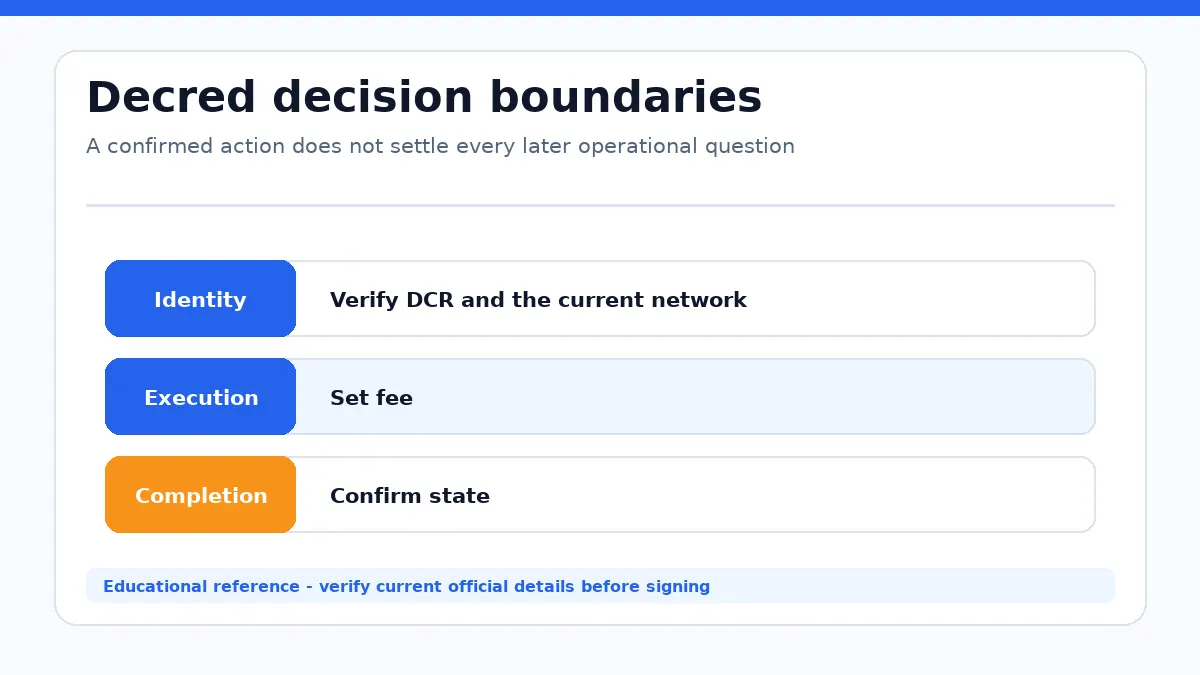
Decred confirmation does not settle every later operational question.
Two decision channels
Onchain ticket votes approve blocks and can activate coded consensus changes after required thresholds. Politeia records proposals, discussion and ticket-backed votes for treasury spending and policy. Its data is anchored cryptographically so censorship or alteration can be detected.
A passed proposal does not rewrite consensus by itself, and an onchain agenda vote does not automatically approve a contractor budget. Read the proposal scope, voting window, eligibility and implementation plan. Treasury funding also does not make a funded product risk-free.
Separate payment, ticket and proposal tasks before acting.
A practical sequence
For a payment, verify UTXOs, change and fee. For a ticket, review the current price, lockup and voting setup. For governance, identify whether the question belongs to a consensus agenda or Politeia proposal and read the complete record.
Do not treat ticket funds as instantly liquid, confuse a voting service with custody or assume a miner alone determines final acceptance. Use Decred documentation and explorers for current status.
Miners propose blocks, while randomly selected live tickets vote to approve the previous block and can vote on consensus changes. Politeia handles proposal discussion and ticket-backed decisions about policy and treasury spending.
A Decred transaction can be valid while the recipient still waits for more confirmations or cannot use the selected address type. DCR is the asset shown in the market snapshot. DCR pays ordinary and ticket-purchase transaction fees.
What Decred users should verify and why this design differs
Ticket price, rewards and voting agendas change with protocol state. Provider policies require separate review.
For Decred, the practical sequence is Verify address, Choose amount, Set fee, Broadcast, Confirm state. Confirm the official destination and current network, then inspect the final balance, position, receipt or documented exit state that actually completes the task: Send DCR or participate in ticket voting with a clear view of fees, lockups and governance roles.
Decred Transactions FAQ
Does Decred use both mining and staking?
Yes. Miners produce blocks and selected proof-of-stake tickets vote on them.
What does a Decred ticket do?
It time-locks DCR for a chance to vote on blocks and eligible governance decisions.
Is Politeia the same as onchain consensus voting?
No. Politeia handles proposals and policy or treasury decisions; onchain votes validate blocks and consensus changes.
What pays transaction fees when using Decred?
Decred (DCR) pays the applicable network fee. DCR pays ordinary and ticket-purchase transaction fees. Verify the selected network before signing because a later approval, bridge, claim or exit can require another transaction.
Known Limitations
Ticket price, rewards and voting agendas change with protocol state.
Provider policies require separate review.
The page does not buy tickets or cast votes.
Market Data Methodology
The page uses a CoinGecko aggregated DCR/USD snapshot. No exchange chart is rendered for this entity.
Market Snapshot Source
CoinGecko aggregated market data (DCR/USD)
Cache
Snapshot cache is approximately 60 seconds.
Failure Handling
Verified cached data is labeled Cached or Delayed. Missing values remain unavailable.