What the Cronos user is confirming
Cronos EVM uses an account-based state model, EVM smart-contract execution and a validator consensus process to order transactions and commit blocks.
Cronos is an EVM-compatible Layer 1 network built with the Cosmos SDK, and CRO is the protocol-native asset used to pay transaction fees on Cronos EVM. This page focuses on cronos Gas and Fees and the checks users need before sending funds, paying fees or using the network.
Help users understand how Cronos transactions and fees work and make safer usage and transaction decisions for Cronos.
Use this page as an educational network and market reference. It is not an executable exchange quote, price forecast or trading recommendation.
BitcoinToolkit presents a sourced CoinGecko USD snapshot and explains Cronos accounts, CRO units, gas, transactions, contracts and validator finality without presenting an unavailable exchange chart.
Cronos EVM uses an account-based state model, EVM smart-contract execution and a validator consensus process to order transactions and commit blocks.
Cronos (CRO) is the asset profiled on this page. CRO is the market asset displayed in the reference snapshot.
Cronos (CRO) pays the applicable transaction cost. CRO pays EVM transaction execution fees on Cronos.
Compare fees, execution, security and user workflow before choosing between Cronos and Gnosis Chain.
Cronos is an EVM-compatible Layer 1 network, while CRO is the protocol-native asset used for fees and value transfer.
Cronos EVM
Cronos (CRO): CRO pays EVM transaction execution fees on Cronos.
EVM Layer 1
Cronos EVM is a Cosmos SDK-based blockchain that exposes EVM-compatible accounts, RPC methods and smart-contract execution.
Native CRO is not a CRC-20 contract token; wrapped CRO is a separate token contract used by applications that need a token interface.
Cronos EVM tracks account-based state with balances, nonces, contract code and contract storage.
Each EVM address maps to account state that changes when a valid transaction executes.
A private key controls an externally owned account and signs transactions.
Contract accounts contain deployed EVM bytecode and execute when called.
A sender nonce orders transactions from one account and prevents replay.
An account balance records native CRO available on Cronos EVM.
The EVM executes contract bytecode against the current network state.
Contracts maintain persistent storage after successful execution and block commitment.
Cronos EVM represents native CRO with 18 decimal places; raw EVM values use wei and gas prices are commonly shown in gwei.
Wallets display CRO, fee interfaces commonly quote gwei, and JSON-RPC values use integer wei.
Cronos transactions meter EVM computation in gas and pay the resulting execution fee in native CRO.
CRO
Gas measures computation and storage work requested by a transaction.
The gas limit caps the work a transaction may consume.
Gas used records the work consumed by execution.
The gas price states the amount of CRO-denominated wei offered per gas unit.
Execution cost equals gas used multiplied by the effective gas price.
A Cronos transaction is created, signed, checked, propagated, executed by the EVM, included in a block and committed by validator consensus.
Cronos runs EVM-compatible smart contracts and exposes familiar account and JSON-RPC concepts.
Contract accounts contain deployed bytecode and have no private key.
Compiled EVM bytecode executes under Cronos network rules and gas limits.
Contracts read and update persistent EVM storage after successful execution.
Calls can transfer native CRO and pass encoded input to contract functions.
CRC-20 contracts maintain token balances and allowances independently from native CRO.
Native CRO pays protocol gas; CRC-20 balances belong to contracts and cannot automatically replace CRO as the fee asset.
Cronos validators order transactions and commit blocks through its proof-of-authority validator consensus.
Cronos EVM uses a proof-of-authority validator set with Byzantine fault-tolerant agreement to order transactions and commit blocks.
Authorized validators operate nodes, propose blocks and validate proposals according to the active validator set and consensus rules.
An eligible validator proposes a block for the validator set to evaluate and commit.
A committed block receives deterministic consensus finality after the required validator agreement, rather than relying on proof-of-work depth.
Applications should rely on node-reported committed or finalized state and handle RPC delays instead of assuming a fixed confirmation time.
Use this page as an educational network and market reference.
Compare fees, execution, security and user workflow before choosing between Cronos and Avalanche.
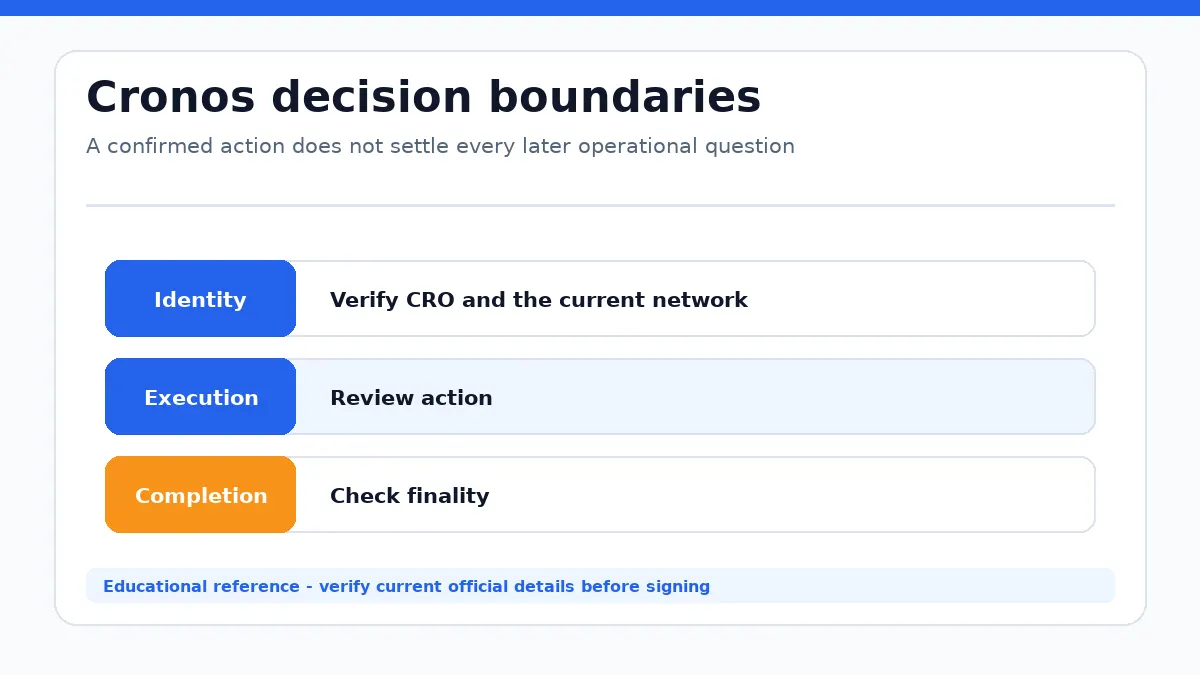
A Cronos transaction can execute successfully while the application state, contract permission or later exit remains wrong for the user's goal. CRO is the market asset displayed in the reference snapshot. CRO pays EVM transaction execution fees on Cronos.
The CoinGecko USD snapshot is an aggregated market reference and not an executable quote. No exchange chart is shown because no verified CRO spot market source is configured.
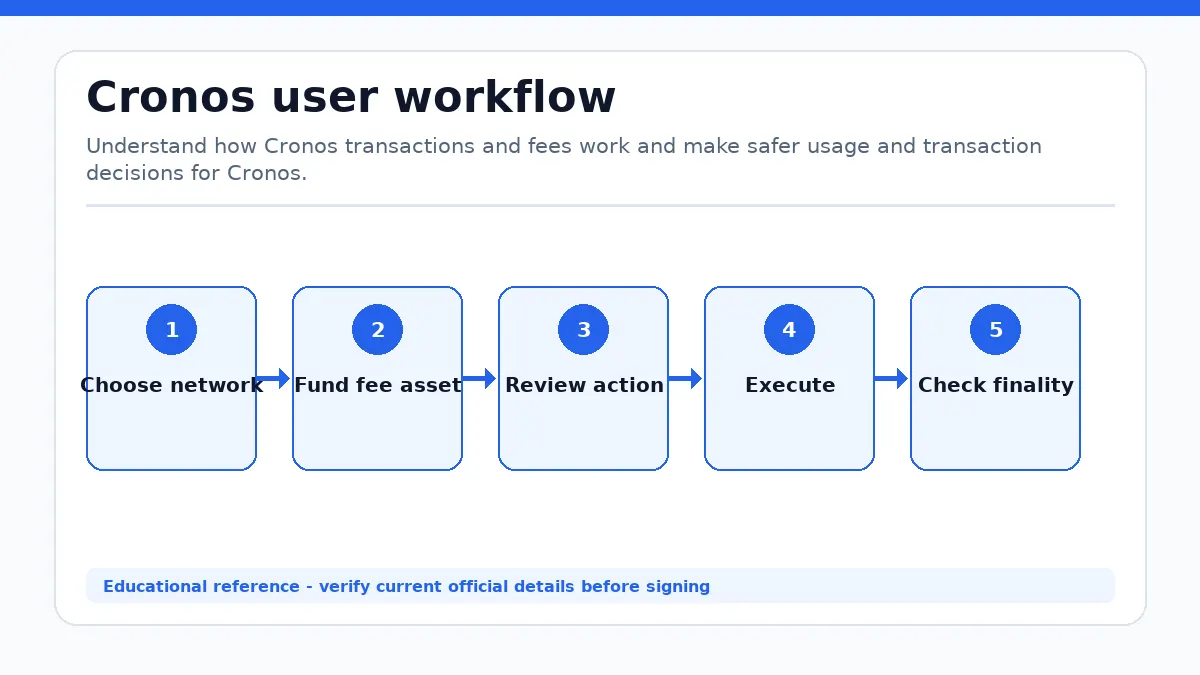
For Cronos, the practical sequence is Choose network, Fund fee asset, Review action, Execute, Check finality. Confirm the official destination and current network, then inspect the final balance, position, receipt or documented exit state that actually completes the task: Understand how Cronos transactions and fees work and make safer usage and transaction decisions for Cronos.
Before treating the Cronos task as complete, confirm each of these states separately: Choose network, Fund fee asset, Review action, Execute, Check finality. The final check should use the current official interface, explorer or documented accounting state rather than a copied ticker or an interface notification alone.
Cronos is an EVM-compatible Layer 1 blockchain built with the Cosmos SDK.
Native CRO pays Cronos EVM gas fees.
Native CRO is not a CRC-20 token; wrapped CRO is a separate contract token.
No verified CRO spot market source is configured, so this page shows only a sourced CoinGecko USD snapshot.
The page uses CoinGecko aggregated USD data. No exchange chart is shown because no verified CRO spot market source is configured.
Selected primary sources support the operational explanations. Market-provider attribution remains separate.
Verified technical content, reviewed sources and update history.