Core (CORE): CORE Delegation and Dual-Staking Checks
Core is an EVM-compatible Layer 1 that combines validator staking with Bitcoin-linked security signals. CORE is its native asset for gas, staking and network governance. This page focuses on cORE Delegation and Dual-Staking Checks and the checks users need before sending funds, paying fees or using the network.
Use Core EVM and evaluate CORE or BTC staking without confusing Core transactions with Bitcoin transactions.
Subject:
Core
Market mode:
Snapshot Only
Fee asset:
CORE
Timezone:
UTC
This page does not create a Bitcoin timelock, delegate stake, select a validator, bridge assets or guarantee staking rewards.
Content ownership: BitcoinToolkit Editorial TeamTechnical references: Official protocol and developer documentation.Review approach: Technical explanations are checked against primary sources and updated when the network or asset changes.Last content review: Data integration last tested:
CORE Delegation and Dual-Staking Checks
Reward estimates depend on protocol state and the selected validator.
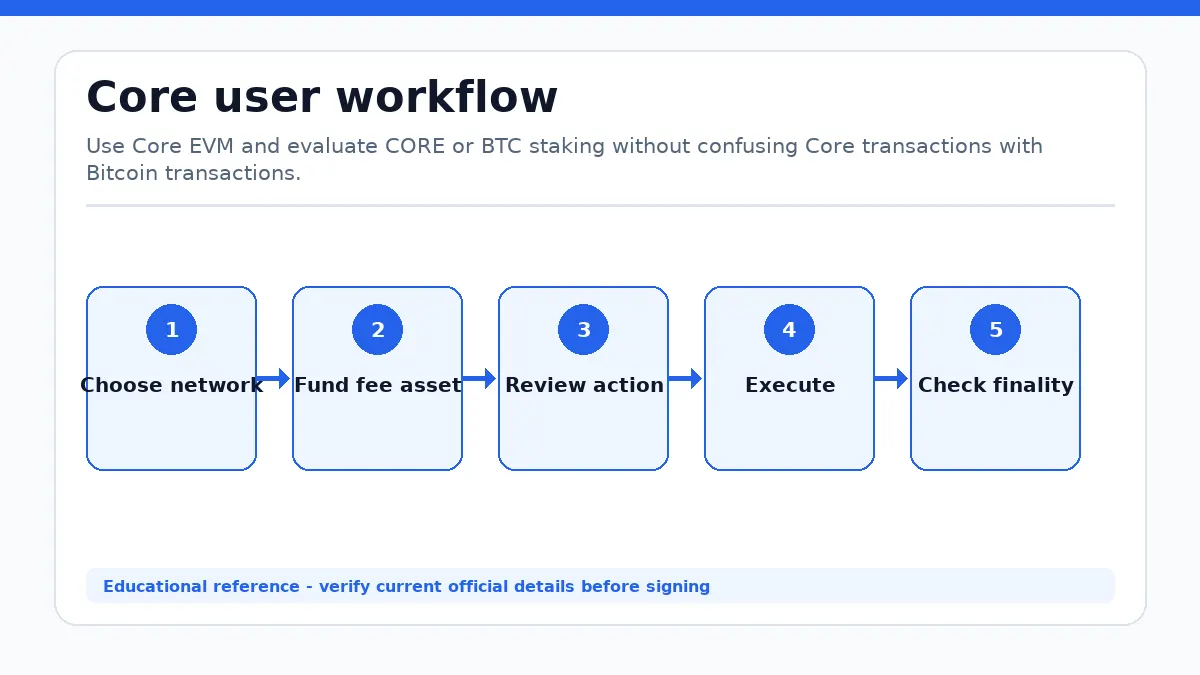
Core workflow from the first user decision to a verified outcome.
Before committing capital
Check validator status, commission, performance, lock or unbonding rules and the exact asset being delegated. Dual staking can change reward treatment when a BTC position is paired with CORE delegation, but published tiers and rates are not permanent promises. Keep liquid CORE available for any Core-side transaction fees.
Do not send BTC to a Core EVM address, pay a third party for a supposed staking unlock or assume delegation transfers ordinary wallet control. Use current Core and Bitcoin explorers to track the correct ledger. Bridge risk is separate from native BTC staking and must be evaluated independently when wrapped assets are involved.
Core Operating Context
Core is EVM-compatible, but its validator election is designed around Bitcoin-aligned participation.
Miners, BTC stakers and CORE delegators
Bitcoin miners can delegate hash-related support, BTC holders can timelock bitcoin and delegate to Core validators, and CORE holders can delegate stake. These inputs influence validator selection under Satoshi Plus. They are not three versions of the same asset and do not move all activity onto one ledger.
Validators produce and validate Core blocks, while Bitcoin continues to settle BTC transactions independently. Core applications should be judged as Core EVM contracts. Bitcoin-linked participation adds an economic relationship, but it does not make a Core contract identical to a Bitcoin script or inherit every Bitcoin security property automatically.
Core addresses and contracts follow EVM execution rules.
Account, nonce and gas checks
A Core transaction names a sender, recipient or contract, nonce, gas limit and fee parameters. CORE funds execution. BTC in a Bitcoin wallet cannot pay Core gas, and a bridged token balance cannot silently substitute for CORE. The sender also needs the correct Core chain configuration and enough balance for the maximum authorized fee.
Contract calls can consume more gas than simple transfers and may change several application states. Review the decoded method, token approvals and minimum received before signing. A transaction that appears in a wallet still needs a successful receipt; a reverted call can spend gas without completing the intended action.
Core BTC Staking Uses Bitcoin Timelocks
The self-custodial design keeps the staked bitcoin on the Bitcoin network.
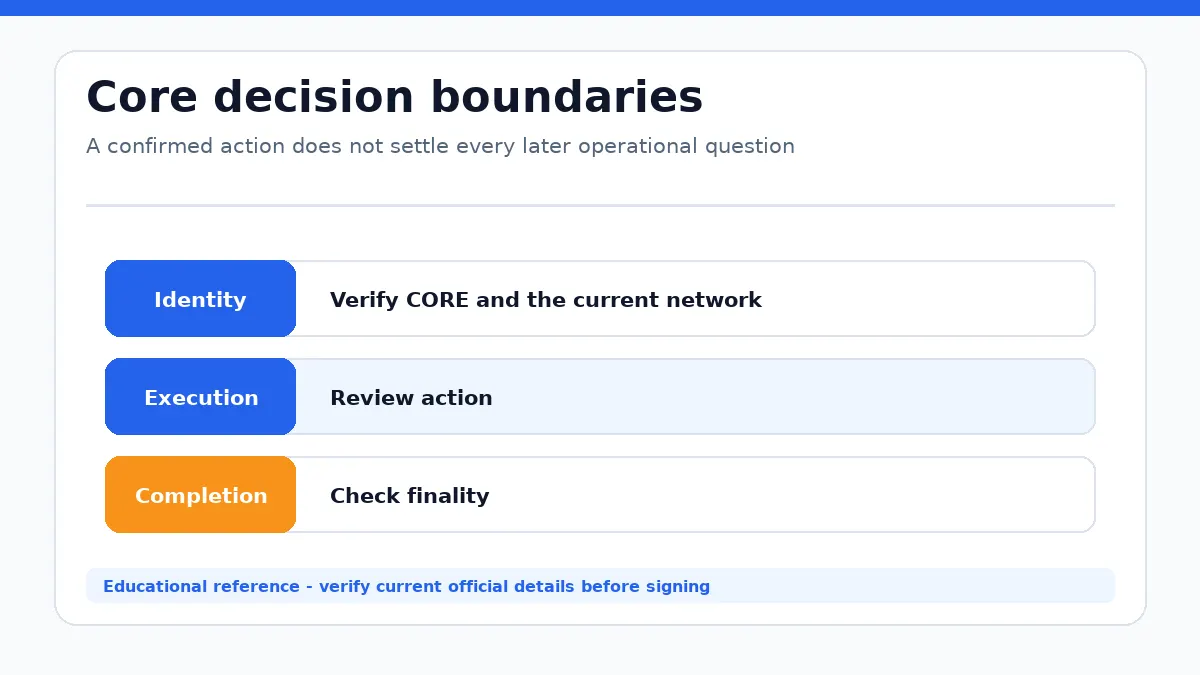
Core confirmation does not settle every later operational question.
Two ledgers and two fee contexts
BTC staking creates a Bitcoin transaction that timelocks BTC with validator and protocol metadata. The bitcoin is not wrapped or transferred to a Core custodian. The user retains the Bitcoin key needed after the lock expires, subject to the exact script and wallet workflow. Creating and later spending the position requires Bitcoin network fees.
Rewards are associated with Core participation and may be paid in CORE under current rules. That does not turn CORE into bitcoin or eliminate lock duration, validator performance and integration risk. Confirm the Bitcoin address, lock period, validator, reward terms and change output before broadcasting the staking transaction.
Choose the Next Core Check
Start from the asset and ledger involved in your task.
EVM, CORE staking or BTC staking
For an application transaction, verify the Core chain ID, contract and CORE gas estimate. For CORE delegation, review the current validator set and unbonding conditions. For BTC staking, inspect the Bitcoin timelock transaction and keep enough BTC for network fees and later spending.
Use Bitcoin guidance for the UTXO and fee side, wallet tools for address checks and the Core documentation for validator metadata. Treat each step as a separate confirmation instead of relying on a single ecosystem label.
Satoshi Plus combines delegated proof of work from Bitcoin miners, delegated proof of stake in CORE and self-custodial Bitcoin staking. Core EVM transactions still use ordinary account, nonce and gas concepts.
A Core transaction can execute successfully while the application state, contract permission or later exit remains wrong for the user's goal. CORE is the asset shown in the market snapshot. CORE pays gas for Core EVM transactions.
What Core users should verify and why this design differs
Validator rules, rewards and delegation tiers can change. Bitcoin timelocks have separate fees and settlement behavior.
For Core, the practical sequence is Choose network, Fund fee asset, Review action, Execute, Check finality. Confirm the official destination and current network, then inspect the final balance, position, receipt or documented exit state that actually completes the task: Use Core EVM and evaluate CORE or BTC staking without confusing Core transactions with Bitcoin transactions.
Core Network use FAQ
What pays gas on Core?
CORE pays gas for Core EVM transactions.
Does Core BTC staking wrap bitcoin?
The documented self-custodial path timelocks BTC on Bitcoin rather than wrapping it for custody on Core.
What is Satoshi Plus?
It combines Bitcoin miner support, self-custodial BTC staking and delegated CORE stake in validator selection.
Known Limitations
Validator rules, rewards and delegation tiers can change.
Bitcoin timelocks have separate fees and settlement behavior.
The page does not execute staking or inspect a contract.
Market Data Methodology
The page uses a CoinGecko aggregated CORE/USD snapshot. No exchange chart is rendered for this entity.
Market Snapshot Source
CoinGecko aggregated market data (CORE/USD)
Cache
Snapshot cache is approximately 60 seconds.
Failure Handling
Verified cached data is labeled Cached or Delayed. Missing values remain unavailable.