Compound (COMP): Each Compound III Market Has One Base Asset
Compound is an EVM lending protocol. Compound III deployments use a Comet market with one borrowable base asset and separate collateral assets, while COMP governs approved protocol changes. This page focuses on each Compound III Market Has One Base Asset and the checks users need before using the protocol or evaluating the token role.
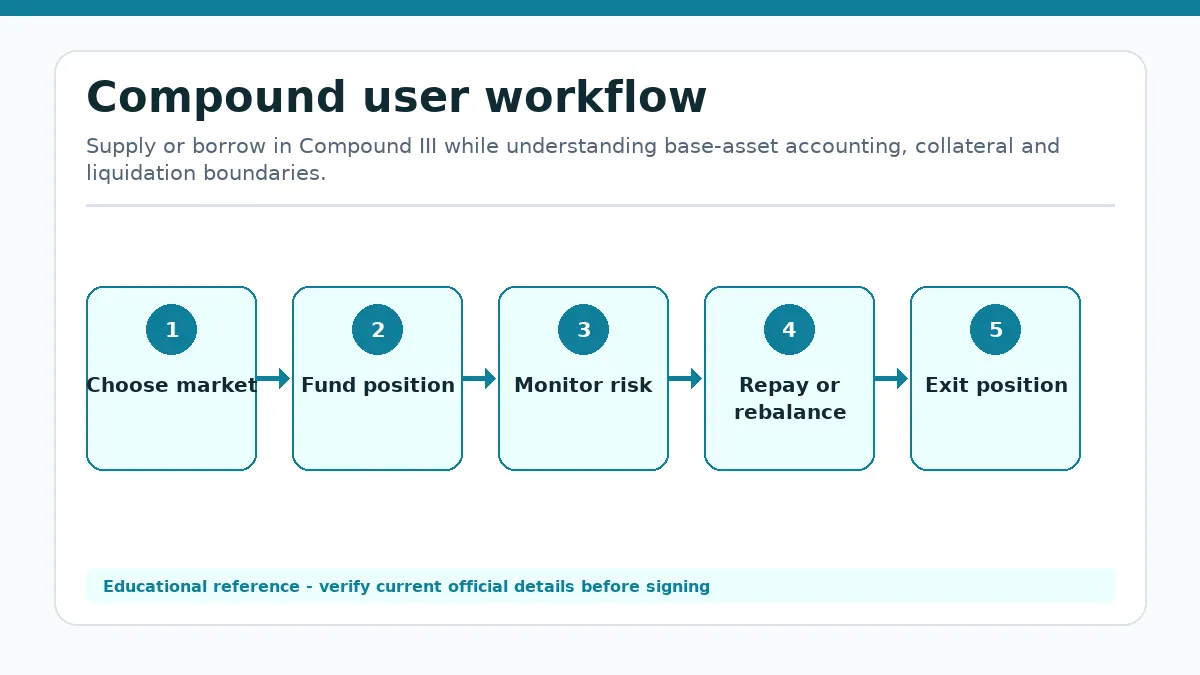
Supply or borrow in Compound III while understanding base-asset accounting, collateral and liquidation boundaries.
Subject:
Compound
Market mode:
Snapshot Only
Fee asset:
ETH / varies
Timezone:
UTC
This page does not quote interest, calculate liquidation, approve a manager, verify a Comet deployment, supply collateral or vote a proposal.
Content ownership: BitcoinToolkit Editorial TeamTechnical references: Official protocol and developer documentation.Review approach: Technical explanations are checked against primary sources and updated when the network or asset changes.Last content review: Data integration last tested:
Each Compound III Market Has One Base Asset
Compound is an onchain lending protocol. In Compound III, each deployment centers on one borrowable base asset and a defined set of collateral assets, so users should evaluate a specific market rather than a universal COMP product.
Compound workflow from the first user decision to a verified outcome.
Who the market serves
A supplier can provide the market's base asset, while a borrower can post supported collateral and borrow that base asset within protocol limits. This can suit users who want a focused market with transparent collateral factors and who are prepared to monitor utilization, rates, price feeds and liquidation conditions.
It is not a fit for undercollateralized personal credit, guaranteed principal or users who assume all deposited collateral earns the same return as the base asset. The behavior of collateral and base balances must be checked separately.
Select the deployment first
Compound markets exist on multiple networks. Verify the chain, base asset and collateral list before approving tokens, because liquidity and risk parameters differ by deployment.
Compound Operating Context
Compound replaces bilateral loan matching with shared smart-contract markets that calculate rates and enforce collateral rules programmatically.
Liquidity without negotiating a lender
Suppliers contribute assets to a market and borrowers draw available liquidity by posting eligible collateral. Interest rates react to market utilization under the configured model. Users do not negotiate terms with a named counterparty, but they accept the protocol's rules, oracle inputs and liquidation process.
Compound III narrows each market around a base asset rather than treating every supported asset as equally borrowable. This can simplify accounting and isolate some risks, while limiting the combinations available inside one deployment.
Automation changes responsibility
Smart contracts enforce the position, but they do not decide whether leverage is sensible. Wallet security, collateral buffers, network fees and exit liquidity remain user decisions.
How a Compound III Position Works
The transaction sequence depends on whether the user supplies the base asset or borrows it against collateral.
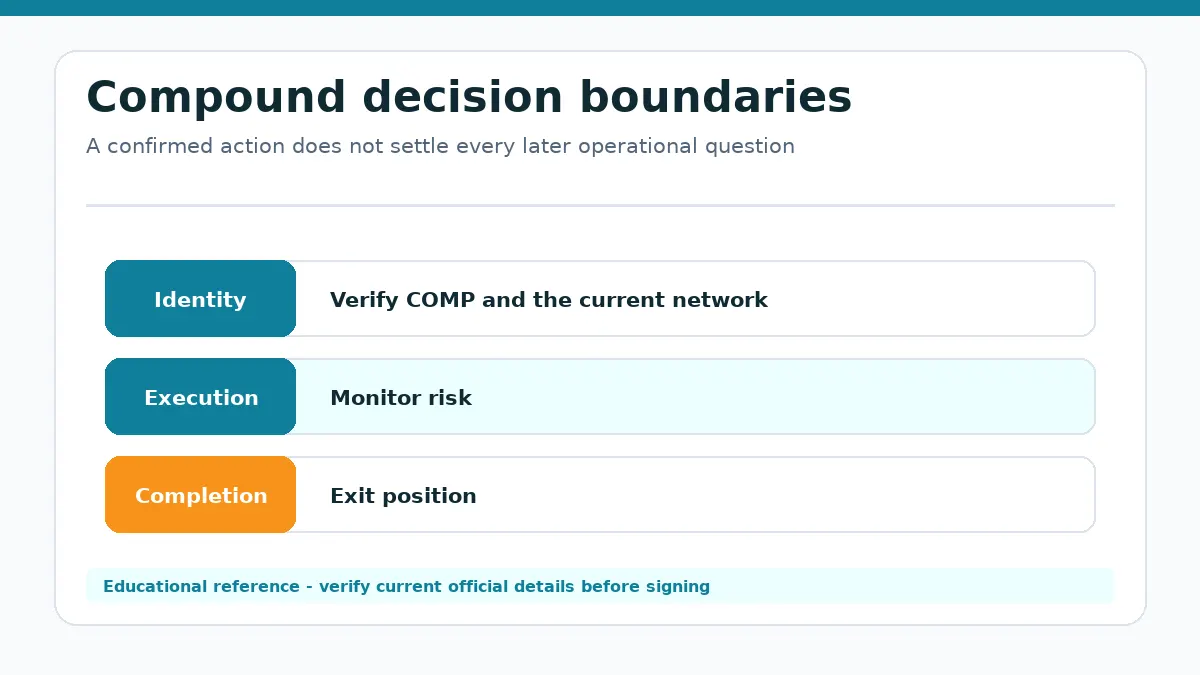
Compound confirmation does not settle every later operational question.
Supply or borrow
A base-asset supplier connects to the correct deployment, approves and supplies the asset, then monitors the supply rate and available liquidity. A borrower supplies an approved collateral asset and withdraws the base asset, which creates debt under the market's accounting rules.
As collateral value, rates or borrowing limits change, the account can approach liquidation. Repaying base debt restores capacity; collateral should only be withdrawn after confirming the account remains within its borrowing constraint.
Exit deliberately
Suppliers should check utilization and available cash before expecting an immediate full withdrawal. Borrowers should account for accrued interest and network fees rather than relying on the original borrowed amount.
COMP Governance and the Risks of a Compound Position
COMP is a governance token; the Compound lending balances themselves use the assets configured in each market.
What COMP does not do
COMP does not automatically represent a deposit, pay all network gas, remove liquidation risk or guarantee a share of protocol income. Governance participation can influence supported deployments and parameters, but holding COMP is separate from supplying a base asset or posting collateral.
Users should not treat token-market performance as evidence that a particular lending market is safe or liquid.
Position-specific failure modes
Smart-contract defects, oracle problems, collateral volatility, utilization spikes, governance changes and bridge or network risk can affect positions. Common mistakes include assuming collateral earns interest, borrowing near the limit, selecting the wrong deployment and ignoring accrued debt when planning repayment.
Why Compound's Design Matters
The two protocols share an overcollateralized lending purpose but expose different market structures and features.
What Compound users should verify and why this design differs
Compound III centers a market on one base asset with selected collateral. Aave deployments can support several supplied and borrowed assets within a broader governed market and may expose features unavailable in a given Compound deployment. The trade-off is not simply simplicity versus complexity; it includes liquidity, collateral treatment, rate models and available risk controls.
Users should compare the same chain and asset pair, then review liquidation thresholds, oracle sources, current utilization and withdrawal depth.
Compound Position management FAQ
What should I verify before a Compound transaction?
Check the official destination, current network, asset representation, amount, recipient and requested permissions. Users supply the base asset to earn utilization-based interest or supply approved collateral to borrow the base asset. Price feeds and collateral factors determine borrowing capacity and liquidation eligibility. After confirmation, inspect the resulting balance or protocol state instead of relying only on a wallet success message.
Can a successful Compound transaction still leave a position unsafe?
Yes. Execution success does not measure collateral, debt, utilization, liquidity or liquidation exposure after the state change.
Known Limitations
Deployments, rates and collateral parameters can change.
Oracle and manager risks are market-specific.
The page does not calculate or monitor a live account.
Market Data Methodology
The page uses a CoinGecko aggregated COMP/USD snapshot. No exchange chart is rendered for this entity.
Market Snapshot Source
CoinGecko aggregated market data (COMP/USD)
Cache
Snapshot cache is approximately 60 seconds.
Failure Handling
Verified cached data is labeled Cached or Delayed. Missing values remain unavailable.