Monero is a Proof of Work payment network that makes sender selection, recipient addresses and transferred amounts difficult to trace on its public ledger. XMR is the native value and fee asset, while wallets manage privacy-specific keys and output scanning. This page focuses on how Monero Transactions Protect Privacy and the checks users need before sending funds, paying fees or using the network.
Use Monero privacy features without assuming the wallet, network connection or counterparties reveal nothing.
Subject:
Monero
Market mode:
Snapshot Only
Fee asset:
XMR
Timezone:
UTC
This page does not guarantee anonymity, operate a remote node, inspect a transaction or recommend ways to evade legal obligations.
Content ownership: BitcoinToolkit Editorial TeamTechnical references: Official protocol and developer documentation.Review approach: Technical explanations are checked against primary sources and updated when the network or asset changes.Last content review: Data integration last tested:
How Monero Transactions Protect Privacy
Monero combines several mechanisms because no single cryptographic feature hides every transaction relationship.
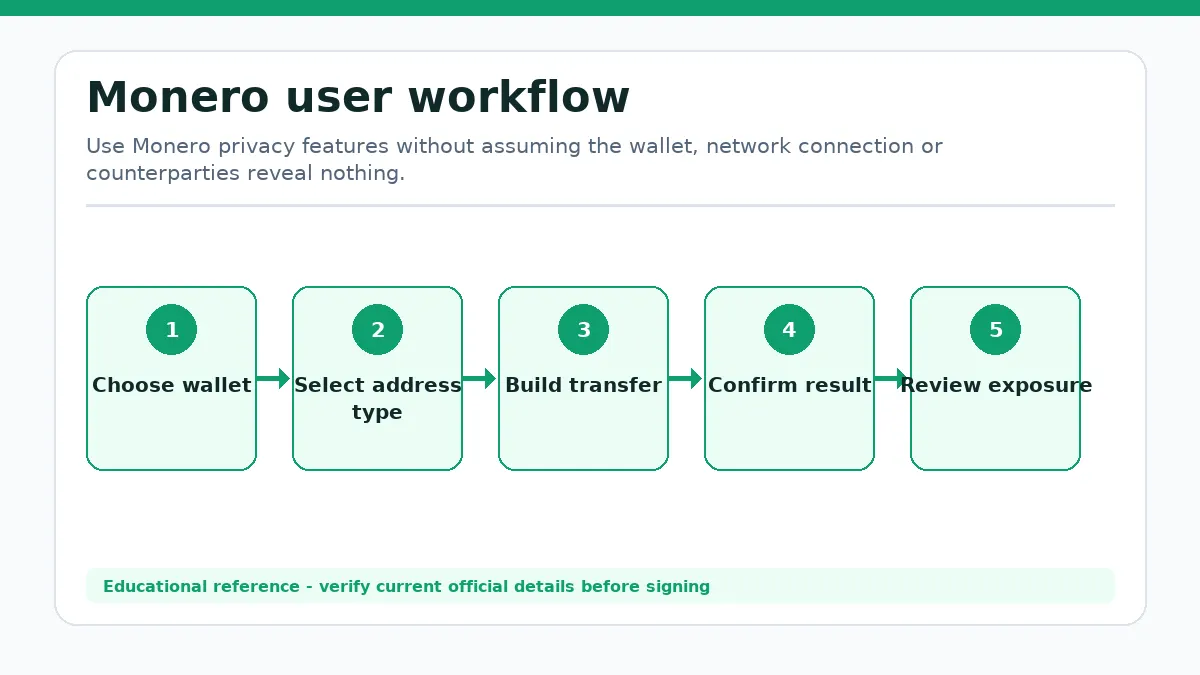
Monero workflow from the first user decision to a verified outcome.
Sender, recipient and amount privacy
Ring signatures place the real spent output among decoys so an observer cannot directly identify which ring member authorized the spend. Stealth addresses make the sender derive a one-time output for the recipient, preventing published wallet addresses from appearing as ordinary reusable destinations on the ledger.
Ring Confidential Transactions hide transferred amounts while still allowing nodes to verify that inputs and outputs balance. These protections make Monero activity less transparent by default than Bitcoin-style ledgers, but privacy is probabilistic and operational context can still expose information outside the chain.
A wallet must scan outputs because the public ledger does not list a readable balance beside a published address.
View and spend authority
Monero wallets use private view information to test ledger outputs and discover incoming funds. Spending additionally requires private spend authority. A watch-only setup can monitor incoming activity with a view key, but official documentation warns that outgoing visibility can be incomplete, so it should not be treated as a perfect accounting export.
Wallet synchronization may take time because relevant outputs must be scanned. An incorrect restore height can hide older incoming funds until the wallet rescans from an earlier point. Sharing a private view key deliberately reduces privacy for the information it reveals and should be handled as sensitive data.
XMR Fees, Mining and Spendability
Transaction size and network conditions affect fees, while mining controls confirmation progress.
Proof of Work settlement
XMR fees compensate miners and depend on transaction weight rather than a sat/vB unit copied from Bitcoin. Privacy proofs, inputs and outputs contribute to transaction size. Wallet software normally estimates an appropriate fee, and a user should review the selected priority instead of assuming all private transactions cost the same.
Monero uses RandomX Proof of Work and targets blocks at roughly two-minute intervals. A transaction first appears in the pool, then gains confirmations as blocks extend the chain. Wallets and services may wait for an unlock period or a chosen number of confirmations before treating outputs as spendable.
Monero Privacy Mistakes to Avoid
Strong ledger privacy does not erase internet, endpoint or behavioral metadata.
Operational privacy matters
A remote node can observe connection details and wallet requests even though it cannot read private keys. Internet providers, malware, exchange records, timing patterns and recipient behavior can also reveal context. Users who need stronger network privacy must understand node trust and routing rather than assuming the protocol automatically hides an IP address.
Reusing identifying information, combining exchange withdrawals with personal details or disclosing view data can reduce practical privacy. Verify the destination format, keep wallet software current, back up the seed securely and test recovery. A confirmed private transaction remains irreversible, so privacy features do not recover funds sent to the wrong recipient.
Protect both view and spend secrets.
Use a trusted node path.
Allow the wallet to finish scanning.
Treat off-chain records as part of the privacy model.
A Monero privacy feature can work as designed while wallet choice, address reuse, counterparties or network metadata still reveal information.
The XMR result needs context
Ring signatures obscure the real spent output among decoys, stealth addresses create one-time destinations, and RingCT hides amounts. RandomX miners order transactions and secure the chain; wallets scan the ledger with private view data to discover incoming funds.
XMR is the market asset shown in the snapshot. Transaction fees are paid in XMR.
What Monero users should verify and why this design differs
Privacy can be weakened by network and counterparty metadata. Wallet software and protocol details evolve.
For Monero, the practical sequence is Choose wallet, Select address type, Build transfer, Confirm result, Review exposure. Confirm the official destination and current network, then inspect the final balance, position, receipt or documented exit state that actually completes the task: Use Monero privacy features without assuming the wallet, network connection or counterparties reveal nothing.
Monero Privacy use FAQ
Are Monero transactions completely anonymous?
Monero provides strong default on-chain privacy, but network, wallet, exchange and behavioral metadata can still expose information.
What is a Monero view key?
View information lets a wallet identify incoming outputs and can be shared selectively, but it is sensitive and not a perfect record of outgoing activity.
What pays Monero fees?
Transaction fees are paid in XMR and compensate Proof of Work miners.
Known Limitations
Privacy can be weakened by network and counterparty metadata.
Wallet software and protocol details evolve.
The page does not inspect a transaction or node.
Market Data Methodology
The page uses a CoinGecko aggregated XMR/USD snapshot. No exchange chart is rendered for this entity.
Market Snapshot Source
CoinGecko aggregated market data (XMR/USD)
Cache
Snapshot cache is approximately 60 seconds.
Failure Handling
Verified cached data is labeled Cached or Delayed. Missing values remain unavailable.