TRON (TRX): How Energy, Bandwidth and Token Transfers Work
TRON is an account-based smart-contract network. TRX is its native currency, the asset used for staking and voting, and the fallback currency burned when an account lacks the Bandwidth or Energy required by a transaction. This page focuses on how TRON Energy, Bandwidth and Token Transfers Work and the checks users need before sending funds, paying fees or using the network.
Estimate what a TRON transaction needs and avoid confusing TRX, Bandwidth, Energy and TRC tokens.
Subject:
TRON
Market mode:
Snapshot Only
Fee asset:
TRX
Timezone:
UTC
This page does not estimate the live Energy cost of a contract, select a Super Representative or validate a destination address.
Content ownership: BitcoinToolkit Editorial TeamTechnical references: Official protocol and developer documentation.Review approach: Technical explanations are checked against primary sources and updated when the network or asset changes.Last content review: Data integration last tested:
How TRON Energy, Bandwidth and Token Transfers Work
TRON does not present every cost as a single Ethereum-style gas number.
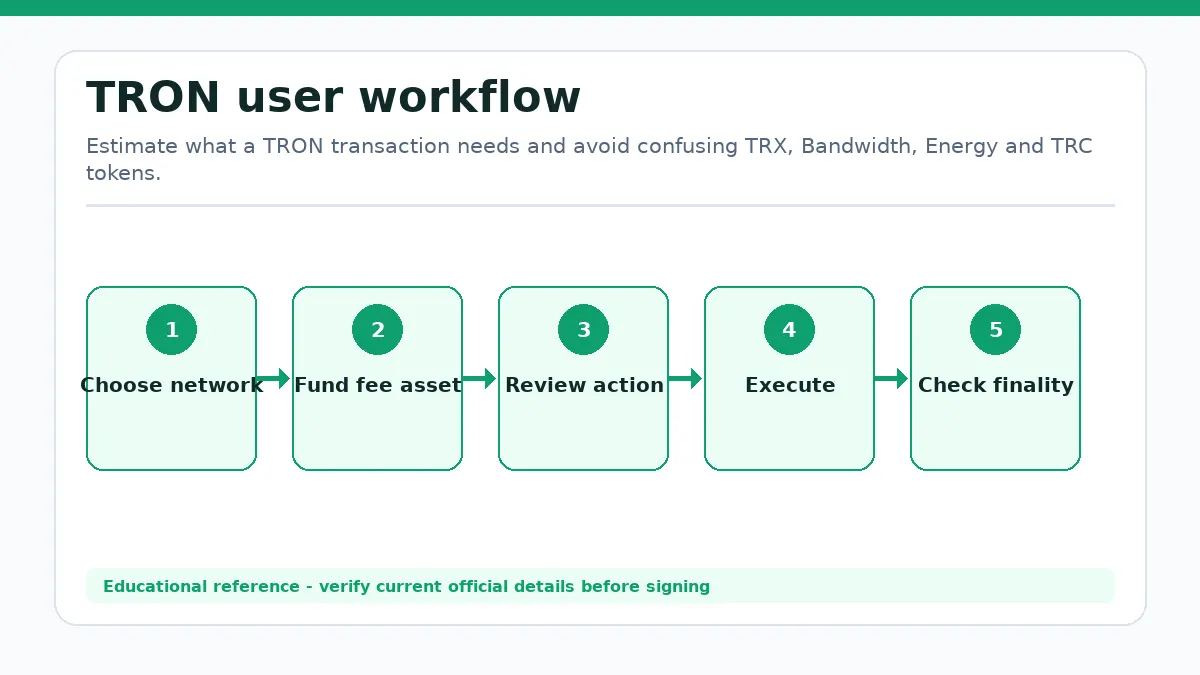
TRON workflow from the first user decision to a verified outcome.
Two resource meters
Bandwidth reflects the serialized size of an on-chain transaction. Accounts receive a limited free allocation and can obtain more by staking TRX. If the available Bandwidth is insufficient, protocol rules can burn TRX to pay for the missing amount. Transfers, account actions and contract transactions all consume Bandwidth.
Energy measures computation performed by the TRON Virtual Machine. Contract calls, including many TRC-20 transfers, consume Energy as well as Bandwidth. Popular contracts can be affected by the dynamic Energy model, and a contract deployer may share part of the Energy cost. Users should estimate the specific call instead of assuming every token transfer has the same fee.
TRON Tools
Fee Calculators
$
Stablecoin Transfer Fee Calculator
Estimate USDC, USDT and DAI transfer fees across verified networks. Compare fee assets, cost ranges, fee percentages and sender total cost.
Addresses can hold TRX and tokens, call contracts and participate in network voting.
Account activation and native value
TRON uses externally controlled accounts and contract accounts. A newly generated address may need on-chain activation before normal API queries and contract interactions work as expected. TRX transfers move native value, while TRC-10 and TRC-20 assets follow their own issuance or contract rules inside the same account environment.
TRX has several network roles: it transfers value, can be staked for resources, creates voting power and can be burned to cover resource deficits. A TRC-20 token balance cannot replace TRX when the account needs to pay an uncovered resource cost.
Super Representatives and Transaction Confirmation
TRON security and governance depend on elected block producers rather than open proof-of-work mining.
Delegated block production
TRX holders can stake to receive TRON Power and vote for Super Representatives. Twenty-seven elected representatives take turns producing blocks and validating network activity. Staking can also allocate Bandwidth or Energy, so governance participation and transaction resources share the same locked TRX base while remaining distinct outcomes.
A broadcast transaction should be checked for execution result as well as block inclusion. Smart-contract transactions can consume resources and still fail because of a revert, an inadequate fee limit or changing Energy requirements. Receiving services may apply their own confirmation threshold beyond the first visible block.
The largest practical risks are wrong-network deposits, resource assumptions and unverified contracts.
Prepare before signing
Confirm that the destination explicitly supports TRON and the intended token standard. Check whether the address is activated, whether the token contract is canonical and whether the sender has enough Bandwidth, Energy or TRX to cover the expected deficit. A displayed token value does not reveal the execution cost of its contract.
Use a current wallet or node estimate for contract calls and set a sensible fee limit. Review unstaking wait periods before locking TRX for resources. Never paste a private key into an Energy rental page or assume that a similar Base58 address means another network can receive the transfer.
Match TRON and the exact token contract.
Check both Bandwidth and Energy.
Keep TRX for uncovered costs.
Verify transaction execution, not only submission.
TRON meters transaction bytes with Bandwidth and smart-contract computation with Energy. Staking TRX can allocate these resources and voting power, while elected Super Representatives produce and validate blocks under delegated proof of stake.
A TRON transaction can execute successfully while the application state, contract permission or later exit remains wrong for the user's goal. TRX is the market asset shown in the snapshot. TRX can be burned when an account lacks Bandwidth or Energy.
What TRON users should verify and why this design differs
Resource prices and governance parameters can change. A contract call may consume resources even when execution fails.
For TRON, the practical sequence is Choose network, Fund fee asset, Review action, Execute, Check finality. Confirm the official destination and current network, then inspect the final balance, position, receipt or documented exit state that actually completes the task: Estimate what a TRON transaction needs and avoid confusing TRX, Bandwidth, Energy and TRC tokens.
TRON Network use FAQ
What pays TRON transaction costs?
Bandwidth and Energy are consumed first; TRX can be burned when the account lacks the required resources.
Does every TRON transaction use Energy?
No. All on-chain transactions use Bandwidth, while smart-contract execution also uses Energy.
What does staking TRX provide?
Staking can allocate Bandwidth or Energy and creates voting power for Super Representative elections.
Known Limitations
Resource prices and governance parameters can change.
A contract call may consume resources even when execution fails.
The page does not calculate a live fee limit.
Market Data Methodology
The page uses a CoinGecko aggregated TRX/USD snapshot. No exchange chart is rendered for this entity.
Market Snapshot Source
CoinGecko aggregated market data (TRX/USD)
Cache
Snapshot cache is approximately 60 seconds.
Failure Handling
Verified cached data is labeled Cached or Delayed. Missing values remain unavailable.