Hyperliquid is one blockchain with two closely connected execution environments: HyperCore for native exchange and financial actions, and HyperEVM for EVM-compatible smart contracts. HYPE is the ecosystem asset and the native gas token on HyperEVM. This page focuses on how HYPE Moves and Pays Costs and the checks users need before sending funds, paying fees or using the network.
Use HYPE safely across HyperCore, HyperEVM, staking and trading workflows.
Subject:
Hyperliquid
Market mode:
Snapshot Only
Fee asset:
HYPE
Timezone:
UTC
This page does not execute trades, recommend validators, calculate liquidation risk or verify an unofficial HyperEVM application.
Content ownership: BitcoinToolkit Editorial TeamTechnical references: Official protocol and developer documentation.Review approach: Technical explanations are checked against primary sources and updated when the network or asset changes.Last content review: Data integration last tested:
How HYPE Moves and Pays Costs
Trading fees, staking balances and EVM gas are three different accounting contexts.
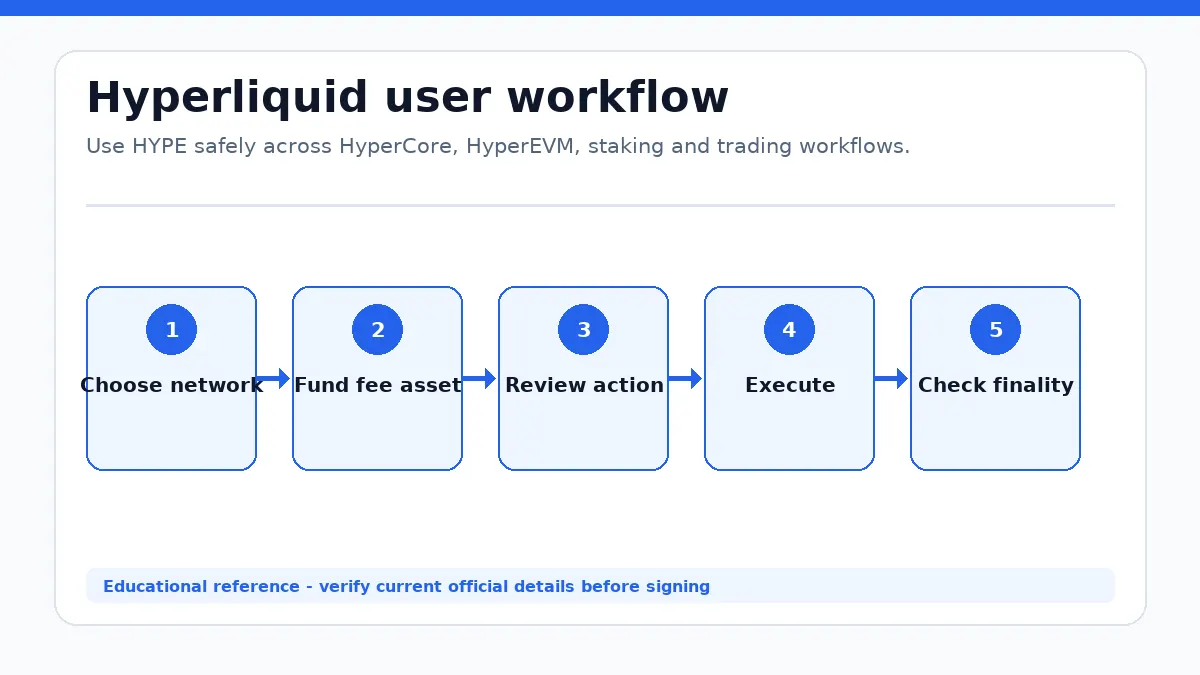
Hyperliquid workflow from the first user decision to a verified outcome.
Native transfers and gas
HYPE on HyperEVM uses 18 decimals and pays EVM execution gas. The network supports EIP-1559-style base fees, and official documentation notes that base and priority fees are burned under HyperBFT. A contract interaction therefore needs HYPE in the EVM account, not only a HYPE spot balance visible in HyperCore.
Native transfer actions move HYPE between HyperCore and HyperEVM. Trading on HyperCore follows maker, taker and product-specific fee schedules rather than an EVM gas calculation. Before a transfer, users should verify the direction, destination environment and official system action instead of sending to a copied contract address.
Where Hyperliquid Differs for Users
The environments are integrated, but a balance and action must still be addressed to the correct one.
Trading engine and smart-contract runtime
HyperCore contains the native order books, perpetual and spot market logic, staking actions and other protocol-native operations. It is not exposed as an ordinary EVM contract application. HyperEVM adds EVM blocks to the same blockchain so developers can deploy Solidity contracts and interact through JSON-RPC.
HyperEVM is not a separate rollup or an independent chain secured by Ethereum. Official documentation states that it inherits HyperBFT security alongside HyperCore. This shared foundation enables native connections between environments, but users still need to know whether an application expects a HyperCore spot balance or an EVM account balance.
Staking is a HyperCore workflow with transfer and withdrawal timing that should be planned before funds are locked.
Validator delegation
HYPE intended for staking must be in the appropriate HyperCore balance and then moved into a staking balance. Users select a validator and accept validator performance and operational risk. Staking documentation also describes delays when reversing the workflow, so staked HYPE is not equivalent to immediately liquid spot or EVM HYPE.
HyperBFT orders and finalizes the blockchain activity that supports both environments. A transaction becoming final does not guarantee a trade was profitable or a contract was safe. Application correctness, oracle behavior, margin requirements and smart-contract permissions remain separate layers of risk.
Most mistakes happen at the boundary between balances, environments and third-party interfaces.
Before you move, trade or stake
Confirm whether the destination expects HyperCore or HyperEVM, keep HYPE for EVM gas, and use the documented native transfer route. Review token identity before using an EVM asset because an identical ticker on HyperCore and a contract token on HyperEVM can represent linked but operationally distinct balances.
When staking, review validator information and withdrawal timing. When trading, separate exchange fees from network gas and calculate liquidation exposure independently. Hyperliquid documentation notes that community frontends can exist for HyperEVM, so users should verify the interface origin, permissions and transaction data before signing.
Identify HyperCore or HyperEVM first.
Keep HYPE in the environment that needs it.
Use documented native-transfer actions.
Treat interface and contract safety as separate checks.
Both environments inherit security from HyperBFT consensus, but they expose different account surfaces and workflows. Native transfers link HyperCore balances and HyperEVM balances; a normal third-party bridge or ERC-20 assumption can misdescribe that relationship.
A Hyperliquid transaction can execute successfully while the application state, contract permission or later exit remains wrong for the user's goal. HYPE is the market asset shown in the snapshot. HYPE is the native gas asset on HyperEVM; HyperCore trading fees follow the trading fee schedule.
What Hyperliquid users should verify and why this design differs
Trading and staking parameters can change. Third-party HyperEVM interfaces are not audited by this page.
For Hyperliquid, the practical sequence is Choose network, Fund fee asset, Review action, Execute, Check finality. Confirm the official destination and current network, then inspect the final balance, position, receipt or documented exit state that actually completes the task: Use HYPE safely across HyperCore, HyperEVM, staking and trading workflows.
Hyperliquid Network use FAQ
Is HyperEVM a separate blockchain?
No. Official documentation describes HyperCore and HyperEVM as parts of the same Hyperliquid blockchain secured by HyperBFT.
What pays HyperEVM gas?
HYPE is the native gas asset on HyperEVM.
Can HYPE be staked from an EVM balance directly?
The documented workflow moves HYPE to HyperCore and then into a staking balance.
Known Limitations
Trading and staking parameters can change.
Third-party HyperEVM interfaces are not audited by this page.
The market snapshot does not describe HyperCore liquidity or liquidation risk.
Market Data Methodology
The page uses a CoinGecko aggregated HYPE/USD snapshot. No exchange chart is rendered for this entity.
Market Snapshot Source
CoinGecko aggregated market data (HYPE/USD)
Cache
Snapshot cache is approximately 60 seconds.
Failure Handling
Verified cached data is labeled Cached or Delayed. Missing values remain unavailable.