Cardano (ADA): How Staking and EUTXO Transactions Work
Cardano is a proof-of-stake blockchain that uses an extended unspent transaction output model. ADA is its native asset for value, fees, staking and governance participation. This page focuses on how Cardano Staking and EUTXO Transactions Work and the checks users need before sending funds, paying fees or using the network.
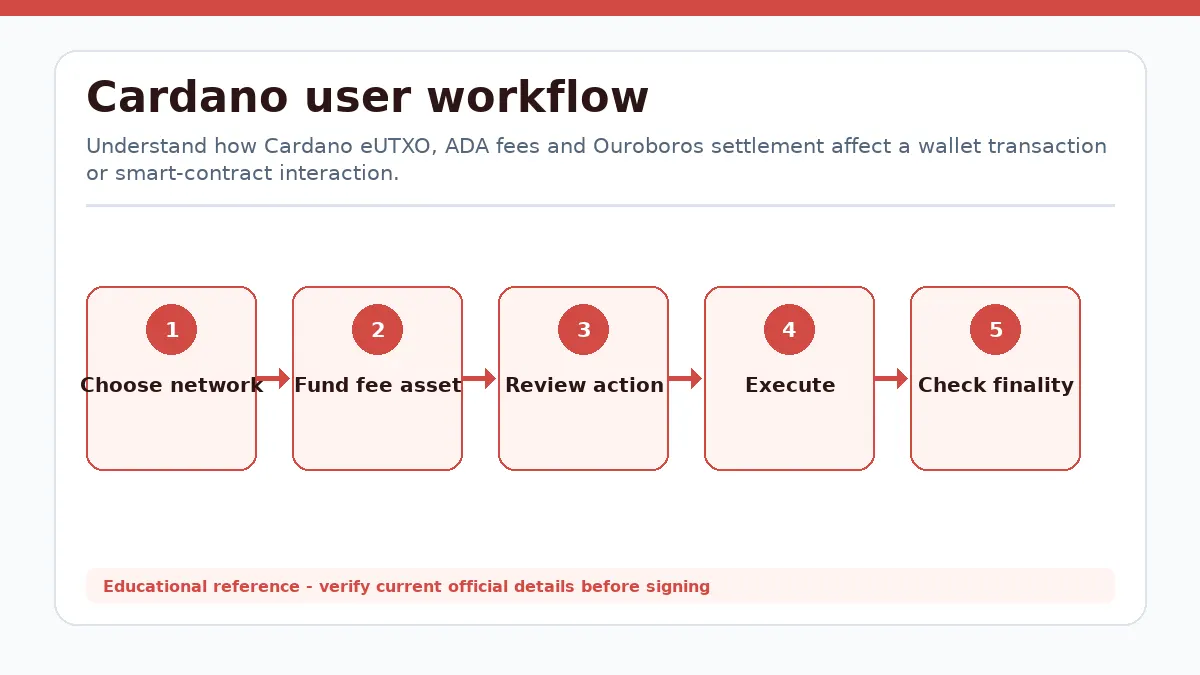
Understand how Cardano eUTXO, ADA fees and Ouroboros settlement affect a wallet transaction or smart-contract interaction.
Subject:
Cardano
Market mode:
Chart and Snapshot
Fee asset:
ADA
Timezone:
UTC
This page does not recommend a stake pool, guarantee rewards, estimate a live transaction or copy Bitcoin and EVM assumptions onto Cardano.
Content ownership: BitcoinToolkit Editorial TeamTechnical references: Official protocol and developer documentation.Review approach: Technical explanations are checked against primary sources and updated when the network or asset changes.Last content review: Data integration last tested:
How Cardano Staking and EUTXO Transactions Work
Delegation helps select block producers, while settlement confidence depends on chain depth.
Cardano workflow from the first user decision to a verified outcome.
Stake pools and delegation
Ouroboros selects slot leaders through stake-based protocol rules. Stake pools operate online nodes and delegators assign staking power without transferring ordinary spending control to the pool. Rewards depend on protocol parameters, pool performance, costs and epoch calculations rather than a guaranteed rate.
Delegating ADA is not the same as locking it in a generic staking contract. A wallet registers staking credentials and delegates them, while the ADA can remain spendable. Pool identity, retirement status and fees should be checked before delegation.
Settlement
Ouroboros allows recent chain segments to change under protocol conditions. Confidence grows with block depth, and stronger settlement relates to the stability window. Services choose confirmation policies based on value and risk instead of claiming instant deterministic finality.
ADA Candlestick Chart
ADA/USDT · Binance Spot · UTC
Historical Only
Pair
ADA/USDT
Venue
Binance Spot
Market Type
Spot
Interval
1H
Timezone
UTC
Last Update
Oct 11, 2026 05:05:17 UTC
Interval
Range
Long ranges automatically use a compatible candle interval.
Historical Binance Spot candles are available. JavaScript is required for current-candle updates.
Historical Binance Spot candles are available. JavaScript is required for current-candle updates.
Recent OHLC and volume data
Time (UTC)
Open (USDT)
High (USDT)
Low (USDT)
Close (USDT)
Volume (ADA)
Oct 11, 2026 05:00:00 UTC
0.25 USDT
0.25 USDT
0.25 USDT
0.25 USDT
113,844.00 ADA
Oct 11, 2026 04:00:00 UTC
0.25 USDT
0.25 USDT
0.25 USDT
0.25 USDT
2,474,388.70 ADA
Oct 11, 2026 03:00:00 UTC
0.25 USDT
0.25 USDT
0.25 USDT
0.25 USDT
6,056,764.10 ADA
Oct 11, 2026 02:00:00 UTC
0.25 USDT
0.25 USDT
0.25 USDT
0.25 USDT
3,181,108.00 ADA
Oct 11, 2026 01:00:00 UTC
0.25 USDT
0.25 USDT
0.25 USDT
0.25 USDT
3,347,269.30 ADA
Market data: Binance Spot ADA/USDT
Charting library: TradingView Lightweight Charts
Cardano Transaction and Fee Checks
Cardano tracks discrete outputs rather than mutating a global account balance.
Inputs, outputs and local state
A Cardano transaction consumes one or more unspent outputs completely and creates new outputs for recipients, change and scripts. An output can contain ADA plus native assets. Wallets perform coin selection because the displayed balance may be distributed across many separate UTXOs.
Extended UTXO adds script credentials, datum data, redeemers and transaction context. A validator script decides whether a particular output may be consumed. State is represented through outputs rather than a mutable EVM contract account, so application design and concurrency patterns are different.
Predictability and contention
A transaction can be evaluated against its declared inputs before submission. However, another valid transaction can consume an expected input first, so applications must handle contention and rebuild rather than assuming a global nonce queue.
Transaction size, script resources and UTXO structure determine what a wallet must assemble.
Fees and value balance
Cardano's minimum fee includes protocol parameters applied to serialized transaction size, with additional execution-unit costs for Plutus scripts. The transaction must balance inputs against outputs, deposits and ADA fees. Current parameters should be queried from the network.
Native assets can live directly in Cardano outputs without an ERC-20 contract for basic transfer, but ADA remains necessary for fees and minimum-output requirements. A wallet sending tokens must select token-bearing UTXOs, include required ADA and return correct change. Fragmented UTXOs can increase size and cost.
Script collateral
Transactions using phase-two scripts include ADA-only collateral so validation work is not free when script execution fails. Collateral is a specific transaction field, not the same thing as the normal transfer inputs.
The wallet must reason about outputs, not only a total balance.
Before signing
Verify the Cardano network and address, inspect selected inputs and all outputs, keep enough ADA for fees and minimum values, confirm native-asset policy IDs, and review collateral for script transactions.
Do not use EVM nonce or gas assumptions.
Do not copy Bitcoin script and fee wording.
Do not expect native tokens to pay ADA fees.
Do not treat delegation as custody transfer or guaranteed yield.
Next action
Use a Cardano-aware wallet to preview inputs, outputs, change, fees and token policy IDs, then wait for the receiving service's required settlement depth.
No. ADA is required for fees and minimum-output requirements.
Does Cardano use Ethereum accounts?
No. Cardano consumes and creates eUTXO outputs.
Is delegated ADA locked with a pool?
Delegation assigns staking power while the holder generally retains spending control.
What should I verify before a Cardano transaction?
Check the official destination, current network, asset representation, amount, recipient and requested permissions. Transactions consume complete UTXOs and create new outputs containing ADA, native assets and optional script data. Ouroboros stake pools produce blocks, while settlement confidence grows with block depth and the protocol stability window. After confirmation, inspect the resulting balance or protocol state instead of relying only on a wallet success message.
Known Limitations
Protocol parameters and governance rules can change.
Stake rewards are not guaranteed.
The page does not construct or inspect a specific transaction.
Market Data Methodology
The snapshot is CoinGecko aggregated ADA/USD data. The chart is Binance Spot ADA/USDT data. USD and USDT are separate quote units and values may differ.
Market Snapshot Source
CoinGecko aggregated market data (ADA/USD)
Candlestick Source
Binance Spot market data (ADA/USDT)
Pair
ADA/USDT
Venue
Binance Spot
Market Type
Spot
Timezone
UTC
Cache
Snapshot cache is approximately 60 seconds.
Failure Handling
Verified cached data is labeled Cached or Delayed. Missing values remain unavailable.