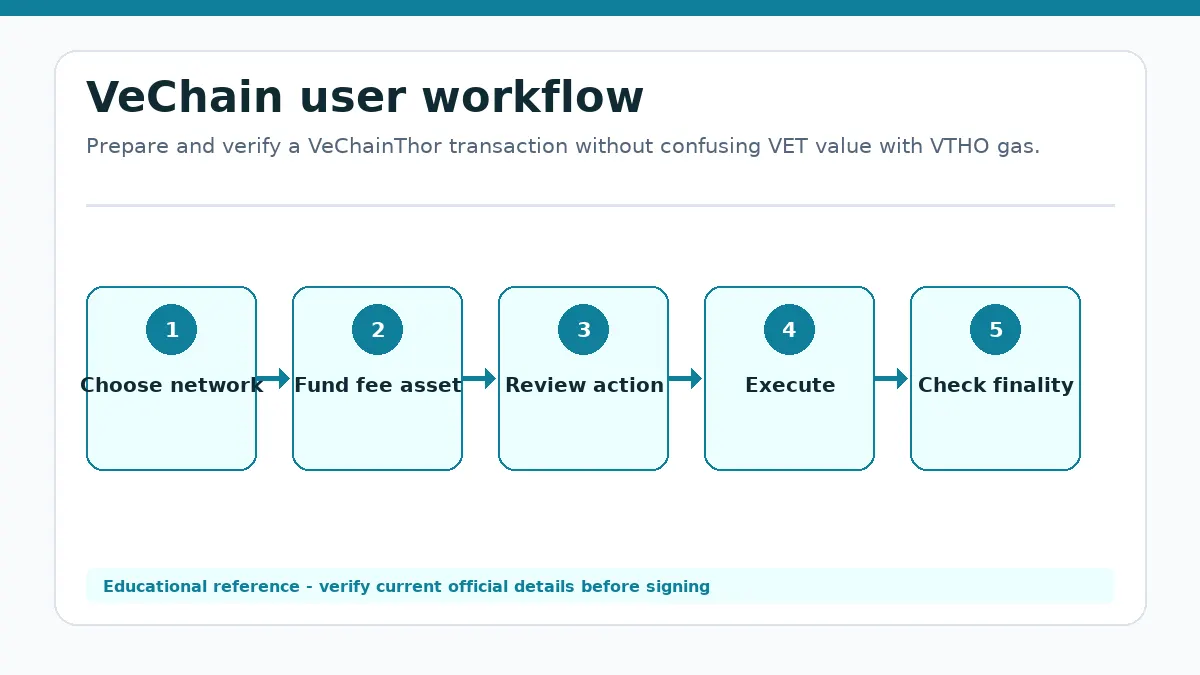
VeChainThor is an EVM-compatible Layer 1 network. VET is the value asset profiled on this page, while the separate VTHO token pays transaction and smart-contract execution fees. This page focuses on why VeChain Uses VET and VTHO and the checks users need before sending funds, paying fees or using the network.
Prepare and verify a VeChainThor transaction without confusing VET value with VTHO gas.
Subject:
VeChain
Market mode:
Chart and Snapshot
Fee asset:
VTHO
Timezone:
UTC
This is an educational network and market reference. It does not estimate a wallet's VTHO balance, approve authority nodes, execute transactions or provide investment advice.
Content ownership: BitcoinToolkit Editorial TeamTechnical references: Official protocol and developer documentation.Review approach: Technical explanations are checked against primary sources and updated when the network or asset changes.Last content review: Data integration last tested:
Why VeChain Uses VET and VTHO
The network deliberately separates the asset people value from the asset applications consume.
VeChain workflow from the first user decision to a verified outcome.
Two balances, two jobs
VET is the protocol-native value asset and the market subject of this page. A transfer can move VET between VeChainThor addresses, and VET also participates in the network economic model. Holding VET does not mean every wallet interface automatically exposes a spendable VTHO balance.
VTHO is the operational fee token. Gas used by a transfer or contract call is settled in VTHO, with fee-market rules determining the effective cost. A user preparing a transaction therefore needs the correct network, the intended VET or token balance, and enough VTHO unless an approved sponsor will pay.
What users should verify
A wallet label that says VeChain can hide the role split, so check the symbol beside each balance. VET market prices do not quote the cost of a particular transaction, and a VTHO fee estimate does not describe how much VET is being transferred. Contract tokens add a third balance type and cannot silently substitute for VTHO gas.
Historical Binance Spot candles are available. JavaScript is required for current-candle updates.
Historical Binance Spot candles are available. JavaScript is required for current-candle updates.
Recent OHLC and volume data
Time (UTC)
Open (USDT)
High (USDT)
Low (USDT)
Close (USDT)
Volume (VET)
Aug 25, 2026 15:00:00 UTC
0.01 USDT
0.01 USDT
0.01 USDT
0.01 USDT
2,378,466.20 VET
Aug 25, 2026 14:00:00 UTC
0.01 USDT
0.01 USDT
0.01 USDT
0.01 USDT
6,726,160.10 VET
Aug 25, 2026 13:00:00 UTC
0.01 USDT
0.01 USDT
0.01 USDT
0.01 USDT
13,843,162.70 VET
Aug 25, 2026 12:00:00 UTC
0.01 USDT
0.01 USDT
0.01 USDT
0.01 USDT
10,389,552.50 VET
Aug 25, 2026 11:00:00 UTC
0.01 USDT
0.01 USDT
0.01 USDT
0.01 USDT
4,061,946.00 VET
Market data: Binance Spot VET/USDT
Charting library: TradingView Lightweight Charts
VeChain Guidance for Holders
VeChainThor keeps an account-based EVM environment but adds transaction fields that ordinary Ethereum software may not expose.
Clauses and lifecycle controls
A transaction can contain several clauses. Each clause defines a recipient, value and data payload, and the clauses execute in their listed order as one atomic transaction. That design can batch transfers and contract calls, but it also means every clause must be reviewed before signing because one failing clause can affect the complete operation.
BlockRef and expiration constrain when the transaction is valid. A nonce, dependency fields and the chain tag help establish uniqueness and ordering. Developers migrating an Ethereum flow should use VeChain-aware libraries instead of assuming that a single to-value-data payload describes every signed action.
Fee delegation
VeChainThor supports designated gas payers and its Multi-Party Payment protocol. A sponsor can cover VTHO fees under configured rules, which can remove a gas-token step for an application user. Sponsorship is conditional: the transaction must request the supported flow, signatures must be valid and the sponsor or credit plan must have enough VTHO.
Authority Consensus and Finality
Authority-based participation changes the trust and operating model compared with permissionless proof-of-work networks.
Block production and finality
Identified Authority Masternodes participate in VeChainThor block production under network governance rules. This model prioritizes accountable operators and predictable execution rather than open anonymous mining. Applications should describe that tradeoff directly instead of reducing it to the generic phrase proof of stake.
VeChainThor finality rules add deterministic finality after the required voting rounds. A wallet can show a transaction soon after inclusion, but a service handling valuable or dependent actions should distinguish initial block inclusion from the finalized state reported by a current node or explorer.
Operational implication
Enterprise-oriented features do not remove ordinary signing, contract and integration risks. Authority status is not a warranty for an application, and fee delegation does not make a transaction free; it changes which authorized account pays the VTHO cost.
No. VTHO is the operational fee asset used for transaction execution.
Can one transaction call several contracts?
A VeChainThor transaction can contain several ordered clauses that execute atomically.
Can an application pay a user's fee?
Supported fee-delegation flows can authorize a sponsor to pay VTHO under configured conditions.
What should I verify before a VeChain transaction?
Check the official destination, current network, asset representation, amount, recipient and requested permissions. VeChainThor combines authority-based block production with chain-specific transaction features, including ordered clauses, controllable lifecycles and fee delegation. Its dual-token model means a VET balance and a VTHO gas balance solve different tasks. After confirmation, inspect the resulting balance or protocol state instead of relying only on a wallet success message.
Known Limitations
Authority and fee parameters can change after network upgrades.
A sponsor can reject or lack funds for a delegated fee.
The page does not inspect a specific wallet, contract or transaction.
Market Data Methodology
The snapshot is CoinGecko aggregated VET/USD data. The chart is Binance Spot VET/USDT data. USD and USDT are separate quote units and values may differ.
Market Snapshot Source
CoinGecko aggregated market data (VET/USD)
Candlestick Source
Binance Spot market data (VET/USDT)
Pair
VET/USDT
Venue
Binance Spot
Market Type
Spot
Timezone
UTC
Cache
Snapshot cache is approximately 60 seconds.
Failure Handling
Verified cached data is labeled Cached or Delayed. Missing values remain unavailable.