Sonic is an EVM-compatible Layer 1 and S is its native token for fees, staking, validators and governance. Sonic succeeds the Fantom Opera development path but is a separate network with a migration process from FTM. This page focuses on how Sonic Transactions Reach Finality and the checks users need before using the current asset or handling a legacy representation.
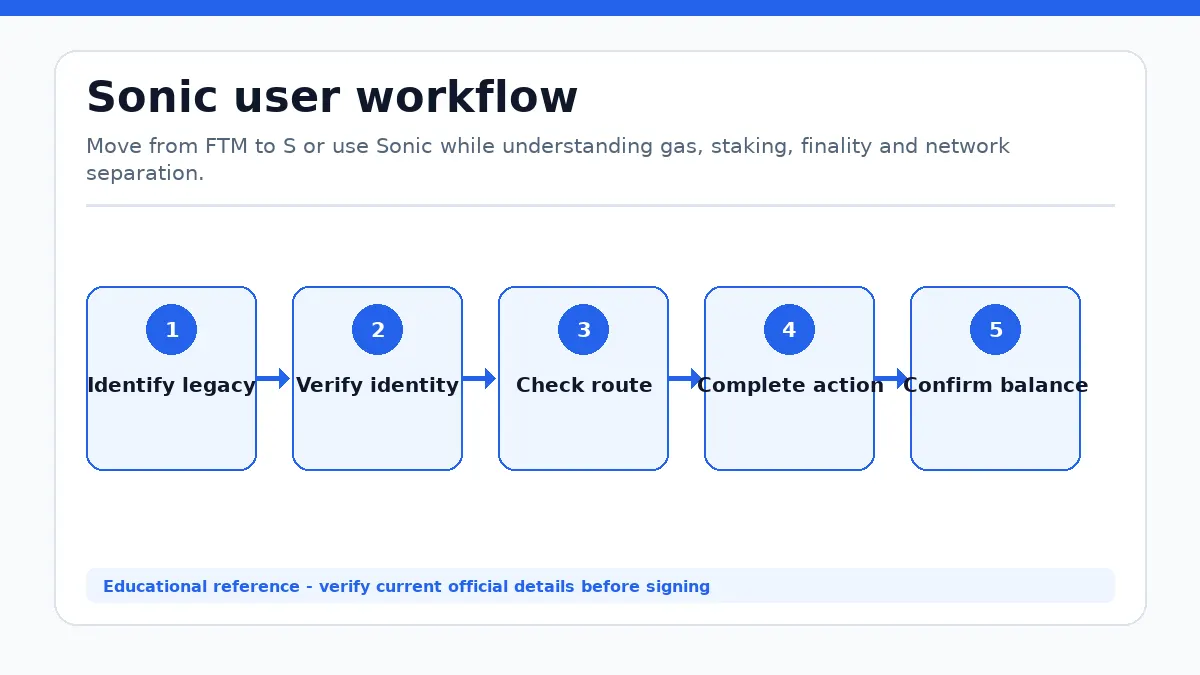
Move from FTM to S or use Sonic while understanding gas, staking, finality and network separation.
Subject:
Sonic
Market mode:
Snapshot Only
Fee asset:
S
Timezone:
UTC
This page does not perform an FTM migration, estimate rewards, operate a bridge or verify a Sonic contract.
Content ownership: BitcoinToolkit Editorial TeamTechnical references: Official protocol and developer documentation.Review approach: Technical explanations are checked against primary sources and updated when the network or asset changes.Last content review: Data integration last tested:
How Sonic Transactions Reach Finality
Validator event exchange and the final ordered chain are related stages.
Sonic workflow from the first user decision to a verified outcome.
Asynchronous BFT and DAG events
Sonic documentation describes validators creating and exchanging event blocks without requiring a single producer to serialize every step. Events that gain sufficient validator knowledge become roots and are ordered into the final main chain. The explorer presents the resulting blocks rather than every internal DAG event.
Current documentation describes transaction finalization on the order of one to two seconds under normal operation. Applications should still choose confirmation and risk policies based on value, contract behavior and service requirements rather than treating a speed estimate as a universal guarantee.
Sonic Operating Context
The asset migration and application migration are separate tasks.
From Fantom Opera to Sonic
Sonic launched as a new EVM network with S as its native token. Official migration guidance began with a two-way FTM and S swap, then moved to a one-way FTM-to-S route after the initial period. Users should follow the current upgrader rather than relying on an old bridge or exchange assumption.
Opera can continue to exist while development and liquidity focus move to Sonic. A wallet may therefore show FTM on Opera and S on Sonic at the same address. The balances, gas and contracts remain network-specific until a documented migration or bridge completes.
Token migration does not migrate every application asset
App tokens, liquidity positions and contract state require their own supported migration paths. Converting FTM to S does not automatically move a lending position, NFT or third-party token. Verify the application and destination contract before signing.
Exchange support can abstract parts of the process but introduces custody and network-selection rules. Confirm whether a deposit expects Opera FTM or Sonic S.
The same S fee can be distributed through several network rules.
Native execution and validator incentives
S pays ordinary Sonic gas and is also used by validators and delegators. Staking can earn network rewards and a share of applicable fees, subject to validator performance, withdrawal delay, slashing and current tokenomics. Users should retain liquid S for transactions rather than staking the entire balance.
Sonic Fee Monetization allows approved applications to receive a documented share of fees their contracts generate, with the remainder supporting validators. This is an application program, not a rebate owed to every transaction sender, and eligibility can change.
Common Sonic Migration Mistakes
Legacy naming and familiar EVM addresses make wrong-network errors easy.
Before converting or bridging
Confirm Opera or Sonic, FTM or S, and the official migration route. Verify app-token migrations separately, keep S for destination gas and inspect contract approvals. Do not use an old two-way-swap description as evidence that S can currently be converted back to FTM.
Choose validators using current performance and terms, account for the withdrawal period, and reject promises of fixed rewards. A quick finality signal does not make an unreviewed contract safe.
Choose the Next Sonic Resource
Continue with migration, staking or EVM context.
Migration, validator or tools
Use Sonic documentation for the current FTM upgrader and staking parameters. Compare Avalanche for a different EVM finality design, or use wallet and gas tools before interacting with a Sonic application.
A familiar S ticker can refer to a legacy representation, a current asset or an unsupported migration route.
The S result needs context
Validators exchange event blocks through an asynchronous Byzantine-fault-tolerant DAG process, then order finalized activity into the visible chain. S funds execution and staking, while the Fee Monetization program can route part of eligible application fees to developers.
S is the asset shown in the market snapshot. S pays Sonic transaction and smart-contract gas.
What Sonic users should verify and why this design differs
Migration and tokenomics rules can change. Finality timing is an operating expectation rather than a per-transaction guarantee.
For Sonic, the practical sequence is Identify legacy asset, Verify current identity, Check route, Complete action, Confirm balance. Confirm the official destination and current network, then inspect the final balance, position, receipt or documented exit state that actually completes the task: Move from FTM to S or use Sonic while understanding gas, staking, finality and network separation.
Sonic Migration checks FAQ
What pays gas on Sonic?
The native S token pays Sonic transaction and contract gas.
Can S always be swapped back to FTM?
Current migration guidance moved from an initial two-way period to a one-way FTM-to-S route.
Is Sonic the same chain as Fantom Opera?
No. Sonic is a separate network and balances require supported migration paths.
Known Limitations
Migration and tokenomics rules can change.
The page does not verify a migration contract or validator.
Market Data Methodology
The page uses a CoinGecko aggregated S/USD snapshot. No exchange chart is rendered for this entity.
Market Snapshot Source
CoinGecko aggregated market data (S/USD)
Cache
Snapshot cache is approximately 60 seconds.
Failure Handling
Verified cached data is labeled Cached or Delayed. Missing values remain unavailable.