UNUS SED LEO (LEO): How the LEO Burn Program Is Tracked
UNUS SED LEO is a utility token for the Bitfinex and wider iFinex ecosystem. It exists on Ethereum and Vaulta, after the former EOS representation followed that network rebrand. This page focuses on how the LEO Burn Program Is Tracked and the checks users need before using the protocol or evaluating the token role.
Use or transfer LEO while understanding current Bitfinex benefits, burn mechanics and network representations.
Subject:
UNUS SED LEO
Market mode:
Snapshot Only
Fee asset:
ETH / A
Timezone:
UTC
This page does not calculate Bitfinex benefits, verify account eligibility, predict burns or confirm a deposit address.
Content ownership: BitcoinToolkit Editorial TeamTechnical references: Official protocol and developer documentation.Review approach: Technical explanations are checked against primary sources and updated when the network or asset changes.Last content review: Data integration last tested:
How the LEO Burn Program Is Tracked
The public dashboard records acquisition and burn activity rather than guaranteeing a market outcome.
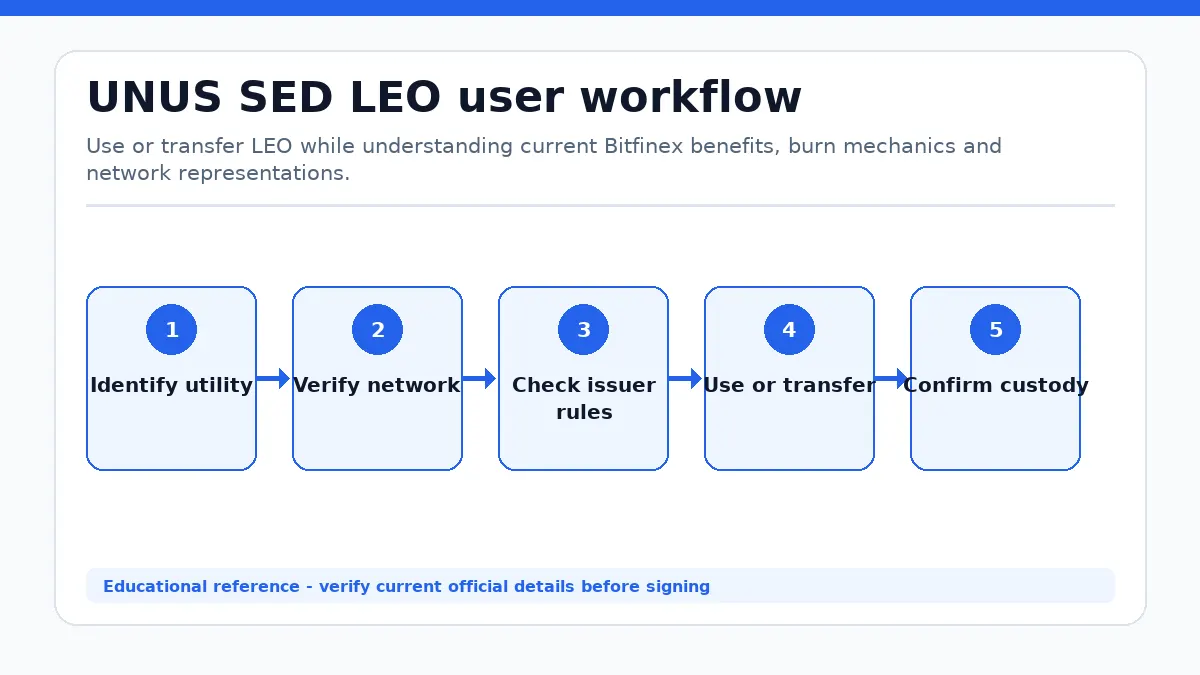
UNUS SED LEO workflow from the first user decision to a verified outcome.
Supply reduction and transparency
iFinex documentation describes a repurchase-and-burn framework tied to defined revenue and recovery categories. The transparency dashboard publishes supply, burned amount, pending burn values and individual burn transactions. Users can compare the current dashboard with the original whitepaper instead of relying on static token-supply summaries.
A burn permanently removes the reported tokens but does not guarantee price appreciation, platform profitability or a completion date. The input revenue, token acquisition price and legal or operational events can affect timing. A dashboard observation should therefore be dated and should not be projected as a fixed future schedule.
UNUS SED LEO Operating Context
The token remains active even though one prominent historical benefit ended.
Current benefits versus old descriptions
Bitfinex describes LEO as a utility token for its platform and related services. After Bitfinex moved maker and taker trading fees to zero in December 2025, the trading-fee discount linked to LEO stopped applying because there was no trading fee to discount. Current support materials still describe other benefits, including qualifying funding-fee discounts, affiliate multipliers and some deposit or withdrawal benefits.
Benefits depend on account verification, region, average holdings and the current fee schedule. A self-custody wallet balance may need to be deposited or converted inside Bitfinex before it counts toward a platform calculation. Holding LEO does not create a right to every product, and Bitfinex can change product terms.
Utility token is not company ownership
LEO does not represent shares, deposits or a general claim on iFinex assets. Platform benefits and the burn framework are contractual or operational token uses. Market value can move independently from the amount of any fee reduction or burn event.
Users should separate token utility from exchange custody risk. Keeping LEO at an exchange can make platform benefits easier to access but introduces account and custodian dependency; self-custody removes that account balance from immediate platform use and adds wallet and network responsibility.
LEO balances can use two different host networks and fee systems.
Choose the correct transport protocol
Bitfinex currently supports LEO as ERC-20 on Ethereum and on Vaulta. The Vaulta representation follows the 2025 rebrand of EOS. Ethereum transfers require ETH gas, while Vaulta transfers follow Vaulta account, resource and fee rules. LEO itself does not replace either host fee asset.
Exchange deposits and withdrawals must use the selected transport protocol. Confirm the network, address and any memo requirement, and verify that the receiver supports the same LEO version. A conversion inside Bitfinex can change representation, but sending directly between incompatible networks cannot.
Outdated benefit tables and the EOS-to-Vaulta rename create avoidable confusion.
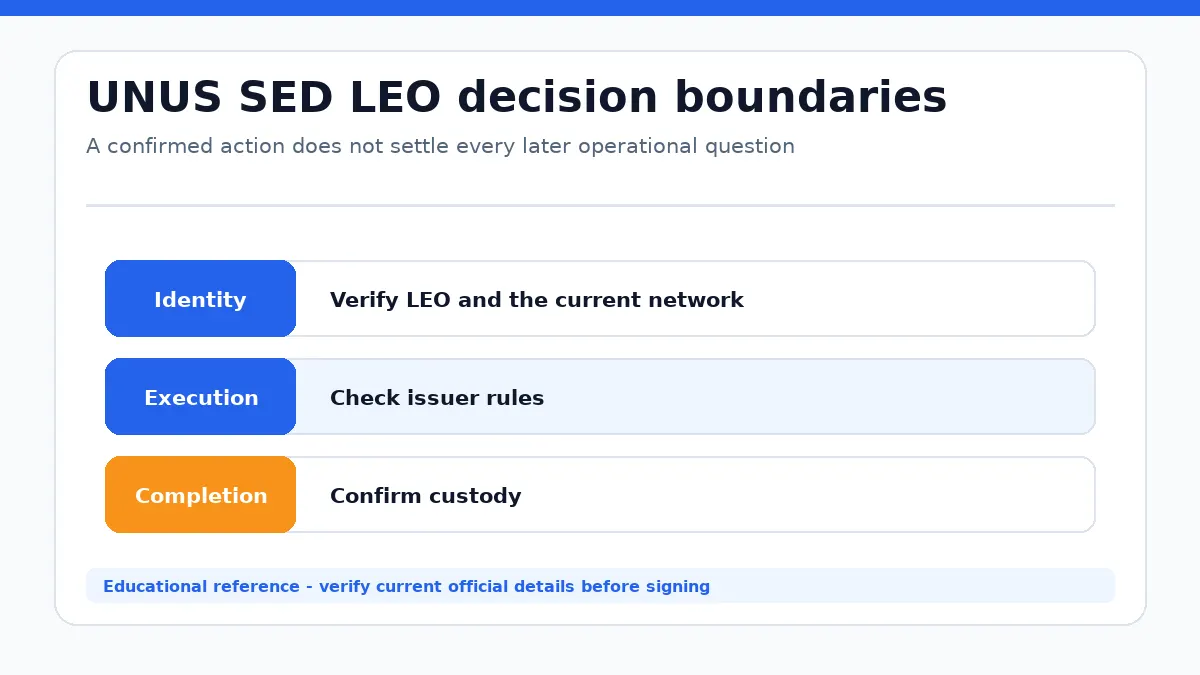
UNUS SED LEO confirmation does not settle every later operational question.
Before holding or transferring
Check the latest Bitfinex benefits page instead of assuming LEO still discounts spot trading. Confirm whether the balance must be held in a specific Bitfinex wallet or converted form. For withdrawals, choose Ethereum or Vaulta deliberately and keep the appropriate fee asset in self-custody.
Use the official contract and reject imitation tokens. Do not treat a burn as guaranteed investment return. Review exchange account restrictions, custody risk and the possibility that a product benefit changes independently of the token contract.
Choose the Next LEO Resource
Continue with current benefits, burn evidence or network handling.
Benefit schedule, dashboard or tools
Use current Bitfinex help pages for account-specific utility and the LEO transparency dashboard for dated burn evidence. Review Ethereum before an ERC-20 transfer. Use wallet and address tools for transfer checks without exposing private keys or relying on an unverified token list.
Eligible Bitfinex users can receive defined platform benefits based on LEO holdings, while iFinex operates a published acquisition-and-burn program. LEO transfers still use the selected blockchain fee asset and do not represent equity in iFinex.
Holding LEO does not guarantee exchange custody, withdrawal availability, discounts, redemption or issuer support. LEO is the utility token shown in the market snapshot. The selected host network asset pays transfer fees.
What UNUS SED LEO users should verify and why this design differs
Platform benefits and eligibility can change. Burn data does not predict price or completion timing.
For UNUS SED LEO, the practical sequence is Identify utility, Verify network, Check issuer rules, Use or transfer, Confirm custody. Confirm the official destination and current network, then inspect the final balance, position, receipt or documented exit state that actually completes the task: Use or transfer LEO while understanding current Bitfinex benefits, burn mechanics and network representations.
UNUS SED LEO Ecosystem use FAQ
Does LEO still reduce Bitfinex trading fees?
The former trading-fee discount no longer applies after Bitfinex moved those trading fees to zero; other benefits may remain.
Which networks support LEO?
Bitfinex currently supports Ethereum ERC-20 and Vaulta representations.
Does a LEO burn guarantee a higher price?
No. Burns reduce reported supply but do not guarantee a market outcome.
What pays transaction fees when using UNUS SED LEO?
Host-chain gas asset (ETH / A) pays the applicable network fee. The selected host network asset pays transfer fees. Verify the selected network before signing because a later approval, bridge, claim or exit can require another transaction.
Known Limitations
Platform benefits and eligibility can change.
Burn data does not predict price or completion timing.
The page does not verify a Bitfinex account or transfer destination.
Market Data Methodology
The page uses a CoinGecko aggregated LEO/USD snapshot. No exchange chart is rendered for this entity.
Market Snapshot Source
CoinGecko aggregated market data (LEO/USD)
Cache
Snapshot cache is approximately 60 seconds.
Failure Handling
Verified cached data is labeled Cached or Delayed. Missing values remain unavailable.