Mantle Network is an EVM-compatible Ethereum Layer 2, and MNT is its native L2 gas asset and an ecosystem governance token. This page focuses on how Mantle Gas Differs From Ethereum Gas and the checks users need before bridging assets, paying fees or waiting for finality.
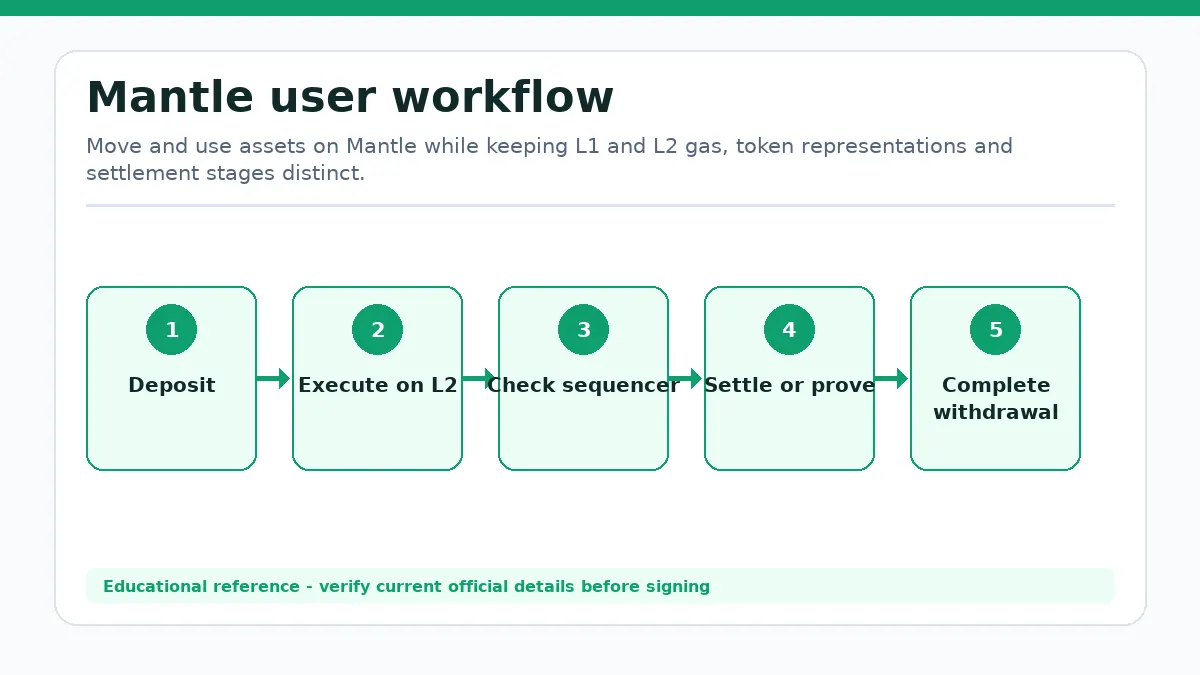
Move and use assets on Mantle while keeping L1 and L2 gas, token representations and settlement stages distinct.
Subject:
Mantle
Market mode:
Snapshot Only
Fee asset:
MNT
Timezone:
UTC
This page does not operate the bridge, verify a token contract, guarantee withdrawal time or provide investment advice.
Content ownership: BitcoinToolkit Editorial TeamTechnical references: Official protocol and developer documentation.Review approach: Technical explanations are checked against primary sources and updated when the network or asset changes.Last content review: Data integration last tested:
How Mantle Gas Differs From Ethereum Gas
The same EVM transaction vocabulary applies, but the fee currency changes across the L1 and L2 boundary.
Mantle workflow from the first user decision to a verified outcome.
MNT on Layer 2, ETH on Layer 1
Ordinary Mantle Network transactions pay gas in MNT. An Ethereum deposit transaction still requires ETH for L1 gas, and claiming a completed withdrawal on Ethereum also requires ETH. A user can therefore hold the bridged asset and still be unable to continue if the correct gas asset is missing on the current side.
Mantle fees reflect Layer 2 execution plus the network cost model for publishing or making transaction data available. Wallet estimates can change with L2 activity and underlying Ethereum conditions. The displayed MNT market snapshot does not quote the fee of a pending transaction.
Developer implications
Applications should query the Mantle RPC for gas estimates and should not hardcode ETH as the native EVM currency. Contract code that reads native value, wallet balance or fee fields must be tested with MNT semantics. Relayers and account-abstraction systems add separate sponsorship rules.
Mantle Operating Context
The network, its L2 gas currency and the Ethereum representation of MNT are related but not interchangeable wallet balances.
A separate EVM execution environment
Mantle Network has its own chain ID, RPC endpoints, contract deployments and transaction history while remaining connected to Ethereum as a Layer 2. Solidity contracts and EVM tooling can be reused, but an Ethereum contract address does not automatically contain the same code or asset on Mantle.
MNT is native on Mantle Network v2 and pays Layer 2 execution fees. MNT also has an Ethereum representation used in ecosystem and bridge workflows. A wallet can show both, so users must check the selected network and token contract rather than relying on the MNT ticker alone.
Governance is not settlement
MNT also participates in Mantle governance and ecosystem decisions. Holding MNT does not make a user a sequencer, guarantee bridge redemption or grant ownership of applications deployed on Mantle. Those systems have separate contracts, operators and risk assumptions.
Deposits, Withdrawals and Settlement Stages
Moving assets between Ethereum and Mantle is a cross-domain operation, not an ordinary same-chain transfer.
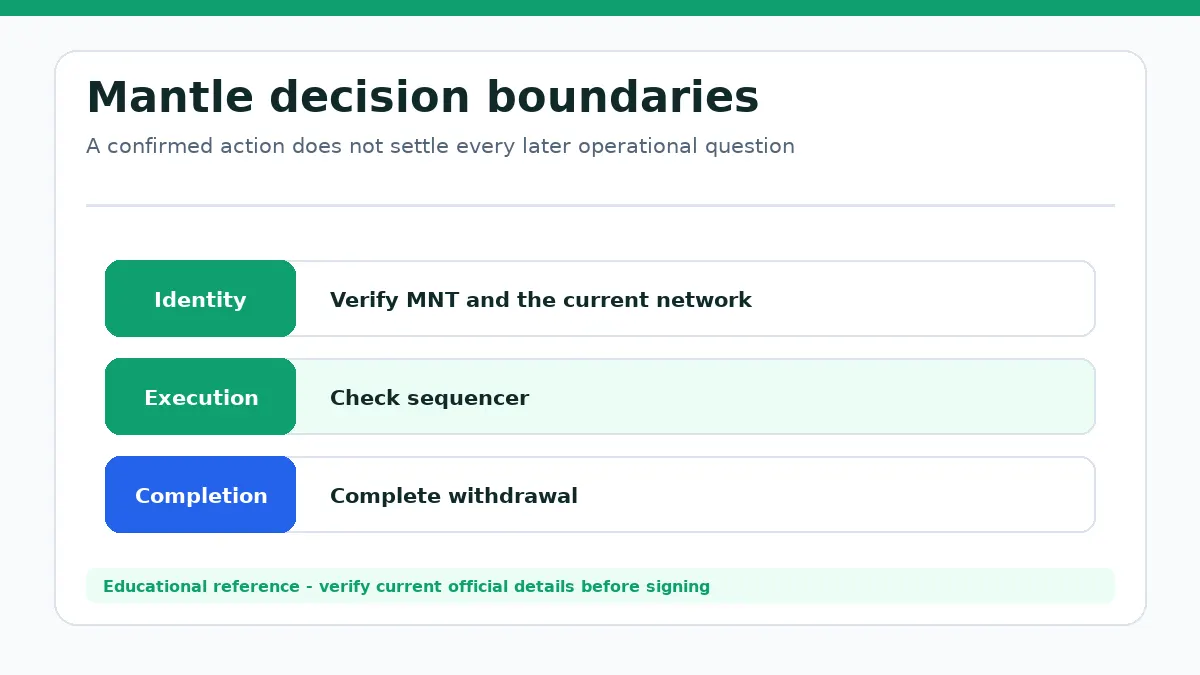
Mantle confirmation does not settle every later operational question.
Depositing to Mantle
A canonical deposit begins with an Ethereum transaction that locks or routes the supported asset and communicates the deposit to Mantle. The user pays ETH gas on Ethereum. After the L2 representation is credited, MNT is needed for further Mantle transactions. Token support and contract mappings must be checked before deposit.
A third-party bridge can use different liquidity, contracts and trust assumptions. Its speed does not change what the canonical bridge guarantees. Users should verify the bridge domain, source and destination networks, token representation, recipient and minimum received amount.
Withdrawing to Ethereum
A canonical withdrawal begins on Mantle, passes through proof or challenge-related settlement stages, and is later claimed on Ethereum. It can require MNT for the L2 initiation and ETH for the L1 claim. The interface should expose the current status rather than promising one fixed completion time.
Sequencer States, Data Availability and Finality
A fast sequencer confirmation and an Ethereum-finalized Layer 2 state answer different questions.
Unsafe, safe and finalized
The sequencer orders Mantle transactions and can provide quick inclusion. OP Stack-derived status labels distinguish newer unsafe blocks from data accepted into the broader settlement pipeline and from finalized L1-backed state. Applications should choose a state threshold based on the value and reversibility of the action.
Mantle uses a modular data-availability design rather than assuming every byte follows the simplest Ethereum calldata path. Data availability, batch submission, proof and upgrade mechanisms are distinct components. Users should rely on current network documentation because Mantle has an active ZK and modular-upgrade roadmap.
What EVM compatibility does not guarantee
EVM compatibility helps tools and contracts port, but it does not make bridge timing, fee currency, sequencer behavior or deployed addresses identical to Ethereum. A transaction final on Mantle cannot be treated as an Ethereum transaction without the required cross-domain process.
Most avoidable errors happen at the boundary between Ethereum and Mantle.
Operational checklist
Verify both network names, chain IDs, bridge domain, token contract or native asset, recipient and fee assets. Keep ETH on Ethereum and MNT on Mantle for the stages you plan to complete. Read the current withdrawal status before closing the bridge interface.
Do not send an L1 token directly to an L2 contract address.
Do not assume MNT and ETH pay gas on the same side.
Verify canonical versus third-party bridge assumptions.
Wait for the state level required by the receiving application.
What Mantle users should verify and why this design differs
Review Ethereum for the base-layer fee and settlement model. Developers should use current Mantle network information and bridge contracts. The tools directory provides general utilities, but it cannot replace the canonical bridge status for a real withdrawal.
Mantle Layer 2 use FAQ
What pays gas on Mantle Network?
MNT is the native gas asset on Mantle Network v2; Ethereum-side transactions still require ETH.
Is Mantle the same chain as Ethereum?
No. Mantle is a separate EVM-compatible Layer 2 with its own state and contracts, connected to Ethereum settlement.
Why can a Mantle withdrawal take longer than a transfer?
A canonical withdrawal crosses settlement, proof or challenge, and Ethereum claim stages rather than staying on one chain.
What should I verify before a Mantle transaction?
Check the official destination, current network, asset representation, amount, recipient and requested permissions. Mantle executes transactions on its Layer 2, orders them through a sequencer and relies on Ethereum-linked settlement and bridge processes. Its data-availability and proof roadmap must be evaluated separately from ordinary EVM compatibility. After confirmation, inspect the resulting balance or protocol state instead of relying only on a wallet success message.
Known Limitations
Mantle proof, data-availability and bridge behavior can change through upgrades.
Bridge timing depends on settlement state and current service conditions.
The page does not verify a bridge, token mapping, contract or transaction.
Market Data Methodology
The page uses a CoinGecko aggregated MNT/USD snapshot. No exchange chart is rendered for this entity.
Market Snapshot Source
CoinGecko aggregated market data (MNT/USD)
Cache
Snapshot cache is approximately 60 seconds.
Failure Handling
Verified cached data is labeled Cached or Delayed. Missing values remain unavailable.