Ripple USD (RLUSD): What Backs RLUSD and Who Can Redeem
Ripple USD is a dollar-referenced stable asset issued by Standard Custody & Trust Company and recorded on supported networks including the XRP Ledger and Ethereum. RLUSD is not the native currency of either network and does not have its own validators or consensus. This page focuses on what Backs RLUSD and Who Can Redeem and the checks users need before choosing a network, redeeming or moving funds.
Verify the RLUSD network, fee asset and redemption path before receiving, sending or redeeming.
Subject:
Ripple USD
Market mode:
Snapshot Only
Fee asset:
XRP or ETH
Timezone:
UTC
This page does not verify a pasted token address, determine redemption eligibility, guarantee one-dollar execution or recommend a bridge.
Content ownership: BitcoinToolkit Editorial TeamTechnical references: Official protocol and developer documentation.Review approach: Technical explanations are checked against primary sources and updated when the network or asset changes.Last content review: Data integration last tested:
What Backs RLUSD and Who Can Redeem
Reserve support and direct issuer access are related but separate questions.
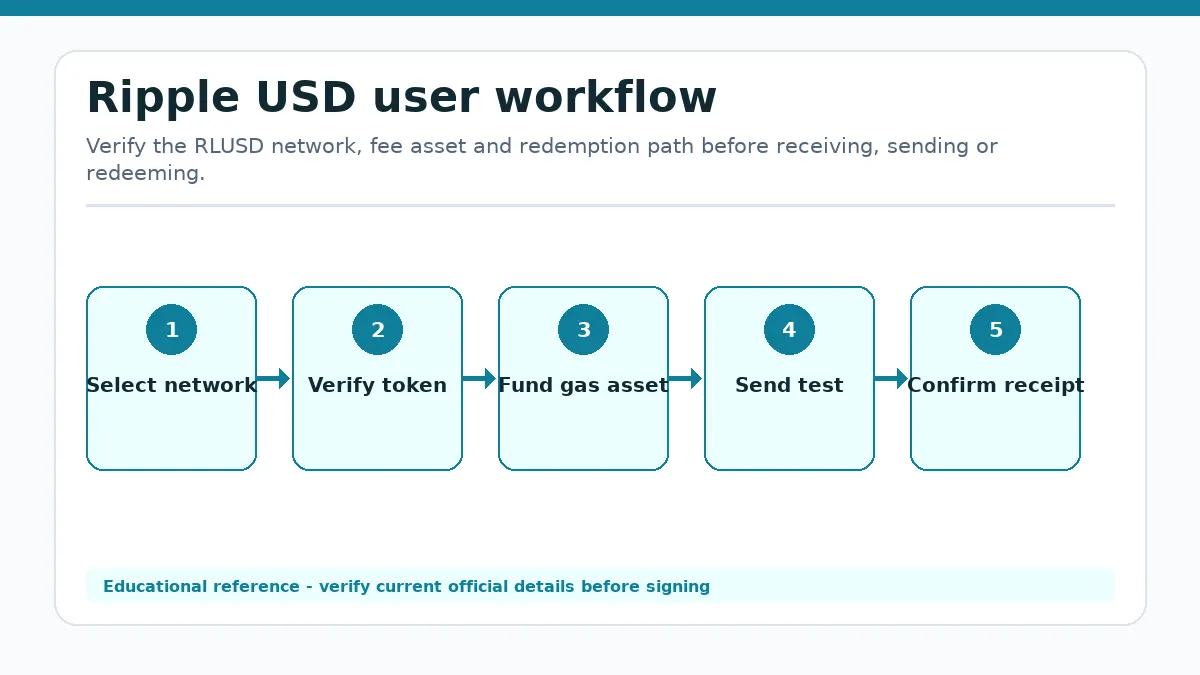
Ripple USD workflow from the first user decision to a verified outcome.
Issuer-backed value with eligibility limits
Ripple states that RLUSD reserves are held in segregated accounts and include U.S. dollar cash and highly liquid cash equivalents. Monthly reporting helps users inspect the reserve framework, but it does not make the token a bank deposit or guarantee that every exchange order fills at exactly one dollar.
Direct purchase and redemption are available to approved customers under Ripple and issuer terms, identity checks and jurisdictional limits. Other holders usually trade through an exchange or application. That secondary transaction depends on liquidity and counterparties rather than creating automatic access to issuer redemption.
The same ticker does not remove host-network requirements.
Trust lines, contracts and fee assets
On the XRP Ledger, RLUSD is an issued token. An account must be active and establish the correct issuer trust line before it can hold RLUSD. The account also needs XRP for its base reserve, any owner reserve associated with the trust line and transaction fees. RLUSD itself cannot replace XRP for those protocol requirements.
On Ethereum, RLUSD is transferred through a token contract and the wallet needs ETH for gas. An Ethereum token address is not interchangeable with the XRPL issuer and currency pair. Users should verify the exact network, official identifier and destination support rather than relying only on the RLUSD symbol.
Issuer Controls and Redemption Boundaries
Stable-asset operation includes compliance and contract controls.
What an on-chain balance does and does not promise
RLUSD terms allow issuer actions required by law or policy, and supported contracts can include controls associated with regulated issuance. A confirmed transfer proves that the ledger accepted the transaction; it does not prove that a recipient is eligible to redeem, that a bank transfer will settle immediately or that a platform will credit an unsupported network.
Redemption instructions require the correct nominated wallet and can require an XRPL destination tag for omnibus accounts. Banking settlement time can differ from the on-chain processing time. Users should treat custody, exchange, issuer, smart-contract and temporary depeg risks as separate dependencies.
Most preventable errors come from the wrong network, issuer or destination details.
A practical transfer sequence
Confirm whether both sides use XRP Ledger or Ethereum, verify the official issuer or contract, and keep XRP or ETH for network requirements. On XRPL, check the trust line and any destination tag. On Ethereum, review token approvals and the receiving contract or exchange network.
Send a small test when the destination is new. Do not assume a bridge produces issuer-native RLUSD or that an exchange accepting RLUSD supports both networks. For redemption, obtain current instructions from Ripple and verify the bank, wallet and compliance requirements before transferring the full amount.
Match the host network.
Verify issuer or contract.
Keep XRP or ETH for fees.
Confirm trust line and destination tag when required.
The issuer maintains reserve assets and provides mint and redemption access under eligibility and compliance terms. XRP Ledger RLUSD uses issued-token trust lines, while Ethereum RLUSD uses token contracts; each representation depends on its host network and fee asset.
A RLUSD ticker match can still point to the wrong network, contract or bridged representation. RLUSD is the market-profiled stable asset. XRP pays XRP Ledger fees and reserves; ETH pays Ethereum gas.
What Ripple USD users should verify and why this design differs
Supported networks and eligibility can change. The page does not validate a token address.
For Ripple USD, the practical sequence is Select network, Verify token, Fund gas asset, Send test, Confirm receipt. Confirm the official destination and current network, then inspect the final balance, position, receipt or documented exit state that actually completes the task: Verify the RLUSD network, fee asset and redemption path before receiving, sending or redeeming.
Ripple USD Transfers FAQ
Is RLUSD the same as XRP?
No. RLUSD is an issued dollar stable asset, while XRP is the native currency of the XRP Ledger.
What pays an RLUSD transfer fee?
XRP pays XRPL fees and reserves; ETH pays Ethereum gas.
Can every holder redeem with Ripple?
No. Direct redemption depends on customer eligibility, terms and compliance requirements.
Known Limitations
Supported networks and eligibility can change.
The page does not validate a token address.
Secondary prices can move away from the reference.
Market Data Methodology
The page uses a CoinGecko aggregated RLUSD/USD snapshot. No exchange chart is rendered for this entity.
Market Snapshot Source
CoinGecko aggregated market data (RLUSD/USD)
Cache
Snapshot cache is approximately 60 seconds.
Failure Handling
Verified cached data is labeled Cached or Delayed. Missing values remain unavailable.