Gram is the current name and GRAM the current ticker for the native currency of The Open Network, formerly called Toncoin with ticker TON. The blockchain remains TON; the 2026 rename did not create a new token contract, migrate balances or replace existing wallet addresses. This page focuses on gram Transfer and Staking Checks and the checks users need before using the current asset or handling a legacy representation.
Understand the TON-to-GRAM rename and safely prepare a native Gram transfer or staking action.
Subject:
Gram
Market mode:
Snapshot Only
Fee asset:
GRAM
Timezone:
UTC
This page does not migrate exchange balances, validate a jetton, choose a staking pool or recover a wallet.
Content ownership: BitcoinToolkit Editorial TeamTechnical references: Official protocol and developer documentation.Review approach: Technical explanations are checked against primary sources and updated when the network or asset changes.Last content review: Data integration last tested:
Gram Transfer and Staking Checks
Fake migration jettons and incorrect payment comments are the main rename-era risks.
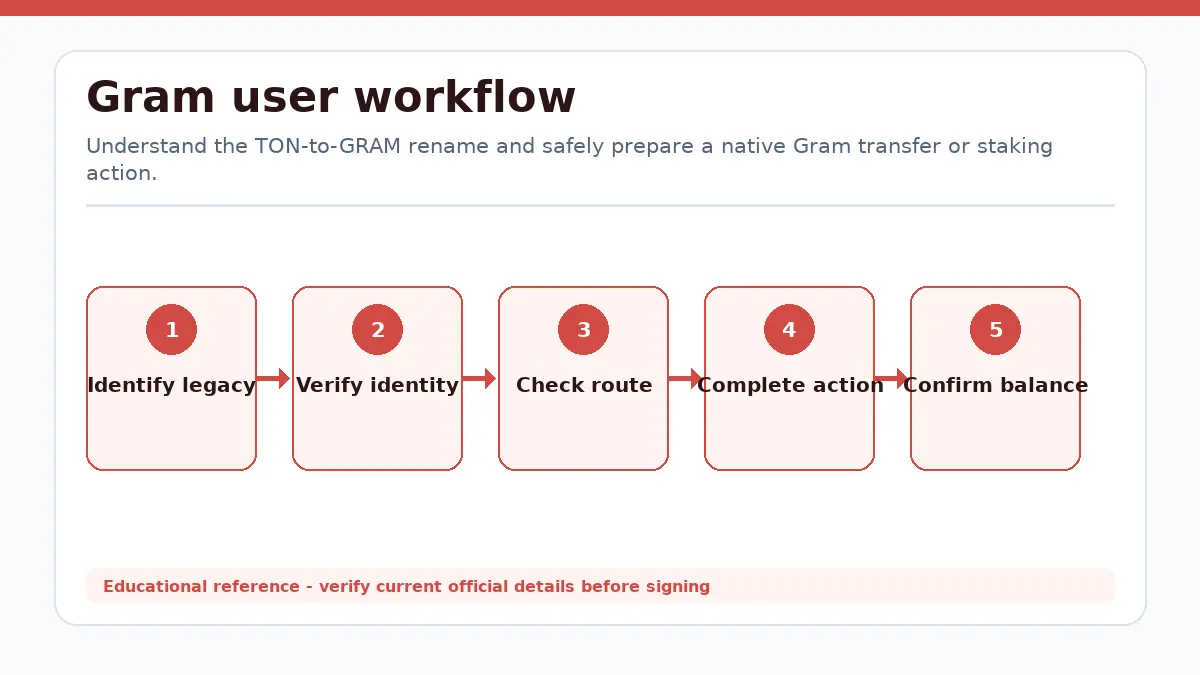
Gram workflow from the first user decision to a verified outcome.
Verify native currency and contract flows
Confirm TON mainnet, the wallet address and any required comment. Native GRAM is the network currency and does not need a jetton contract. Reject pages asking users to swap Toncoin through a contract solely because of the rename.
For staking, identify the exact pool or nominator contract, minimums, commission, validator responsibility, withdrawal behavior and fee reserve. Keep recovery phrases away from staking sites. On exchanges, confirm whether the platform has completed its display-ticker update before depositing or withdrawing.
The naming changed, while the TON ledger and user balances stayed in place.
A rename, not a token swap
TON official media guidance identifies Gram as the token name and GRAM as its ticker, formerly Toncoin or TON. The Open Network and its TON abbreviation remain the blockchain identity. Wallet addresses, smart contracts, balances and staking positions continue on the same network.
Users do not need to send native funds to a migration contract. Exchanges and market-data services may update symbols on different schedules, so old TON labels can remain visible temporarily. Verify whether a service means the blockchain, the former ticker or the current native asset before acting.
A wallet address represents deployed or deployable code and state, not an Ethereum-style external account.
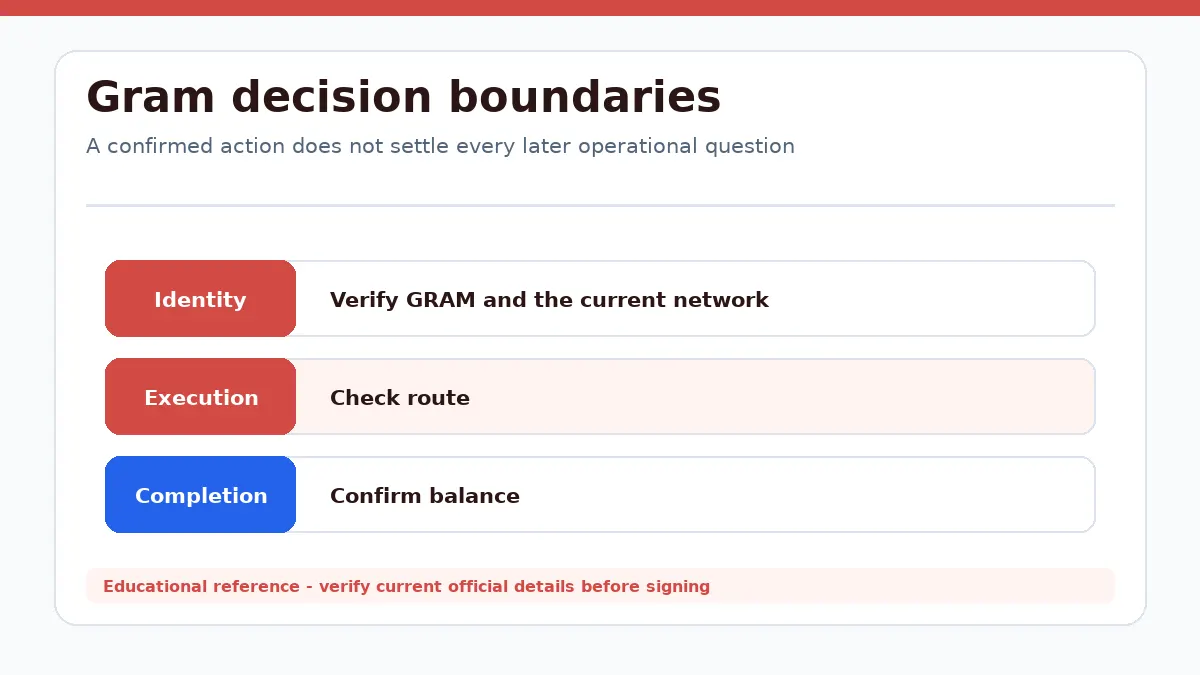
Gram confirmation does not settle every later operational question.
Messages drive transfers
A TON wallet contract receives an external message signed by its owner and sends internal messages to other accounts or contracts. Wallet versions and initialization state matter. An address can be derived before its contract is deployed, and the first transaction may initialize it.
Payment services often use one wallet plus a transaction comment or invoice identifier. A correct address with a missing comment can require manual recovery. Unique-deposit-address systems reduce comment dependence but add wallet deployment, storage and monitoring costs.
GRAM Fees, Storage and Sharded Delivery
TON fees can include computation, forwarding and persistent contract storage.
Asynchronous execution across shards
GRAM funds message execution and network resource charges. A wallet should retain enough balance for outbound processing and, where relevant, ongoing contract storage. Complex contract interactions can send several internal messages, so the final fee may involve more than one execution step.
TON splits account activity across shardchains and routes messages asynchronously. A sending wallet can record an outbound message before a downstream contract finishes all work. Applications should inspect resulting messages and destination state rather than treating the first transaction record as proof of every dependent action.
Where Gram Differs for Users
A familiar GRAM ticker can refer to a legacy representation, a current asset or an unsupported migration route.
The GRAM result needs context
TON is a sharded proof-of-stake network where wallets are smart contracts and transactions are asynchronous messages. GRAM pays computation, forwarding and storage costs, backs validators and can move through wallet, payment-comment and staking-contract workflows.
GRAM is the current market-profiled name for the former Toncoin asset. GRAM pays TON computation, forwarding and storage fees.
What Gram users should verify and why this design differs
Exchange ticker updates can lag. The page does not verify a wallet or pool.
For Gram, the practical sequence is Identify legacy asset, Verify current identity, Check route, Complete action, Confirm balance. Confirm the official destination and current network, then inspect the final balance, position, receipt or documented exit state that actually completes the task: Understand the TON-to-GRAM rename and safely prepare a native Gram transfer or staking action.
Gram Migration checks FAQ
Do I need to swap Toncoin for Gram?
No. The official change is a rename of the native asset; balances and addresses remain on TON.
Is the blockchain now called Gram?
No. The blockchain remains The Open Network, or TON; Gram is the native currency.
What pays TON fees now?
The same native asset, now named Gram with ticker GRAM, pays network fees.
Known Limitations
Exchange ticker updates can lag.
The page does not verify a wallet or pool.
Fee and staking parameters can change.
Market Data Methodology
The page uses a CoinGecko aggregated GRAM/USD snapshot. No exchange chart is rendered for this entity.
Market Snapshot Source
CoinGecko aggregated market data (GRAM/USD)
Cache
Snapshot cache is approximately 60 seconds.
Failure Handling
Verified cached data is labeled Cached or Delayed. Missing values remain unavailable.