Vaulta is the renamed network that succeeded EOS, and A is its current native token. The transition preserves the account-based chain while replacing the user-facing network and token identity through an official 1:1 swap. This page focuses on common Vaulta Migration Mistakes and the checks users need before using the current asset or handling a legacy representation.
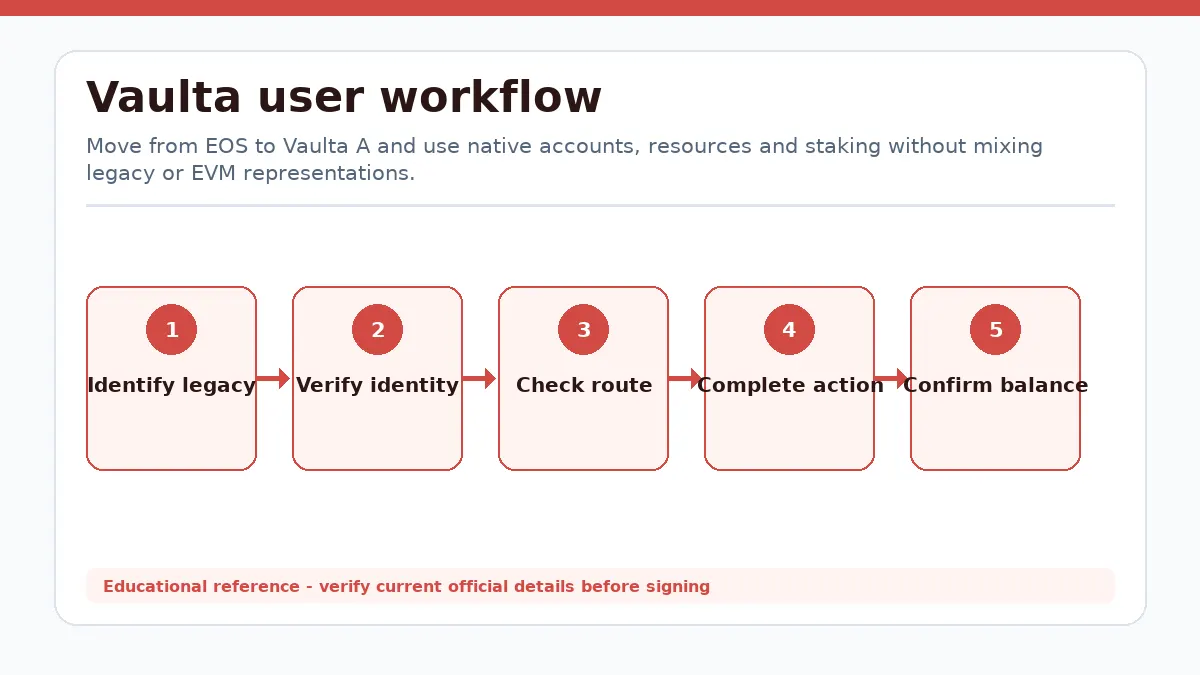
Move from EOS to Vaulta A and use native accounts, resources and staking without mixing legacy or EVM representations.
Subject:
Vaulta
Market mode:
Snapshot Only
Fee asset:
A / resources
Timezone:
UTC
This page does not perform the token swap, recover an account, estimate resources, vote for a producer or operate the EVM bridge.
Content ownership: BitcoinToolkit Editorial TeamTechnical references: Official protocol and developer documentation.Review approach: Technical explanations are checked against primary sources and updated when the network or asset changes.Last content review: Data integration last tested:
Common Vaulta Migration Mistakes
Legacy names and two execution environments create avoidable confusion.
Vaulta workflow from the first user decision to a verified outcome.
Before swapping or sending
Confirm EOS or A, native Vaulta or Vaulta EVM, the token contract, account name and required memo. Use core.vaulta through an official wallet for the documented swap and reject third-party conversion contracts. Check exchange support before sending either ticker.
Review CPU, NET and RAM before native actions, and verify the EVM gas and bridge path separately. Keep account keys and permissions secure; a token conversion does not repair compromised authority.
Vaulta Guidance for Holders
The network continuity and token replacement must be understood together.
Current identity and 1:1 conversion
Vaulta documentation defines A as the replacement for EOS with four decimal places, a maximum supply of 2.1 billion and a one-to-one swap through the core.vaulta system contract. The same contract provides token, swap and system functions that previously used separate legacy contracts.
Users and applications must update the token symbol and contract handling. A legacy EOS balance is not the same ticker as A even when it remains convertible. Exchanges and wallets can adopt the transition on different schedules, so current support must be checked before depositing.
Accounts remain permission-based containers
Vaulta uses human-readable account names with owner and active permission structures. Smart contracts are deployed to accounts, and permissions can include multiple keys, delays or other accounts. The account name, permission and memo can all matter when transferring to an exchange or contract.
The migration does not reset account permissions or make old signing practices safe. Review keys and authorities, use the correct contract and keep recovery procedures separate from token conversion.
Native Vaulta execution consumes system resources rather than only a gas price times gas used.
Transient compute and persistent storage
CPU covers computation, NET covers transaction bandwidth and RAM stores persistent account and contract state. Users can obtain temporary CPU and NET through the PowerUp model, while RAM is purchased and can later be sold subject to the system market. Current examples denominate the maximum PowerUp payment in A.
An account can have enough A to transfer yet still lack the resources required for a complex action. Wallets or applications may sponsor resources, but that is not a universal protocol guarantee. Review resource availability before relying on a time-sensitive transaction.
Vaulta EVM has a separate legacy path
Current Vaulta EVM documentation still describes an EOS representation as EVM gas and an official bridge path that can require swapping A to EOS first. This is different from native Vaulta actions. Users must follow current EVM documentation rather than assuming A automatically appears as the EVM gas balance.
EVM and native addresses, accounts, memos and bridges have different workflows. A transfer to the wrong layer can be difficult to recover even though both operate within the Vaulta ecosystem.
Block Producers, Staking and Finalizers
Producing blocks, voting and finalizing are related but distinct responsibilities.
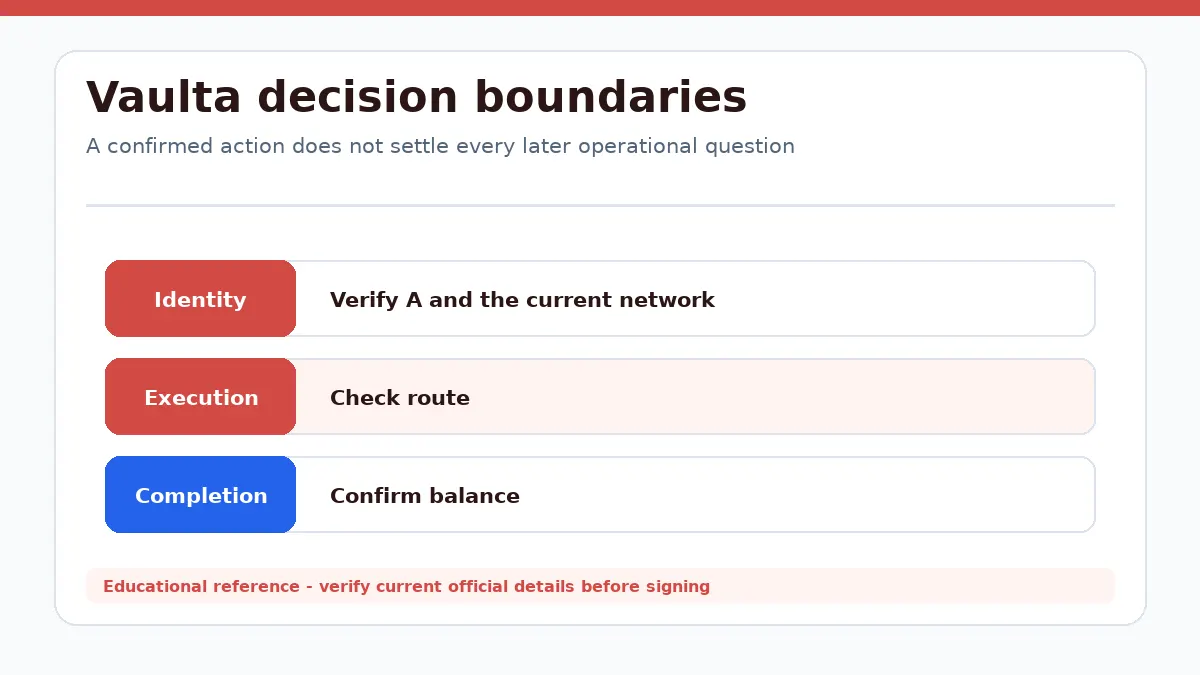
Vaulta confirmation does not settle every later operational question.
Delegated proof of stake
Vaulta token holders can stake and vote for block producers. A rotating active set produces blocks, while token-weighted voting can replace underperforming producers. Current Savanna-era documentation also separates finalizer signing from block publication through registered BLS finalizer keys.
Vaulta staking returns a non-transferable REX accounting token and uses a withdrawal lock period under the current system. Staking rewards, producer voting and network resources should not be treated as the same position. Review current contracts and lock rules before staking.
Choose the Next Vaulta Check
Continue with migration, resources or token compatibility.
Swap, account or tools
Use current Vaulta documentation for the core.vaulta swap, account resources and staking. Review LEO for another ecosystem token affected by the rename, or use wallet tools after confirming the native or EVM destination.
A familiar A ticker can refer to a legacy representation, a current asset or an unsupported migration route.
The A result needs context
Vaulta accounts execute transactions made of ordered actions and use CPU, NET and RAM resources rather than a simple universal per-call gas balance. Delegated proof of stake elects block producers, while current staking and finalizer systems add distinct participation and finality roles.
A is the current asset shown in the market snapshot. Native actions use CPU, NET and RAM resources acquired or managed with A; Vaulta EVM still documents a legacy EOS gas representation.
What Vaulta users should verify and why this design differs
Migration, resource and EVM bridge instructions can change. Producer and staking rules depend on current system contracts.
For Vaulta, the practical sequence is Identify legacy asset, Verify current identity, Check route, Complete action, Confirm balance. Confirm the official destination and current network, then inspect the final balance, position, receipt or documented exit state that actually completes the task: Move from EOS to Vaulta A and use native accounts, resources and staking without mixing legacy or EVM representations.
Vaulta Migration checks FAQ
How does EOS convert to Vaulta A?
The official core.vaulta contract documents a 1:1 EOS-to-A swap.
Does native Vaulta use ordinary EVM gas?
No. Native actions consume CPU, NET and RAM resources; Vaulta EVM has a separate documented gas path.
What is REX in Vaulta staking?
REX is a non-transferable accounting token representing a current Vaulta staking position.
Known Limitations
Migration, resource and EVM bridge instructions can change.
Producer and staking rules depend on current system contracts.
The page does not swap tokens or recover an account.
Market Data Methodology
The page uses a CoinGecko aggregated A/USD snapshot. No exchange chart is rendered for this entity.
Market Snapshot Source
CoinGecko aggregated market data (A/USD)
Cache
Snapshot cache is approximately 60 seconds.
Failure Handling
Verified cached data is labeled Cached or Delayed. Missing values remain unavailable.