Stacks is a Bitcoin-connected smart-contract network using the Clarity language and a Proof of Transfer design. STX is its native fee and Stacking asset, while sBTC is a separate tokenized representation designed for movement between Bitcoin and Stacks. This page focuses on how Stacks Connects to Bitcoin and the checks users need before sending funds, paying fees or using the network.
Understand how Stacks uses Bitcoin and how STX and sBTC differ before transferring or Stacking.
Subject:
Stacks
Market mode:
Snapshot Only
Fee asset:
STX
Timezone:
UTC
This page does not quote Stacking rewards, guarantee an sBTC peg, select a signer or validate a Clarity contract.
Content ownership: BitcoinToolkit Editorial TeamTechnical references: Official protocol and developer documentation.Review approach: Technical explanations are checked against primary sources and updated when the network or asset changes.Last content review: Data integration last tested:
How Stacks Connects to Bitcoin
Bitcoin anchoring supplies ordering and settlement context without making Stacks contracts Bitcoin scripts.
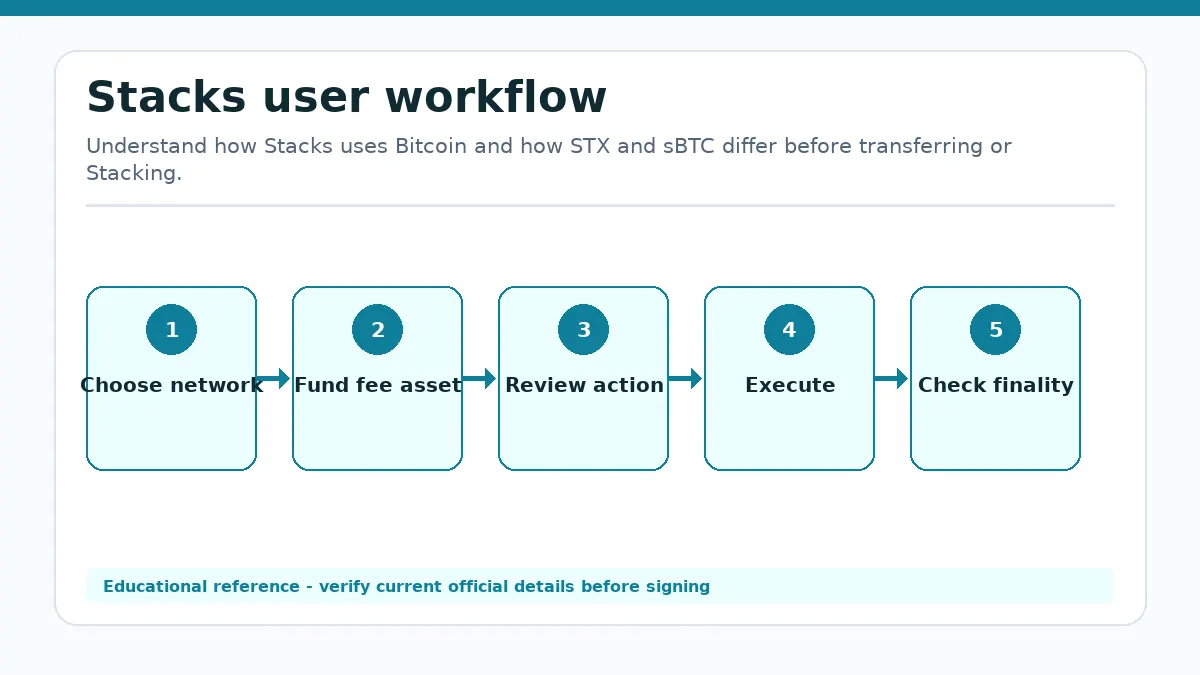
Stacks workflow from the first user decision to a verified outcome.
A separate state machine with Bitcoin-linked tenures
Stacks maintains its own accounts, Clarity contracts and transaction fees. Miners commit through Bitcoin and propose Stacks blocks during tenures. Nakamoto signers validate proposed blocks under Stacks rules. A Stacks transaction is not a native Bitcoin transaction merely because its history is anchored to Bitcoin.
Bitcoin reorganization and Stacks signer behavior create different confirmation considerations. Applications should distinguish a fast Stacks block, signer acceptance and later Bitcoin anchor depth. The appropriate waiting policy depends on the action and whether external BTC movement is involved.
Locking STX supports signer participation and follows protocol cycles rather than ordinary proof-of-stake delegation.
Stackers and miners are separate roles
STX pays regular Stacks transaction fees. In Stacking, eligible participants lock STX and can operate or delegate to signer arrangements under current protocol rules. Nakamoto signers validate Stacks blocks and participate in sBTC operations when configured for those responsibilities.
Stacking is not risk-free yield. Lock periods, pool custody, signer operation, reward qualification and protocol cycles matter. A pool receipt or dashboard can add separate smart-contract and operator assumptions. Users should identify whether they retain custody and what authority a delegate receives.
sBTC Deposits, Withdrawals and Signers
sBTC is not STX and does not rely on the ordinary token bridge pattern.
A signer-managed Bitcoin UTXO
sBTC is a SIP-010 token on Stacks intended to track BTC one for one. Its signer set manages a Bitcoin UTXO holding deposited BTC and authorizes peg operations. The sBTC signer role is distinct from the Nakamoto block-signer role even when participants overlap.
Deposits require Bitcoin confirmation and signer processing. Withdrawals burn or lock the Stacks representation and require signer authorization of a Bitcoin payment. Delays, signer thresholds, contract behavior and Bitcoin fees can affect completion. A Stacks transaction alone does not prove that BTC reached its Bitcoin destination.
Stacks and sBTC Checks Before You Act
Asset identity and multi-stage confirmation deserve explicit review.
Name the chain and signer path
For STX, verify the Stacks network, recipient, memo requirements and STX fee balance. For sBTC, verify the official contract and whether the action is a deposit, transfer or withdrawal. Follow both Stacks and Bitcoin transaction states where applicable.
Review sponsored-fee terms before paying sBTC to a sponsor. For Stacking, confirm lock cycles, operator authority and custody. Developers should audit Clarity contract calls and avoid assuming Ethereum address or approval conventions. Never send BTC directly to an address unless the documented sBTC deposit flow requires it.
Under Nakamoto rules, miners propose Stacks blocks and stacker signers validate them. Bitcoin blocks anchor Stacks tenure activity, while sBTC signers separately manage the Bitcoin UTXO and authorize deposits and withdrawals.
A Stacks transaction can execute successfully while the application state, contract permission or later exit remains wrong for the user's goal. STX is the market-profiled asset. STX pays ordinary Stacks fees; sponsored sBTC flows can compensate a sponsor.
What Stacks users should verify and why this design differs
Signer and sBTC systems can evolve. The page does not verify a contract or pool.
For Stacks, the practical sequence is Choose network, Fund fee asset, Review action, Execute, Check finality. Confirm the official destination and current network, then inspect the final balance, position, receipt or documented exit state that actually completes the task: Understand how Stacks uses Bitcoin and how STX and sBTC differ before transferring or Stacking.
Stacks Network use FAQ
Is STX the same as sBTC?
No. STX is the native Stacks fee asset; sBTC is a separate token representation of BTC.
What pays Stacks fees?
STX pays ordinary fees, though approved sponsorship flows can let a sponsor pay and receive compensation.
Does a Stacks confirmation mean BTC moved?
Not necessarily. sBTC deposits and withdrawals also require Bitcoin and signer processing.
Known Limitations
Signer and sBTC systems can evolve.
The page does not verify a contract or pool.
Bitcoin and Stacks confirmation needs differ.
Market Data Methodology
The page uses a CoinGecko aggregated STX/USD snapshot. No exchange chart is rendered for this entity.
Market Snapshot Source
CoinGecko aggregated market data (STX/USD)
Cache
Snapshot cache is approximately 60 seconds.
Failure Handling
Verified cached data is labeled Cached or Delayed. Missing values remain unavailable.