Aptos (APT): Sequence Numbers, Gas and Sponsored Transactions
Aptos is a proof-of-stake Layer 1 built around the Move programming language and a resource-oriented state model. APT is its native value, gas and staking asset, while applications can sponsor fees or define additional assets through current framework standards. This page focuses on sequence Numbers, Gas and Sponsored Transactions and the checks users need before sending funds, paying fees or using the network.
Prepare a safe Aptos transfer or application transaction by understanding accounts, Move assets and gas.
Subject:
Aptos
Market mode:
Snapshot Only
Fee asset:
APT
Timezone:
UTC
This page does not audit Move code, quote live gas, choose a validator or verify a token address.
Content ownership: BitcoinToolkit Editorial TeamTechnical references: Official protocol and developer documentation.Review approach: Technical explanations are checked against primary sources and updated when the network or asset changes.Last content review: Data integration last tested:
Sequence Numbers, Gas and Sponsored Transactions
A valid Aptos transaction includes replay protection and a bounded execution budget.
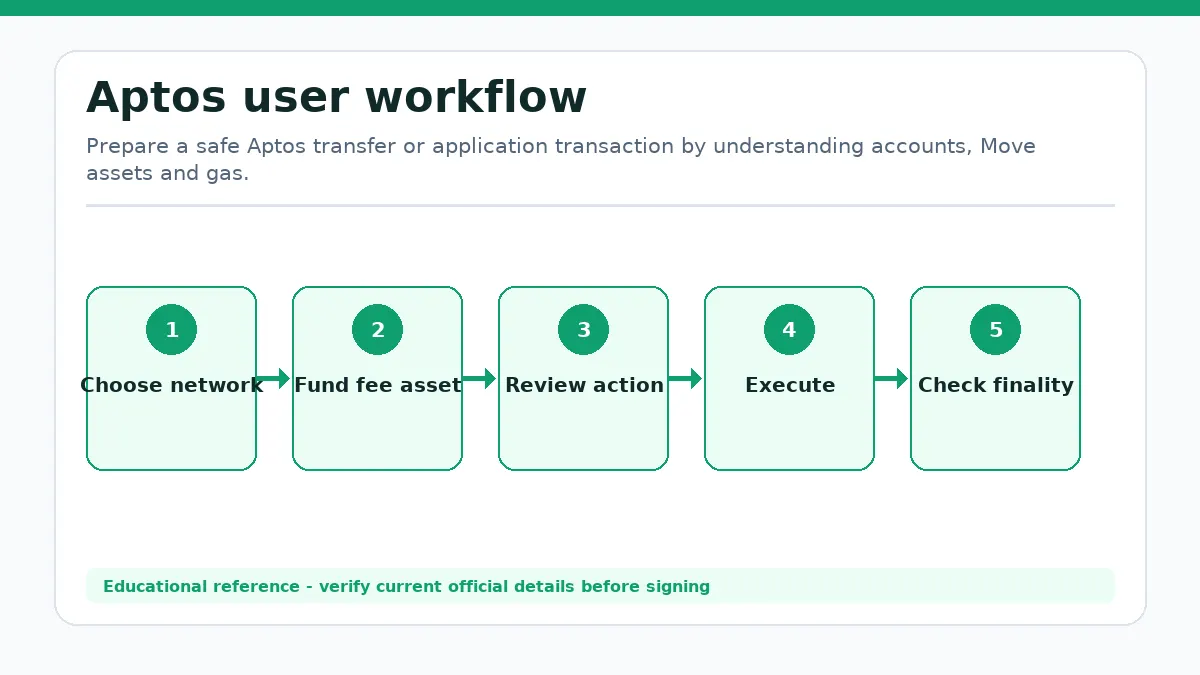
Aptos workflow from the first user decision to a verified outcome.
The sender and gas payer can differ
Ordinary transactions use the sender sequence number and specify maximum gas, gas-unit price and expiration. A stale sequence number or expired transaction can fail before execution. APT normally covers gas, and failed execution can still consume gas for work already performed.
Sponsored transactions allow a fee payer to cover APT gas for another user. Sponsorship can improve onboarding, but it does not transfer signing authority for the requested action. The user should still inspect the payload, while the sponsor should simulate costs and restrict which operations it funds.
Aptos Transaction and Fee Checks
Move state is organized around explicit ownership rather than one undifferentiated contract storage map.
Ownership is part of the type model
An Aptos account has an address and authentication state and can own Move resources, modules and objects. Resources cannot be copied or discarded unless their type permits the operation. This helps applications express ownership constraints in code, but users still need to verify the module and function being called.
Newer fungible-asset and object standards can represent tokens differently from legacy coin types. A matching symbol is not enough to identify an asset. Wallets and explorers should display the object or metadata address, and applications must use the framework standard expected by the destination.
High-throughput execution and consensus commitment are related but separate stages.
Block execution before committed state
Aptos can schedule independent transactions in parallel and resolve conflicts deterministically. Parallelism does not mean every transaction executes at once: shared resources, hot accounts and application design can create contention. Final success should be checked from the committed ledger version.
Validators stake APT and participate in consensus. Delegation or staking services add lock, commission, custody and validator-performance considerations. Governance and upgrades can change framework behavior, so developers should pin supported SDK versions and users should not infer a fixed reward from a current dashboard.
Wrong assets, stale sequence state and opaque sponsored payloads are preventable risks.
Inspect the complete payload
Confirm Aptos mainnet, the recipient, asset metadata address and exact entry function. Check the sequence number, expiration and maximum gas. If a sponsor pays fees, verify what the sponsor can submit and which account still authorizes the state change.
Use simulation where available, keep recovery credentials away from web applications and verify any keyless or multisignature flow independently. For staking, review validator commission, lock conditions and operator risk. A successful signature request is not evidence that a token or application is official.
Signed transactions carry an account sequence number, expiration, gas limit and gas price. Move modules operate on resources with explicit ownership rules, and the execution pipeline can process independent work in parallel before validators agree on committed state.
A Aptos transaction can execute successfully while the application state, contract permission or later exit remains wrong for the user's goal. APT is the market-profiled asset. APT pays transaction gas unless an approved sponsor pays it.
What Aptos users should verify and why this design differs
Framework standards and protocol parameters evolve. The page does not verify a token or module.
For Aptos, the practical sequence is Choose network, Fund fee asset, Review action, Execute, Check finality. Confirm the official destination and current network, then inspect the final balance, position, receipt or documented exit state that actually completes the task: Prepare a safe Aptos transfer or application transaction by understanding accounts, Move assets and gas.
Aptos Network use FAQ
What pays Aptos gas?
APT pays normal gas, although sponsored transactions can let a separate fee-payer account cover it.
Is Aptos an EVM chain?
No. Aptos uses the Move execution environment and resource-oriented state model.
Why can an Aptos transaction fail with enough APT?
Its sequence number, expiration, payload, resource access or execution budget can still be invalid.
Known Limitations
Framework standards and protocol parameters evolve.
The page does not verify a token or module.
Staking terms vary by route.
Market Data Methodology
The page uses a CoinGecko aggregated APT/USD snapshot. No exchange chart is rendered for this entity.
Market Snapshot Source
CoinGecko aggregated market data (APT/USD)
Cache
Snapshot cache is approximately 60 seconds.
Failure Handling
Verified cached data is labeled Cached or Delayed. Missing values remain unavailable.