Cosmos Hub is a sovereign proof-of-stake blockchain built with the Cosmos SDK and connected to other independent chains through IBC. ATOM is its native staking and governance asset; the broader Cosmos ecosystem does not share one universal ledger or one universal token. This page focuses on how IBC Transfers Move ATOM and the checks users need before sending funds, paying fees or using the network.
Understand ATOM roles and safely prepare a Cosmos Hub staking or IBC transfer action.
Subject:
Cosmos Hub
Market mode:
Snapshot Only
Fee asset:
ATOM or allowlisted token
Timezone:
UTC
This page does not select a validator, calculate rewards, guarantee an IBC route or verify a destination token denomination.
Content ownership: BitcoinToolkit Editorial TeamTechnical references: Official protocol and developer documentation.Review approach: Technical explanations are checked against primary sources and updated when the network or asset changes.Last content review: Data integration last tested:
How IBC Transfers Move ATOM
An IBC transfer sends a packet and creates a traceable representation on the destination chain.
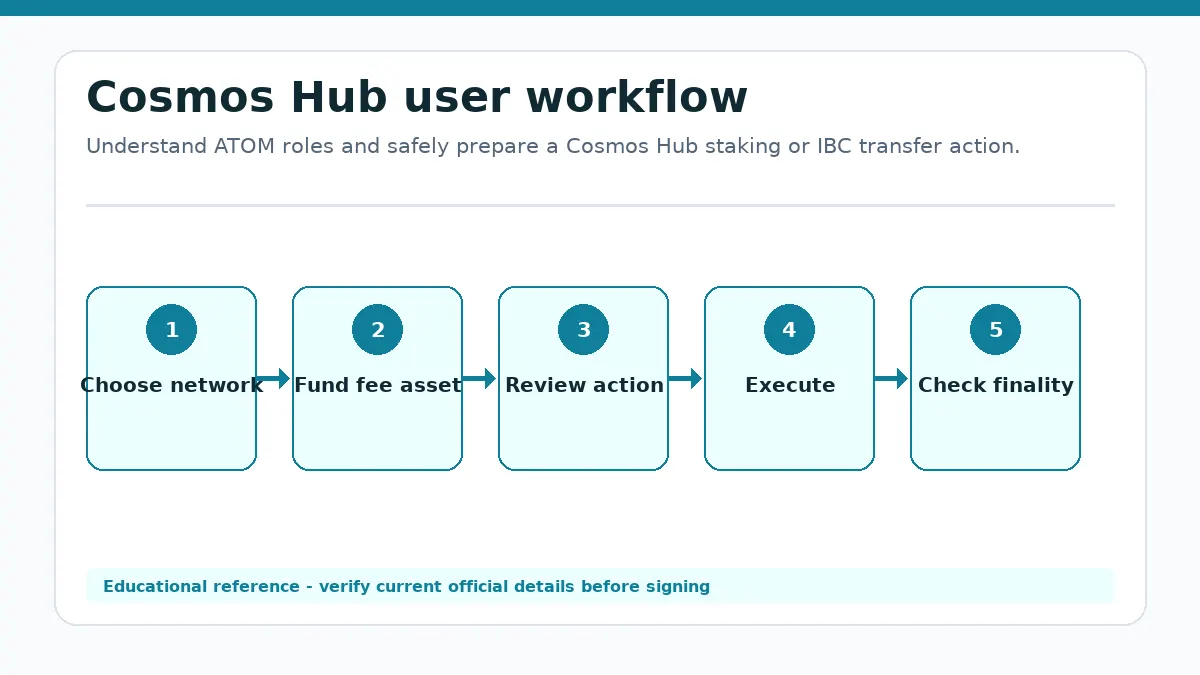
Cosmos Hub workflow from the first user decision to a verified outcome.
Channels and denominations matter
The sender chooses a source port and channel leading toward the destination. The receiving chain records the asset with an IBC denomination trace. If ATOM travels through a different route, it can receive a different denomination even when the wallet displays the same symbol.
Timeouts allow recovery when a packet is not relayed under the route rules, but application interfaces can obscure channel details. Exchanges often support only native Cosmos Hub ATOM and a required memo. Sending IBC ATOM or omitting a memo can prevent automatic crediting even when the blockchain transaction succeeds.
Cosmos Hub Operating Context
Shared software and messaging do not make all Cosmos chains one blockchain.
Sovereign state with connected routes
Cosmos Hub runs its own validator set, governance, accounts and ATOM ledger. Other Cosmos SDK chains can have different validators, tokens, applications and upgrade policies. The term Cosmos may describe the wider ecosystem, while Cosmos Hub refers to the specific network profiled here.
IBC enables authenticated communication between compatible chains through on-chain light clients. It does not guarantee that every asset has a liquid market or a return path. Relayers move packets, but the protocol verifies state according to the configured clients and channels.
Delegation supports consensus and exposes the delegator to validator behavior.
Bonding creates rewards, locks and slashing risk
Validators are weighted by bonded ATOM from self-delegation and delegators. They propose and vote on blocks, earn rewards and can be penalized for downtime or consensus faults. Delegators share validator rewards after commission and can also share slashing losses.
Unbonding takes the protocol-defined waiting period, during which relevant earlier misbehavior can still produce penalties. Staked ATOM can participate in governance, and delegators may override a validator vote. A displayed annual rate does not include every commission, inflation, downtime or token-price effect.
Validator choice, IBC route and exchange memo requirements deserve separate review.
Prepare the exact chain action
For a transfer, confirm Cosmos Hub as the source, the destination chain, IBC channel, token denomination, fee token and any exchange memo. Keep enough accepted fee asset and use a small test for a new route. Check the destination packet result rather than only the source transaction.
For staking, review validator commission, uptime, self-bond, governance activity and concentration. Understand unbonding and redelegation limits before delegating. Treat liquid-staking tokens and consumer-chain rewards as separate contracts or protocols with risks beyond native ATOM delegation.
CometBFT validators order and finalize Cosmos Hub transactions according to stake-weighted consensus. IBC light clients, connections and channels carry packets between sovereign chains, while each destination executes its own state transition and fee rules.
A Cosmos Hub transaction can execute successfully while the application state, contract permission or later exit remains wrong for the user's goal. ATOM is the market-profiled asset. ATOM is the initial fee token and governance can allow additional fee tokens.
What Cosmos Hub users should verify and why this design differs
Channels, relayers and fee allowlists can change. The page does not verify an IBC denomination.
For Cosmos Hub, the practical sequence is Choose network, Fund fee asset, Review action, Execute, Check finality. Confirm the official destination and current network, then inspect the final balance, position, receipt or documented exit state that actually completes the task: Understand ATOM roles and safely prepare a Cosmos Hub staking or IBC transfer action.
Cosmos Hub Network use FAQ
Is Cosmos Hub the same as every Cosmos chain?
No. Cosmos Hub is one sovereign chain; other Cosmos SDK chains keep separate state and validators.
What is ATOM used for?
ATOM is used for Cosmos Hub staking, governance, transfers and commonly transaction fees.
Can I send IBC ATOM to an exchange?
Only if the exchange explicitly supports that route and denomination; many require native ATOM plus a memo.
What pays transaction fees when using Cosmos Hub?
Cosmos Hub fee asset (ATOM or allowlisted token) pays the applicable network fee. Verify the selected network before signing because a later approval, bridge, claim or exit can require another transaction.
Known Limitations
Channels, relayers and fee allowlists can change.
The page does not verify an IBC denomination.
Validator performance and rewards are variable.
Market Data Methodology
The page uses a CoinGecko aggregated ATOM/USD snapshot. No exchange chart is rendered for this entity.
Market Snapshot Source
CoinGecko aggregated market data (ATOM/USD)
Cache
Snapshot cache is approximately 60 seconds.
Failure Handling
Verified cached data is labeled Cached or Delayed. Missing values remain unavailable.