Polkadot (DOT): How Parachains and Shared Security Work
Polkadot is a multi-chain protocol in which a relay chain coordinates shared security and interoperability for system chains and parachains. DOT is the native asset used for staking, governance, transferable value and coretime-related network functions. This page focuses on how Polkadot Parachains and Shared Security Work and the checks users need before sending funds, paying fees or using the network.
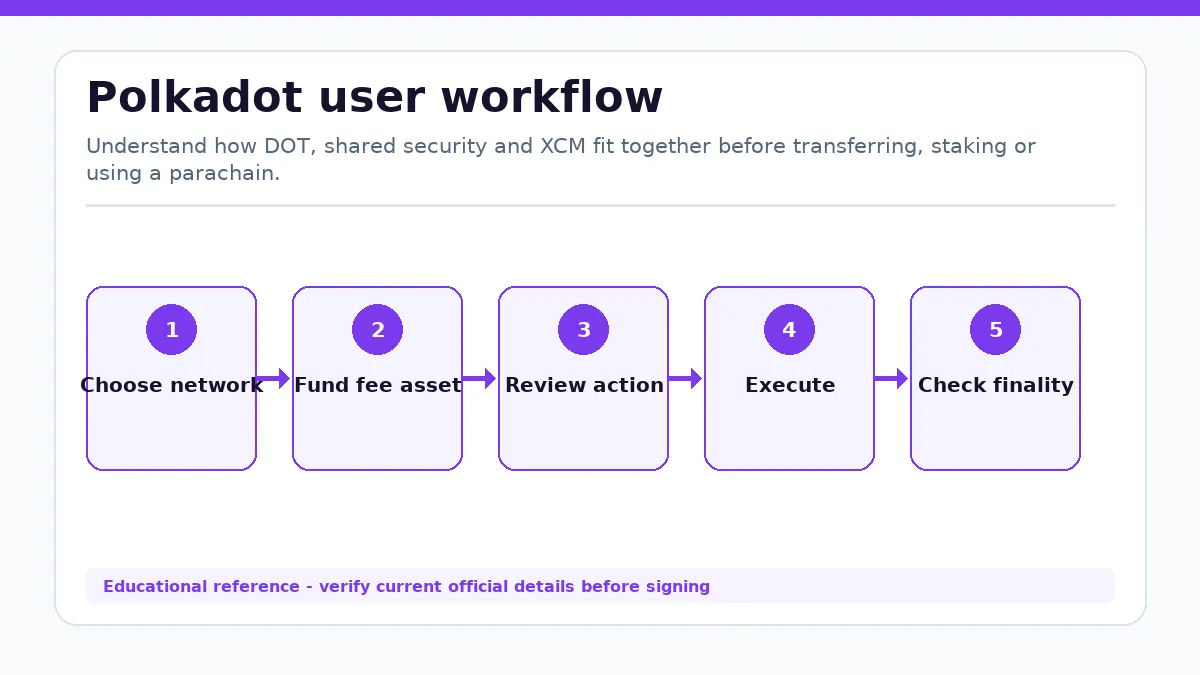
Understand how DOT, shared security and XCM fit together before transferring, staking or using a parachain.
Subject:
Polkadot
Market mode:
Snapshot Only
Fee asset:
DOT or supported asset
Timezone:
UTC
This page does not quote live staking returns, select a validator, guarantee XCM delivery or validate a parachain asset.
Content ownership: BitcoinToolkit Editorial TeamTechnical references: Official protocol and developer documentation.Review approach: Technical explanations are checked against primary sources and updated when the network or asset changes.Last content review: Data integration last tested:
How Polkadot Parachains and Shared Security Work
Polkadot is a coordinated network of chains rather than one general-purpose execution environment.
Polkadot workflow from the first user decision to a verified outcome.
Different chains perform different jobs
The relay chain focuses on shared security, consensus and network coordination. System chains provide common functions such as asset handling, while parachains can define application-specific state transitions. A balance shown on one chain is not automatically available on another even when both are part of Polkadot.
Parachain collators gather transactions and produce candidate blocks with proofs. Relay-chain validators verify those candidates and participate in consensus. Collators support liveness and block construction, but shared security comes from the relay-chain validator set. This distinction matters when assessing a parachain outage, validator risk or transaction-finality claim.
DOT combines network value, staking, governance and resource roles, but fee behavior can vary by chain.
Native asset with chain-specific use
DOT secures Nominated Proof of Stake, participates in OpenGov and can be used for transfers and network resource allocation. The relay chain represents DOT with ten decimals and Planck as its smallest unit. Wallets may display DOT on different Polkadot ecosystem chains, so users must identify the location as well as the symbol.
Relay-chain transactions normally deduct DOT fees. Polkadot Hub and other chains can implement additional fee-asset support under their runtime rules. A user should inspect the transaction preview on the destination chain rather than assume that every XCM or asset operation charges the same fee currency or amount.
How XCM Transfers and Finality Differ
Cross-chain messaging coordinates instructions; it does not turn multiple ledgers into one account.
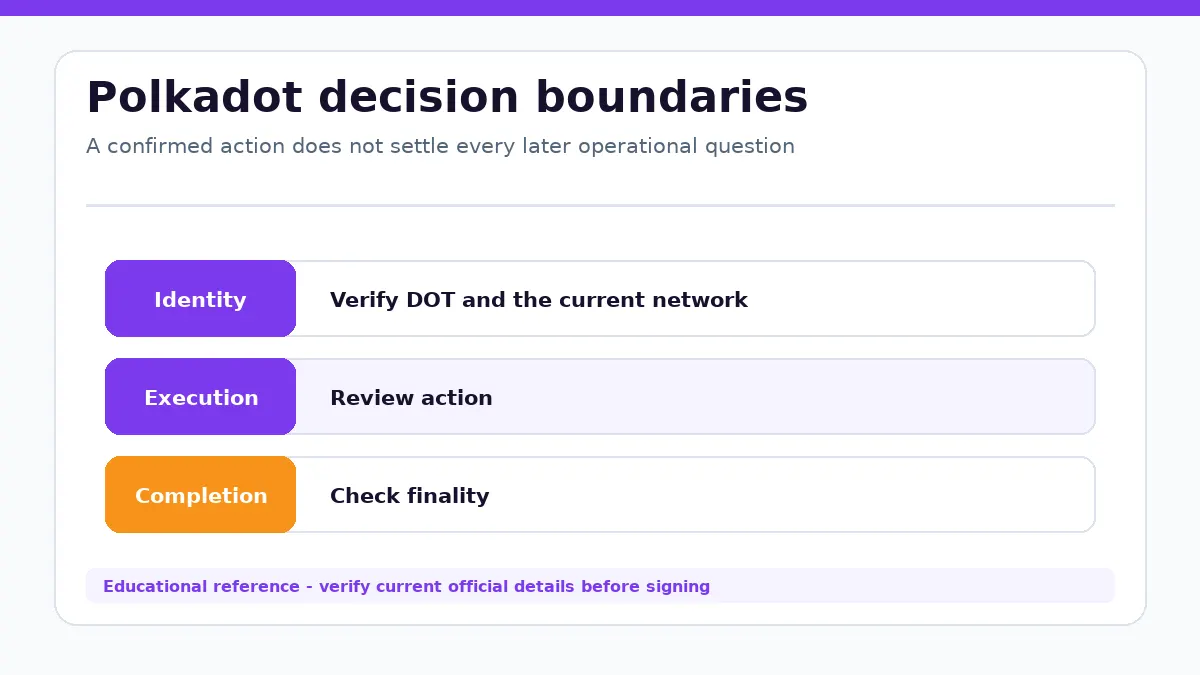
Polkadot confirmation does not settle every later operational question.
Message execution has several stages
XCM is a format for expressing cross-consensus instructions. A transfer can reserve, withdraw, deposit or route assets through specific locations and executors. Success on the source chain does not by itself prove that the destination instruction completed, and route fees or trapped assets can require destination-side investigation.
BABE helps produce relay-chain blocks and GRANDPA finalizes them. Parachain candidate inclusion, relay-chain finality and destination execution should be considered separately. Applications may wait for additional state observations before crediting a transfer, especially when bridges connect Polkadot to external consensus systems.
Chain location, account requirements and validator exposure all affect the outcome.
Prepare the exact action
Before sending, confirm the source chain, destination chain, asset location, address format and XCM route. Keep enough accepted fee asset on each required chain. Avoid copying an exchange deposit address without verifying which Polkadot network and transfer method the exchange supports.
Before staking, understand direct nomination, nomination pools, bonding, unbonding, commission and slashing exposure. Validator requirements and active-set conditions can change through runtime upgrades. OpenGov locks and delegated voting can also affect transfer availability, so review current account locks before committing the same DOT to another task.
It is a coordinated multi-chain protocol with a relay chain, system chains and parachains that keep distinct state.
What is DOT used for?
DOT supports staking, governance, transfers and network resource functions such as coretime.
Does every Polkadot transaction use DOT for fees?
Relay-chain actions generally do, but supported fee assets can differ on system chains and parachains.
What pays transaction fees when using Polkadot?
Polkadot fee asset (DOT or supported asset) pays the applicable network fee. Relay-chain actions generally use DOT, while system chains can support other approved fee assets. Verify the selected network before signing because a later approval, bridge, claim or exit can require another transaction.
What should I verify before a Polkadot transaction?
Check the official destination, current network, asset representation, amount, recipient and requested permissions. Validators secure the relay chain under Nominated Proof of Stake, collators assemble parachain candidates, and XCM defines messages between consensus systems. BABE supports block production while GRANDPA provides finality, so parachain execution and relay-chain security have distinct roles. After confirmation, inspect the resulting balance or protocol state instead of relying only on a wallet success message.
Known Limitations
Runtime rules and fee assets can change.
The page does not select a staking provider.
External bridges add separate trust and finality assumptions.
Market Data Methodology
The page uses a CoinGecko aggregated DOT/USD snapshot. No exchange chart is rendered for this entity.
Market Snapshot Source
CoinGecko aggregated market data (DOT/USD)
Cache
Snapshot cache is approximately 60 seconds.
Failure Handling
Verified cached data is labeled Cached or Delayed. Missing values remain unavailable.